

ChatGPT is suggesting fraudulent websites that could take your credit card information.
The chatbot is revealing counterfeit versions of extinct retail brands, with scammers intentionally creating websites to manipulate its suggestions.
Scammers have discovered a new method to reach consumers: utilizing ChatGPT for their marketing purposes. As reported by The Guardian, the scam verification service Ask Silver has identified that OpenAI's chatbot is directing users to fraudulent retail sites designed to collect payment information from unsuspecting shoppers. These sites replicate legitimate storefronts and employ official-looking URLs, making them hard to distinguish without careful examination.
Inactive brands are a primary target
It seems that fraudsters are intentionally focusing on brands that have recently gone out of business or been taken over, creating a disconnect between consumer interest and a legitimate online presence.
Anna Jones from Ask Silver informed The Guardian about Russell & Bromley, the British shoe retailer that entered administration in January 2026, as a notable case. With no official website after Next absorbed the brand, scammers constructed a convincing replica and optimized it to appear in ChatGPT’s results. Consumers inquiring about Russell & Bromley products by name are directed to this fraudulent site.
Jones mentioned that one possible reason for this issue is that malicious actors may have introduced content into ChatGPT’s training data to promote these counterfeit pages, a practice sometimes referred to as data poisoning.
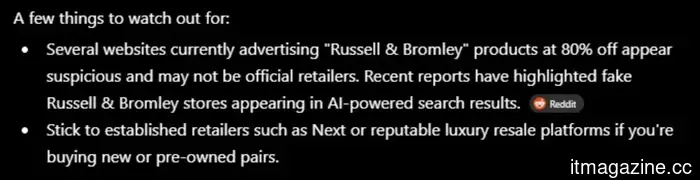
OpenAI seems to have revised its search results for inquiries related to Russell & Bromley, now displaying a warning that states, “Several websites currently advertising Russell & Bromley products at a significant discount appear suspicious and may not be official retailers. Recent reports have indicated the emergence of fake Russell & Bromley stores in AI-driven search results.”
A growing concern as AI becomes more involved in shopping
Research from last year indicated that ChatGPT already has difficulty providing consistent and reliable product recommendations, but redirecting users to fraudulent websites is a more critical issue. The situation is likely to worsen as AI plays an increasingly active role in the purchasing process.
Louise Baxter from the UK’s National Trading Standards told The Guardian that scammers quickly adapt to advancements in technology. With the emergence of agent-driven AI shopping still in its infancy, there is a limited timeframe to address this vulnerability.





Other articles
 Karp from Palantir suggests that Sanders will come to regret seeking just 50% of AI companies, indicating that full nationalization is on the horizon.
Palantir's CEO Alex Karp informed CNBC that within two years, full AI nationalization will become a widely accepted stance among the left. Both Trump and Sanders have already reached a consensus on 50%.
Karp from Palantir suggests that Sanders will come to regret seeking just 50% of AI companies, indicating that full nationalization is on the horizon.
Palantir's CEO Alex Karp informed CNBC that within two years, full AI nationalization will become a widely accepted stance among the left. Both Trump and Sanders have already reached a consensus on 50%.
 Steam is discontinuing gift cards due to issues caused by scammers.
Steam Gift Cards are becoming increasingly scarce on store shelves. According to Valve, scammers have continued to exploit physical cards, despite being warned and the implementation of retail restrictions and various anti-fraud measures.
Steam is discontinuing gift cards due to issues caused by scammers.
Steam Gift Cards are becoming increasingly scarce on store shelves. According to Valve, scammers have continued to exploit physical cards, despite being warned and the implementation of retail restrictions and various anti-fraud measures.
 The researcher that Microsoft threatened has just released a seventh Windows zero-day shortly after Patch Tuesday.
Chaotic Eclipse released RoguePlanet, a Windows Defender zero-day that provides SYSTEM access on fully updated systems, just hours after Microsoft's significant update featuring 200 fixes.
The researcher that Microsoft threatened has just released a seventh Windows zero-day shortly after Patch Tuesday.
Chaotic Eclipse released RoguePlanet, a Windows Defender zero-day that provides SYSTEM access on fully updated systems, just hours after Microsoft's significant update featuring 200 fixes.
 Insta360 Luna Ultra provides creators with 8K recording capabilities and enhanced stabilization features.
Insta360 has introduced the Luna Ultra, an 8K gimbal camera with dual lenses that has been developed in collaboration with Leica, aimed at creators in search of portable video tools for cinematic purposes.
Insta360 Luna Ultra provides creators with 8K recording capabilities and enhanced stabilization features.
Insta360 has introduced the Luna Ultra, an 8K gimbal camera with dual lenses that has been developed in collaboration with Leica, aimed at creators in search of portable video tools for cinematic purposes.
 You can now specify to Instagram’s algorithm exactly what content you'd like to appear on your main feed.
Instagram is offering users genuine control over their feeds with Your Algorithm, a feature that allows you to add and remove topics throughout the entire app.
You can now specify to Instagram’s algorithm exactly what content you'd like to appear on your main feed.
Instagram is offering users genuine control over their feeds with Your Algorithm, a feature that allows you to add and remove topics throughout the entire app.
 I believed that affordable Windows laptops were a thing of the past, but Computex has restored my optimism.
Computex 2026 revitalized the budget Windows laptop market, as Dell and Acer unveiled high-quality devices that directly compete with Apple’s MacBook Neo.
I believed that affordable Windows laptops were a thing of the past, but Computex has restored my optimism.
Computex 2026 revitalized the budget Windows laptop market, as Dell and Acer unveiled high-quality devices that directly compete with Apple’s MacBook Neo.
ChatGPT is suggesting fraudulent websites that could take your credit card information.
According to the scam-checking service Ask Silver, ChatGPT is displaying fraudulent replicas of inactive retail websites when users seek product suggestions. These counterfeit stores are created to capture payment details.