
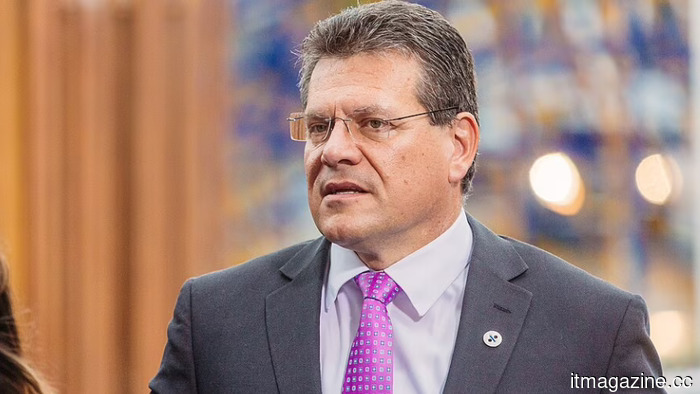
The EU trade commissioner is advocating for a new mechanism to reduce Europe’s reliance on Chinese semiconductors and rare earth minerals.
EU trade commissioner Maroš Šefčovič has proposed a new regulation that would mandate companies in sensitive sectors to have at least three suppliers. This "diversification instrument," inspired by the Energy Union, aims to lessen Europe’s reliance on single suppliers of chips and rare earths. He presented this idea at the Brussels Economic Security Forum hosted by the European Policy Center on Friday.
Šefčovič remarked, “For critical supplies, it is essential to have three distinct suppliers to ensure you aren't penalized for political reasons.” He referenced the Energy Union, which he previously spearheaded to help Europe reduce its dependence on Russian energy following the annexation of Crimea in 2014.
The urgency of this initiative is significant, as the EU currently depends on China for over 90% of its rare earth supplies. Last October, China imposed export restrictions on rare earth magnets amid a tariff conflict with the United States and halted chip deliveries from Nexperia after the Dutch government took control of the company.
These interruptions have adversely affected European car manufacturers and highlighted the bloc's vulnerabilities. “Recent industrial incidents, particularly involving chips and rare earths, have strengthened my belief that a significant change is essential,” Šefčovič stated. “Every high-risk sector needs to be extricated from reliance on a single supplier.”
To address this, the EU has collaborated with Washington and other nations to seek alternative sources. The discovery of Europe's largest rare earth deposit in Sweden provides a potential long-term solution, but mining operations will take over a decade to develop. Until then, Europe continues to face risks.
This proposal follows Šefčovič's call for Brussels and Beijing to tackle the EU’s unsustainable trade deficit with China, which expanded to €360 billion last year, marking an 18% increase from 2024. EU leaders will address China’s industrial overcapacity and subsidized exports at a summit scheduled for June 18-19.
Later this month, Šefčovič will also meet with Chinese counterpart Wang Wentao in Brussels. He indicated that the next step involves a formal legal proposal. “We need to clarify the specifics of the legal proposal,” he stated.
The broader initiative to diminish chip dependence has already led to the EU Chips Act, which targets raising Europe’s global chip production share to 20%. Additionally, a revised Chips Act 2.0 was introduced by the Commission in June 2026, featuring new strategies to further decrease strategic dependencies.
Published June 6, 2026 - 10:59 am UTC
Other articles
 A former executive from IBM's cybersecurity division alleges that the company concealed breaches related to Chinese hacking.
A whistleblower lawsuit claims that IBM hid incidents of breaches by Chinese hackers, who attacked its network over 56,000 times, and failed to inform the US government.
A former executive from IBM's cybersecurity division alleges that the company concealed breaches related to Chinese hacking.
A whistleblower lawsuit claims that IBM hid incidents of breaches by Chinese hackers, who attacked its network over 56,000 times, and failed to inform the US government.
 The top 10 press release distribution services for 2026.
Transitioning from AI-indexed wire distribution to specialized editorial reviews, these press release services provide genuine publisher placements without the outdated wire costs.
The top 10 press release distribution services for 2026.
Transitioning from AI-indexed wire distribution to specialized editorial reviews, these press release services provide genuine publisher placements without the outdated wire costs.
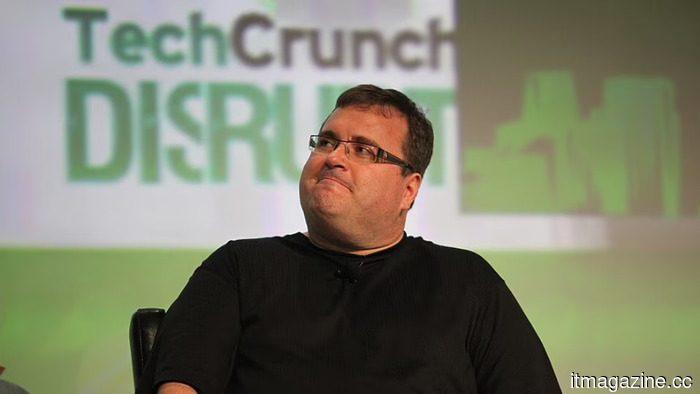 Reid Hoffman steps down from the Microsoft board to enter 'founder mode' with the AI drug company Manus.
Reid Hoffman, co-founder of LinkedIn, is resigning from Microsoft's board after almost ten years in order to concentrate on Manus, his AI-driven drug discovery startup.
Reid Hoffman steps down from the Microsoft board to enter 'founder mode' with the AI drug company Manus.
Reid Hoffman, co-founder of LinkedIn, is resigning from Microsoft's board after almost ten years in order to concentrate on Manus, his AI-driven drug discovery startup.
 GM invests $900 million in LMR battery technology to reduce EV expenses.
GM's newly established Battery Cell Development Centre connects laboratory research and development with manufacturing for LMR cells, potentially reducing EV battery expenses by $6,000 and making them available for trucks by 2028.
An AI agent discovered 21 zero-day vulnerabilities in FFmpeg for $1,000. Chrome recently addressed a historic total of 429 bugs.
An autonomous AI agent from a startup discovered 21 zero-day vulnerabilities in FFmpeg for about $1,000. In contrast, Chrome 149 addressed an unprecedented 429 vulnerabilities in one release.
GM invests $900 million in LMR battery technology to reduce EV expenses.
GM's newly established Battery Cell Development Centre connects laboratory research and development with manufacturing for LMR cells, potentially reducing EV battery expenses by $6,000 and making them available for trucks by 2028.
An AI agent discovered 21 zero-day vulnerabilities in FFmpeg for $1,000. Chrome recently addressed a historic total of 429 bugs.
An autonomous AI agent from a startup discovered 21 zero-day vulnerabilities in FFmpeg for about $1,000. In contrast, Chrome 149 addressed an unprecedented 429 vulnerabilities in one release.
 Trump considers a public share in OpenAI, valued at $850 billion, while Sanders advocates for a 50% share.
Trump is set to meet with AI companies regarding a proposal to provide Americans with equity in firms such as the $850 billion OpenAI. He has already invested in Intel and IBM. Sanders is advocating for a 50% share. Currently, there is no legal framework in place for this.
Trump considers a public share in OpenAI, valued at $850 billion, while Sanders advocates for a 50% share.
Trump is set to meet with AI companies regarding a proposal to provide Americans with equity in firms such as the $850 billion OpenAI. He has already invested in Intel and IBM. Sanders is advocating for a 50% share. Currently, there is no legal framework in place for this.
The EU trade commissioner is advocating for a new mechanism to reduce Europe’s reliance on Chinese semiconductors and rare earth minerals.
Maroš Šefčovič advocated for a "diversification instrument" based on the Energy Union to reduce industry reliance on single suppliers in critical sectors.