
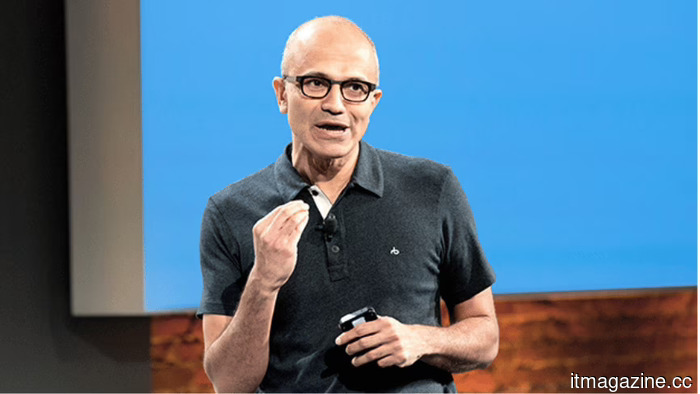
Microsoft excludes important compensation question from employee survey findings.
TL;DR: Microsoft removed its long-standing “good deal” compensation question from its latest employee survey results, prompting employee discussions and concerns on internal forums. Workers are noticing a disparity between the positive survey results and the prevalent dissatisfaction among staff.
For many years, one particular question in Microsoft's internal employee survey acted as a reliable metric for employee sentiment. It inquired whether employees felt they were receiving a “good deal at Microsoft,” which was defined as having a fair return for their contributions. When scores fell significantly, the company typically responded with sizable pay increases.
In the most recent release of employee sentiment survey results, however, that particular question was absent from the main report. Additionally, a question regarding confidence in company leadership was also missing. Employees expressed their confusion on internal message boards; Business Insider accessed some of these comments.
“Could you clarify if this question has been removed and the reasons behind it?” one employee asked, garnering over 200 likes. Another responded using a meme from A Few Good Men: “You can’t handle the truth!”
The official response came from a Microsoft employee identified as the “Head of Employee Listening." They explained that the questions had not been omitted but were instead included in different surveys targeting subsets of employees, “allowing us to explore more topics without extending survey length,” as confirmed by Microsoft.
This explanation did not sit well with staff. Historically, the “good deal” question had been a key metric. By relegating it to a subset survey, the one figure that employees could rely on during times of perceived inadequate compensation was effectively removed.
This measure had a history of influencing company actions. In 2022, after receiving low scores, Microsoft implemented company-wide pay increases and boosted stock awards. By 2023, however, the situation reversed as the company froze salaries, laid off 10,000 employees, and shifted focus towards AI initiatives.
Survey results from 71% of employees, totaling around 265,000 comments, painted a broadly positive picture. Employees reported feeling included in their teams, excited about their work, and aligned with Microsoft’s culture. The item receiving the highest score, at 88, was “I prioritize addressing security challenges in my role,” according to HR Grapevine.
Nonetheless, some employees felt the survey results did not reflect the reality within the company. “It seems like employees have virtually no concerns about the company,” one noted, with over 70 likes on their comment, “but in every public forum, AMA, petition, etc., thousands of employees are voicing concerns regarding Microsoft’s contracts with the Israeli military, ICE, US military, and so on.”
The discrepancy between survey results and actual employee experiences is a common issue not limited to Microsoft. Yet, given the company's recent initiatives like offering voluntary retirement to 7% of its U.S. workforce and tightening performance expectations while investing heavily in AI, the disconnect is particularly notable.
Under CEO Satya Nadella, Microsoft has allocated over $80 billion towards AI data centers and computing capacity, including $37.5 billion in capital expenditures in a single quarter. Nadella has referred to the company’s large workforce of over 220,000 as a “massive disadvantage” in the AI competition.
This perspective conveys a specific message about the company's priorities to employees. With the survey question meant to gauge feelings of fair compensation no longer visible to the entire company, the implication is unmistakable. Throughout the tech industry, a similar trend exists: soaring revenues, substantial AI investments, and a workforce being asked to achieve more with less certainty about their compensation. While Microsoft may still be gathering input on the “good deal” question in other surveys directed to certain employee groups, by omitting it from the widely shared results, the company has effectively answered it.
Other articles
 Uber reduces its HR department by 23% following the appointment of new president Hazelbaker.
Uber has reduced its workforce in the People and Places divisions by 23% under the leadership of new president Jill Hazelbaker. The company has stated that these layoffs are not connected to AI.
Uber reduces its HR department by 23% following the appointment of new president Hazelbaker.
Uber has reduced its workforce in the People and Places divisions by 23% under the leadership of new president Jill Hazelbaker. The company has stated that these layoffs are not connected to AI.
 Uber reduces its HR division by 23% following the appointment of new president Hazelbaker.
Uber has cut 23% of its People and Places positions under the leadership of the new president, Jill Hazelbaker. The company asserts that these reductions are not connected to AI.
Uber reduces its HR division by 23% following the appointment of new president Hazelbaker.
Uber has cut 23% of its People and Places positions under the leadership of the new president, Jill Hazelbaker. The company asserts that these reductions are not connected to AI.
 A vulnerability in GitHub.dev allows attackers to obtain OAuth tokens with a single click.
A vulnerability in VS Code on GitHub.dev allows attackers to obtain complete GitHub OAuth tokens through a single malicious link, endangering all private repositories.
A vulnerability in GitHub.dev allows attackers to obtain OAuth tokens with a single click.
A vulnerability in VS Code on GitHub.dev allows attackers to obtain complete GitHub OAuth tokens through a single malicious link, endangering all private repositories.
 The widely used Codex npm package misappropriated developer tokens for a duration of one month.
The codexui-android npm package discreetly transmitted OpenAI Codex authentication tokens to an attacker's server for a duration of one month, impacting 29,000 downloads per week.
The widely used Codex npm package misappropriated developer tokens for a duration of one month.
The codexui-android npm package discreetly transmitted OpenAI Codex authentication tokens to an attacker's server for a duration of one month, impacting 29,000 downloads per week.
 A vulnerability in GitHub.dev allows attackers to steal OAuth tokens with a single click.
A vulnerability in VS Code on GitHub.dev allows attackers to obtain complete GitHub OAuth tokens through a single malicious link, which could expose all private repositories.
A vulnerability in GitHub.dev allows attackers to steal OAuth tokens with a single click.
A vulnerability in VS Code on GitHub.dev allows attackers to obtain complete GitHub OAuth tokens through a single malicious link, which could expose all private repositories.
 The widely used Codex npm package misappropriated developer tokens for a duration of one month.
The codexui-android npm package covertly transmitted OpenAI Codex authentication tokens to an attacker's server for an entire month, impacting 29,000 weekly downloads.
The widely used Codex npm package misappropriated developer tokens for a duration of one month.
The codexui-android npm package covertly transmitted OpenAI Codex authentication tokens to an attacker's server for an entire month, impacting 29,000 weekly downloads.
Microsoft excludes important compensation question from employee survey findings.
Microsoft left out its "good deal" compensation question from the main survey findings. Employees are expressing their concerns on internal forums.