
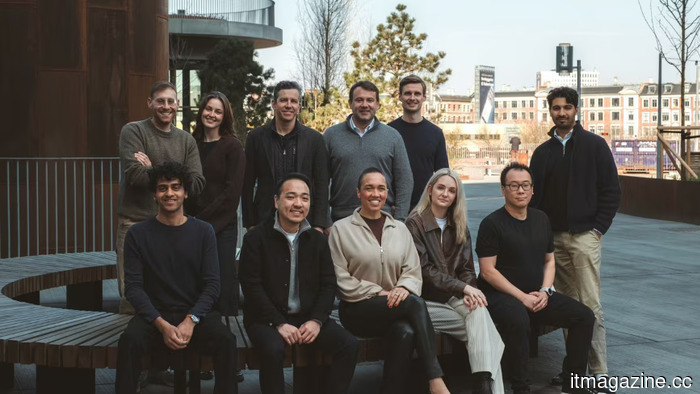
Merantix Capital has successfully closed a €103 million fund aimed at supporting early-stage AI ventures in Europe.
Merantix Capital announced on June 4 that it has completed the closing of a €103m fund aimed at investing in early-stage, AI-focused teams throughout Europe. This fund is over three times larger than its initial fund, which co-founders Rasmus Rothe and Adrian Locher raised at approximately €30m, and it expands the firm’s scope from in-house projects to startups established across the continent.
The uniqueness of the fund lies in its structure, which is evenly split: half of the capital will support founders collaborating with the Merantix team from the “pre-idea” phase, testing concepts through the firm’s ecosystem and developing at the Merantix AI Campus in Berlin, while the other half will be allocated for direct investments in pre-seed and seed-stage companies.
The firm intends to make roughly 40 investments in total, with individual checks ranging from about €1m to €3m, and investment teams located in Berlin and London will be making investments across Europe.
The investment thesis is focused on specific industries rather than a broad approach. Merantix is concentrating on teams that are applying AI in sectors where Europe has established strengths, including logistics, manufacturing, energy, finance, healthcare, life sciences, robotics, enterprise software, and physical AI.
The founders describe their aim as providing “connective tissue”—addressing the gap between Europe’s industrial foundations and the startups attempting to innovate those industries through machine learning, which is the gap the fund aims to bridge.
This approach is a continuation of the philosophy Merantix has maintained since its inception a decade ago, positing that AI's true value comes from its integration within specific sectors where a company already fosters strong relationships.
The fund has already begun making investments, including Droidrun, which develops mobile-native AI agent infrastructure; Arqh, which focuses on logistics optimization; and Outpost Bio, which employs AI in human microbiology. Additional portfolio companies are still under wraps, working in fields such as logistics, manufacturing, recruiting, ERP, energy, and fashion technology. The first fund supported studio incubations, including revel8, Deltia, Vara, and Cambrium.
The limited partners align with the industry-focused pitch of the firm. Merantix has named Union Investment, forklift manufacturer Jungheinrich, KPMG Germany, and two US philanthropic organizations, the Robert Wood Johnson Foundation and the W.K. Kellogg Foundation, as part of its backing, in addition to family offices and institutional investors.
The firm characterizes many of these partnerships as strategic collaborations rather than merely providing passive funding, granting LPs access to early-stage AI startups and pilot opportunities within their own enterprises.
This fund operates within a broader framework. Merantix Capital is a component of the Merantix Group, which also oversees the Berlin AI Campus, home to over 80 resident companies and hosting approximately 300 events annually, along with a London AI Hub, AI House Davos, and Merantix Momentum, an enterprise-AI services section with more than 70 engineers.
The firm contends that the ecosystem it offers is what its portfolio founders gain in addition to financial support: a talent network and a collection of corporate design partners aimed at achieving early traction. While the capital is the primary focus, it is the surrounding platform that Merantix is marketing.
Other articles
 KPMG places Claude before all 276,000 employees in a partnership with Anthropic.
KPMG is integrating Anthropic's Claude into its Digital Gateway platform and providing access to all 276,000+ employees, with a specific emphasis on private equity.
KPMG places Claude before all 276,000 employees in a partnership with Anthropic.
KPMG is integrating Anthropic's Claude into its Digital Gateway platform and providing access to all 276,000+ employees, with a specific emphasis on private equity.
 Quantinuum sets its IPO valuation at $1.68 billion, establishing a new benchmark for the quantum industry.
Quantinuum set the price of its IPO at $60 to generate $1.68 billion, exceeding the expected range, which results in a valuation of $15.6 billion, marking the largest listing in the quantum-computing sector to date.
Quantinuum sets its IPO valuation at $1.68 billion, establishing a new benchmark for the quantum industry.
Quantinuum set the price of its IPO at $60 to generate $1.68 billion, exceeding the expected range, which results in a valuation of $15.6 billion, marking the largest listing in the quantum-computing sector to date.
 Received a missed call from an unfamiliar number? Malwarebytes' newly released free tool can inform you if it's a scam.
Malwarebytes has released a free tool that allows users to enter any phone number and quickly check if it has been marked as a scam.
Received a missed call from an unfamiliar number? Malwarebytes' newly released free tool can inform you if it's a scam.
Malwarebytes has released a free tool that allows users to enter any phone number and quickly check if it has been marked as a scam.
 Quantinuum sets its IPO price at $1.68 billion, establishing a new benchmark for the quantum industry.
Quantinuum set its IPO price at $60 to secure $1.68 billion, exceeding the anticipated range, resulting in a valuation of $15.6 billion, marking the largest listing in the quantum computing sector to date.
Quantinuum sets its IPO price at $1.68 billion, establishing a new benchmark for the quantum industry.
Quantinuum set its IPO price at $60 to secure $1.68 billion, exceeding the anticipated range, resulting in a valuation of $15.6 billion, marking the largest listing in the quantum computing sector to date.
Merantix Capital has successfully closed a €103 million fund aimed at supporting early-stage AI ventures in Europe.
Merantix Capital has finalized a €103 million fund aimed at early-stage European AI startups, with the allocation evenly divided between studio incubations and direct investments.