
Foxconn and Intel are collaborating with SambaNova to develop rackscale AI infrastructure.
The most significant statement in Intel's Computex announcement wasn't regarding a specific chip, but rather about a ratio. According to the company, as AI workloads transition from training to inference, the traditional ratio of four GPUs for every CPU shifts to something closer to one-to-one, which allows the processors that Intel actually markets to regain prominence in the data center.
This underpins the partnership revealed in Taipei on June 2. Intel, alongside SambaNova and Foxconn, announced plans to develop rack-scale AI infrastructure tailored for data center, hyperscale, and what Intel describes as intelligence center deployments, all utilizing Intel Xeon processors.
The companies showcased production-ready racks combining Xeon chips with SambaNova’s SN-50 Reconfigurable Dataflow Units, emphasizing performance per watt and dollar in inference rather than sheer training capability.
Foxconn’s contribution is the integration layer, as the world's largest electronics manufacturer is set to provide system integration for the rack-scale platform and intends to create a CPU-dense variant designed for workloads that do not require additional acceleration, such as cost-optimized inference, data processing, and hybrid AI.
The two companies also announced plans to explore collaboration on design services and custom silicon development, which represents the more exploratory aspect of the announcement that Intel hopes to turn into tangible results.
Intel's CEO Lip-Bu Tan framed this moment as generational, highlighting "the rise of inference, agentic, and physical AI," along with Intel's five decades of building foundational technology in partnership with Taiwanese firms.
Beneath the rhetoric lies the analytical perspective. Creative Strategies principal Ben Bajarin, quoted by Intel, clearly articulated the shift: whereas the training phase operated with approximately one CPU for every four GPUs, agentic inference changes it to one CPU for one GPU or sometimes even fewer.
Foxconn is just one name among a longer list. Intel also outlined expanded or new collaborations with Siemens, Hitachi, Echo Neurotechnologies, and Greenstone Biosciences, each focused on developing industry-specific silicon.
In a separate effort, a new enterprise inference cloud named Vector Core Compute—which comprises Vista Equity Partners and Cambium Capital—showcased a fully disaggregated inference system utilizing Xeon for orchestration, SambaNova RDUs for decoding, and Nvidia Blackwell GPUs for prefill, with Together.ai as its inaugural commercial customer.
At the core of this rack initiative is Intel’s new Xeon 6+ processor, its first data center CPU fabricated using the 18A process. Intel stated that a single liquid-cooled rack can deliver 36,864 cores within 32U of space at approximately 100 kilowatts, aiming for a density that meets the needs of operators seeking to host agents without the need for facility redesign.
What the announcement lacked, however, was any specific dollar amount, equity stake, or volume commitment from Foxconn. It represents an intention among a chipmaker looking to reestablish its relevance in AI, a contract manufacturer capable of meeting market demands, and a dataflow-chip startup optimistic that inference economics will favor something besides the traditional GPU. The sustainability of the one-to-one ratio is the central question on which the entire partnership depends. The racks are tangible; the underlying thesis is still under examination.
Other articles
 Meta claims that Australia has violated a trade agreement due to the news bargaining tax.
Meta claims that Australia's suggested 2.25% News Bargaining Incentive violates the US-Australia Free Trade Agreement and may provoke a trade response from the United States.
Meta claims that Australia has violated a trade agreement due to the news bargaining tax.
Meta claims that Australia's suggested 2.25% News Bargaining Incentive violates the US-Australia Free Trade Agreement and may provoke a trade response from the United States.
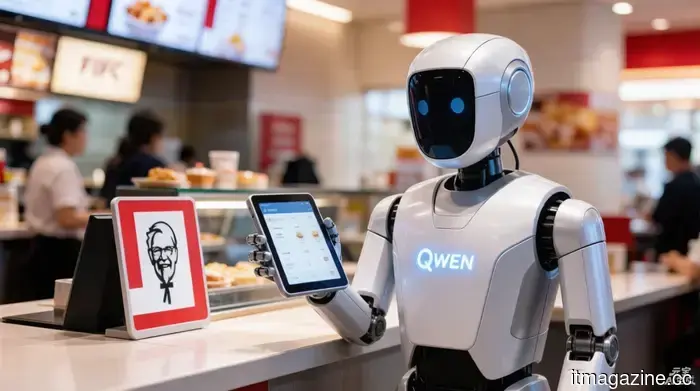 Qwen has launched its platform for third-party AI agents and has welcomed KFC, Luckin Coffee, Mixue, and others.
The Qwen App, supported by Alibaba, declared on Wednesday that it is expanding its platform to include third-party Agents and Skills, enabling businesses to manage branded AI solutions.
Qwen has launched its platform for third-party AI agents and has welcomed KFC, Luckin Coffee, Mixue, and others.
The Qwen App, supported by Alibaba, declared on Wednesday that it is expanding its platform to include third-party Agents and Skills, enabling businesses to manage branded AI solutions.
 Netflix is utilizing generative AI to address an issue it partially contributed to.
In an interview with Bloomberg Tech, Elizabeth Stone from Netflix stated that generative AI combined with a voice interface will assist viewers in navigating the overwhelming amount of content.
Netflix is utilizing generative AI to address an issue it partially contributed to.
In an interview with Bloomberg Tech, Elizabeth Stone from Netflix stated that generative AI combined with a voice interface will assist viewers in navigating the overwhelming amount of content.
 Foxconn and Intel partner with SambaNova to develop rackscale AI infrastructure.
Intel, SambaNova, and Foxconn are collaborating to develop rackscale AI infrastructure utilizing Xeon, wagering that inference will bring the CPU back to the core of the data center.
Foxconn and Intel partner with SambaNova to develop rackscale AI infrastructure.
Intel, SambaNova, and Foxconn are collaborating to develop rackscale AI infrastructure utilizing Xeon, wagering that inference will bring the CPU back to the core of the data center.
 Amazon's newest visual search update incorporates Lens Live and the Circle feature into your app's search functionality.
Amazon has launched eight new visual search features, such as Lens Live, Circle to Search, Visual Suggestions, and AI-generated images in real-time within the search bar, all of which are accessible on both iOS and Android platforms.
Amazon's newest visual search update incorporates Lens Live and the Circle feature into your app's search functionality.
Amazon has launched eight new visual search features, such as Lens Live, Circle to Search, Visual Suggestions, and AI-generated images in real-time within the search bar, all of which are accessible on both iOS and Android platforms.
 Amazon's newest visual search enhancement introduces Lens Live and the Circle feature to your app's Search functionality.
Amazon has introduced eight new visual search functions, which include Lens Live, Circle to Search, Visual Suggestions, and real-time AI-generated images in the search bar, all of which are accessible on both iOS and Android platforms.
Amazon's newest visual search enhancement introduces Lens Live and the Circle feature to your app's Search functionality.
Amazon has introduced eight new visual search functions, which include Lens Live, Circle to Search, Visual Suggestions, and real-time AI-generated images in the search bar, all of which are accessible on both iOS and Android platforms.
Foxconn and Intel are collaborating with SambaNova to develop rackscale AI infrastructure.
Intel, SambaNova, and Foxconn will develop rack-scale AI infrastructure using Xeon, believing that inference will bring the CPU back to the core of the data center.