
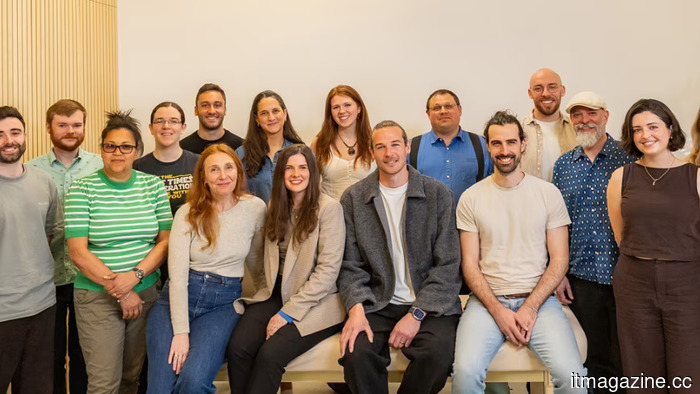
Flok Health secures $12.5 million to expand an AI physiotherapist that the NHS permits to operate without supervision.
The Cambridge clinic has received regulatory approval to triage, treat, and discharge patients independently without a human presence. It now aims to extend this model to conditions related to the hip, knee, and pelvic health.
What distinguishes Flok Health is not just that an AI conducts physiotherapy sessions, but that the NHS has authorized the AI to operate without human oversight. The Cambridge-based company has the regulatory clearance to diagnose, treat, and release patients autonomously, and it recently secured $12.5 million in funding to expand this model to additional areas of the body and a wider geographical reach.
The oversubscribed Series A funding round is spearheaded by AlbionVC, with participation from existing investors Eka VC and Form Ventures, along with new investor Mercia Ventures. This capital will help scale Flok’s back-pain service throughout the UK and support the introduction of three new care pathways: hip and knee pain and women's pelvic health, all set to launch in the UK this year.
What sets Flok apart from the array of healthcare chatbots is the regulatory approval backing it. It is the first AI system in Europe to receive Class IIa medical device certification for the independent delivery of complete care pathways, and it is the only digital musculoskeletal service recognized as a healthcare provider by the UK’s Care Quality Commission. These approvals allow it to triage, treat, and discharge NHS patients without human supervision, a threshold that most AI health tools do not reach.
The product itself is quite innovative. Instead of using an animated avatar, Flok employs real footage of a human physiotherapist to create a simulation of a live video appointment that reacts in real time to patient input. This approach aims to maintain the feel of a clinician-led session, providing a sense of being observed and directed while the underlying system handles clinical reasoning.
Created by Finn Stevenson, a former medic and rower, together with Ric da Silva, a software engineer, the idea emerged at the surgical robotics firm CMR Surgical.
The rationale for trusting this system is based on NHS data rather than laboratory assertions. The service is now accessible to over 2.4 million patients across eleven NHS areas, providing on-demand back-pain appointments without a waiting list. In one English rollout, over 80% of patients rated the AI clinic as "good or better than" traditional physiotherapy, and the pathway saved an average of 856 hours of clinical time each month at one trust, allowing physiotherapists to focus on more complex cases that still require human interaction.
This point is a central argument for Flok, and it is indeed significant. Low back pain is the foremost cause of disability globally, with more than 390,000 individuals on musculoskeletal waiting lists in England alone, and most of these conditions are manageable.
Chief executive Stevenson describes the company’s mission as addressing a supply-demand gap that cannot be filled by hiring more clinicians individually. The new care pathways would enable the AI to handle conditions affecting over 20 million people annually in the UK.
The concerns surrounding autonomous care are not resolved by a funding round. An AI that discharges patients without a clinician possesses a different liability profile compared to one that provides advice; edge cases and overlooked issues become more critical when there is no human review of decisions. The promising NHS results thus far pertain to back pain, which has been the primary focus, while hip, knee, and pelvic health conditions represent uncharted territory. The regulatory approval Flok has attained is specifically related to what it has already demonstrated.
For now, the company has accomplished what many digital health startups only claim: it has presented an autonomous clinical product to millions of real patients within an actual health system and delivered credible results. The $12.5 million investment is a wager that what has proven effective for back pain will be applicable to other areas. As is always the case in healthcare, the true test will come with the next set of pathways rather than those already established.
Other articles
 Factorial has secured $150 million in funding at a valuation of $2.5 billion, with General Catalyst investing twice in the rounds.
Factorial raised $150 million in a Series D funding round led by General Catalyst, achieving a valuation of $2.5 billion. Additionally, they secured a $540 million commitment towards customer value, identifying Germany as its primary growth market.
Factorial has secured $150 million in funding at a valuation of $2.5 billion, with General Catalyst investing twice in the rounds.
Factorial raised $150 million in a Series D funding round led by General Catalyst, achieving a valuation of $2.5 billion. Additionally, they secured a $540 million commitment towards customer value, identifying Germany as its primary growth market.
 A malware campaign targeting Minecraft is said to have infected more than 116,000 players.
According to researchers, a malware campaign masquerading as Minecraft mods and cheats has infected more than 116,000 devices via Discord servers and gaming communities.
A malware campaign targeting Minecraft is said to have infected more than 116,000 players.
According to researchers, a malware campaign masquerading as Minecraft mods and cheats has infected more than 116,000 devices via Discord servers and gaming communities.
 Applied Aerospace & Defense secures $650 million in an IPO that was oversubscribed by tenfold.
Applied Aerospace & Defense secured $650 million during its NYSE IPO, setting a share price at $20 for a valuation of $3.4 billion following a book that was oversubscribed by ten times.
Applied Aerospace & Defense secures $650 million in an IPO that was oversubscribed by tenfold.
Applied Aerospace & Defense secured $650 million during its NYSE IPO, setting a share price at $20 for a valuation of $3.4 billion following a book that was oversubscribed by ten times.
 A malware campaign targeting Minecraft has allegedly compromised more than 116,000 players.
Researchers have reported that a malware campaign masquerading as Minecraft mods and cheats has infected more than 116,000 devices via Discord servers and gaming communities.
A malware campaign targeting Minecraft has allegedly compromised more than 116,000 players.
Researchers have reported that a malware campaign masquerading as Minecraft mods and cheats has infected more than 116,000 devices via Discord servers and gaming communities.
 Factorial has secured $150 million in funding, achieving a valuation of $2.5 billion, with General Catalyst investing twice.
Factorial raised a Series D funding of $150 million, led by General Catalyst, achieving a valuation of $2.5 billion. Additionally, there is a $540 million commitment to customer value, with Germany identified as its primary growth market.
Factorial has secured $150 million in funding, achieving a valuation of $2.5 billion, with General Catalyst investing twice.
Factorial raised a Series D funding of $150 million, led by General Catalyst, achieving a valuation of $2.5 billion. Additionally, there is a $540 million commitment to customer value, with Germany identified as its primary growth market.
 Instagram will cease overwhelming teenagers with repetitive, obsessively unhealthy content.
Meta is trialing a new feature on Instagram aimed at stopping teens from repeatedly encountering the same content, as it rolls out 13+ content settings worldwide.
Instagram will cease overwhelming teenagers with repetitive, obsessively unhealthy content.
Meta is trialing a new feature on Instagram aimed at stopping teens from repeatedly encountering the same content, as it rolls out 13+ content settings worldwide.
Flok Health secures $12.5 million to expand an AI physiotherapist that the NHS permits to operate without supervision.
Flok Health secured $12.5 million in a Series A funding round led by AlbionVC to expand its CQC-approved AI physiotherapy clinic, which is currently providing treatment to 2.4 million NHS patients suffering from back pain.