
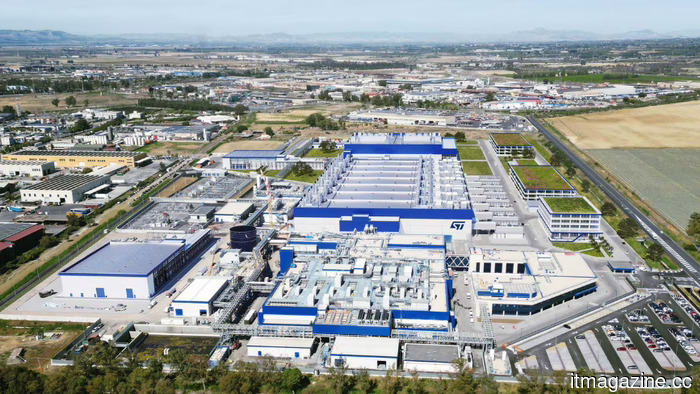
STMicroelectronics increases its revenue projection for data centers to $1 billion.
STMicroelectronics has approximately doubled its revenue expectations from data centers for this year. The Franco-Italian chip manufacturer announced on Monday that it now projects around $1 billion in data center revenue by 2026, an increase from its previous estimate of "nicely above $500 million," attributing this change to sustained demand for AI infrastructure and quicker-than-anticipated advancements in capacity expansion.
This revision also extends into next year. STMicro indicated that data center revenue might double again in 2027, compared to earlier guidance of "well above $1 billion," suggesting that the 2027 figure is on a more aggressive upward trajectory than previously forecasted. This update serves as a guidance adjustment rather than a results announcement, reflecting a mid-year recalibration that indicates stronger order volumes than expected.
A significant factor behind these numbers is a major customer. STMicro is relying on a multi-year contract with Amazon Web Services, described as worth several billion dollars, to expand its data center business in areas such as power conversion, silicon photonics, and high-performance computing.
These three sectors represent the essential infrastructure of an AI data center, focusing on the components that manage power and light rather than the headline-generating accelerators, and this is where STMicro is aligning its offerings.
This adjustment positions the company favorably within a capital spending surge that has benefited component suppliers. Hyperscale companies are investing significantly in AI computing, and this capital flows through a lengthy supply chain before culminating in a completed data center. STMicro’s power and photonics products are part of this chain, and the revised forecast reflects the company's assessment of how much of this expansion it can convert into revenue.
STMicro is typically recognized for the chips used in automobiles and industrial equipment, markets that have seen a downturn, which makes the data center segment one of the more promising aspects of its business, albeit still a modest portion of overall revenue.
The company operates at a scale where $1 billion from data centers is significant but not yet the dominant segment, which is partly why it emphasized the growth trajectory rather than the absolute revenue figure.
STMicro framed this upgrade as a result of both demand and supply, linking the pull for AI infrastructure with what it described as recent improvements in capacity expansion, suggesting that it can now produce and deliver more of what its customers require than it previously anticipated.
However, the company did not disclose details about the margin profile of the data center business or how much of the projected revenue for 2026 and 2027 is already secured through contracts versus projections. Such details would typically be revealed in the next quarterly results.
At this point, STMicro has informed the market to expect increased contributions from data centers compared to its previous statements, highlighting the customer driving much of this growth.
Other articles
 Australia's largest bank reports that corporate AI is increasing costs and generating subpar work.
CBA CEO Matt Comyn highlighted the rising costs of AI and the "work slop" that comes with increased complexity in production, which is reversing the advantageous per-token AI economics that characterized 2024-2025.
Australia's largest bank reports that corporate AI is increasing costs and generating subpar work.
CBA CEO Matt Comyn highlighted the rising costs of AI and the "work slop" that comes with increased complexity in production, which is reversing the advantageous per-token AI economics that characterized 2024-2025.
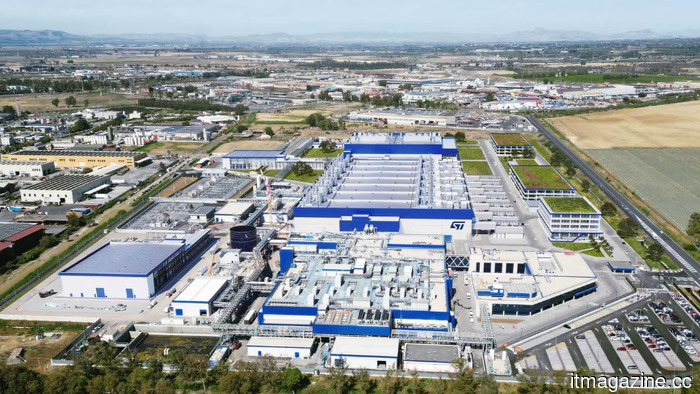 STMicroelectronics increases its revenue forecast for data centers to $1 billion.
STMicroelectronics now anticipates approximately $1 billion in revenue from data centers by 2026, an increase from over $500 million, attributing this growth to demand for AI infrastructure and a partnership with AWS.
STMicroelectronics increases its revenue forecast for data centers to $1 billion.
STMicroelectronics now anticipates approximately $1 billion in revenue from data centers by 2026, an increase from over $500 million, attributing this growth to demand for AI infrastructure and a partnership with AWS.
 Wondershare PDFelement: Optimize Your PDF Workflow with One Click — Save Hours Each Day
Handling PDFs frequently involves navigating multiple OCR websites, editing tools, conversion utilities, and approval platforms within the same workflow. Wondershare PDFelement consolidates these processes into a single productivity-oriented workspace designed for document-intensive office tasks.
Wondershare PDFelement: Optimize Your PDF Workflow with One Click — Save Hours Each Day
Handling PDFs frequently involves navigating multiple OCR websites, editing tools, conversion utilities, and approval platforms within the same workflow. Wondershare PDFelement consolidates these processes into a single productivity-oriented workspace designed for document-intensive office tasks.
 Samsung One UI 9 will deactivate your fingerprint every time you access the power menu.
One UI 9 Beta 2 automates the lockdown mode on Samsung Galaxy devices, eliminating the need for a manual activation step.
Samsung One UI 9 will deactivate your fingerprint every time you access the power menu.
One UI 9 Beta 2 automates the lockdown mode on Samsung Galaxy devices, eliminating the need for a manual activation step.
 Mach Industries increases fourfold to $1.8 billion as the Pentagon's focus on drone superiority boosts valuations across the defense technology sector.
Mach Industries, a US defense-tech startup established three years ago by 22-year-old Ethan Thornton, has secured $300 million in a Series C funding round, achieving a valuation of $1.8 billion, nearly quadrupling its valuation from June 2025.
Mach Industries increases fourfold to $1.8 billion as the Pentagon's focus on drone superiority boosts valuations across the defense technology sector.
Mach Industries, a US defense-tech startup established three years ago by 22-year-old Ethan Thornton, has secured $300 million in a Series C funding round, achieving a valuation of $1.8 billion, nearly quadrupling its valuation from June 2025.
 Google's first new smart speaker in six years may soon have a launch date.
Google remained silent about its Gemini-powered Home Speaker during the entirety of I/O 2026.
Google's first new smart speaker in six years may soon have a launch date.
Google remained silent about its Gemini-powered Home Speaker during the entirety of I/O 2026.
STMicroelectronics increases its revenue projection for data centers to $1 billion.
STMicroelectronics now anticipates around $1 billion in revenue from data centers by 2026, an increase from over $500 million, attributing this growth to demand for AI infrastructure and an agreement with AWS.