

Australia's largest bank reports that corporate AI is leading to increased expenses and generating 'subpar work'.
Commonwealth Bank of Australia CEO Matt Comyn referred to the term “work slop” to characterize the subpar AI outputs currently permeating corporate processes, as the costs associated with token-based AI increase alongside task complexity. In a speech on Monday, Comyn highlighted two challenges that major corporate buyers have been discreetly navigating concerning AI adoption over the past several months.
Firstly, the expenses linked to integrating generative AI into corporate workflows are rising much more rapidly than most companies anticipated, particularly as tasks become more complex. Secondly, Comyn identified “work slop,” referring to the low-quality outputs—such as text, code, and analysis—generated by AI when employees utilize it without adequate quality controls.
The financial implications are likely to resonate strongly with IT procurement professionals. The token-based pricing model, which charges enterprise customers per character, has transitioned over the last 18 months from a minor expense to a significant operational cost category. Comyn emphasized that the costs are accumulating more quickly than anticipated because the number of tokens consumed per task increases non-linearly as task complexity escalates: for instance, a basic summarization task might require 1,000 tokens, while a more complex multi-step task could exceed 100,000 tokens for an equivalent output. Companies that initially calculated their AI costs based on simpler tasks are now confronted with bills that align with the more complex task metrics.
This issue is not exclusive to the Commonwealth Bank. Last week, Morgan Stanley raised its forecast for AI-related job losses in European banking partly due to indications that the cost-benefit ratios of AI are tightening at a time when large institutions had hoped they would be easing. The token-cost-scaling challenge that Comyn outlined represents the fundamental mechanism at play; the same AI system that operated efficiently during pilot stages may incur costs 10 to 100 times greater during full-scale production.
The outcome is the financial strain on corporate AI procurement that Comyn anticipates will intensify through 2026, with businesses increasing scrutiny over AI spending as pressure builds to prove returns on investment.
The “work slop” metaphor adds a vivid yet important dimension to his message. The category Comyn identified—low-quality AI-generated output that technically fulfills a task but ultimately disrupts subsequent workflows—mirrors the “AI slop” issue seen in social media that emerged in 2024 with image-generation technologies. An example in the banking sector could involve an employee using ChatGPT to draft a customer email; while the email may be grammatically correct, its factual inaccuracies could be misinterpreted by the recipient as a commitment, resulting in a complaint that incurs costs far greater than what would have been involved in completing the task manually.
The specifics concerning the Commonwealth Bank are noteworthy. Earlier this year, the bank revealed 90 job cuts, followed by an additional 120 cuts in May, which were explicitly linked to productivity gains attributed to AI, alongside a A$90 million commitment to reskill its workforce for AI-related roles.
Thus, Comyn's comments align with a broader strategy at the bank that clearly supports extensive AI integration: rather than being a cautious critique of AI, the “work slop” perspective offers a more nuanced understanding of AI usage from one of Australia’s leading adopters.
Moreover, the larger context within the Australian banking sector is significant. Over the past month, Sam Altman has contended that a massive job loss due to AI is unlikely at the macro level, and labor data through March 2026 has generally supported that cautious perspective.
Comyn's statements, however, add complexity to this narrative: while macro labor statistics do not yet reflect widespread displacement, the operating-margin data within large corporations is indicating the AI cost and quality trade-offs that the Commonwealth Bank is increasingly highlighting.
The key takeaway is that the prevailing narrative regarding AI costs in 2024-2025—that token prices were declining swiftly enough to render economic deployment feasible—has fundamentally shifted. Decreasing per-token prices have been overshadowed by increasing token consumption per task as companies transition from pilot testing to practical applications. According to the evidence, the procurement discipline that Comyn predicts will unfold through 2026 is a logical outcome of these developments.
Other articles
 Google's first new smart speaker in six years may soon have a launch date.
Google remained silent about its Gemini-powered Home Speaker during the entirety of I/O 2026.
Google's first new smart speaker in six years may soon have a launch date.
Google remained silent about its Gemini-powered Home Speaker during the entirety of I/O 2026.
 ByteDance and Oracle are utilizing Arm's proprietary AGI CPU, marking the conclusion of the hyperscaler-x86 transition.
Arm has officially acknowledged ByteDance and Oracle as clients for its proprietary AGI CPU, confirming its transition from being a CPU-IP licensor to a silicon supplier and increasing competitive pressure on Intel and AMD from hyperscalers.
ByteDance and Oracle are utilizing Arm's proprietary AGI CPU, marking the conclusion of the hyperscaler-x86 transition.
Arm has officially acknowledged ByteDance and Oracle as clients for its proprietary AGI CPU, confirming its transition from being a CPU-IP licensor to a silicon supplier and increasing competitive pressure on Intel and AMD from hyperscalers.
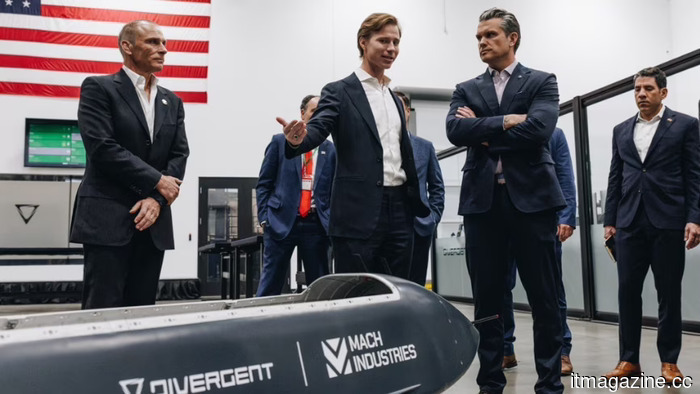 Mach Industries increases fourfold to $1.8 billion as the Pentagon's focus on drone superiority boosts valuations across the defense technology sector.
Mach Industries, a US defense-tech startup established three years ago by 22-year-old Ethan Thornton, has secured $300 million in a Series C funding round, achieving a valuation of $1.8 billion, nearly quadrupling its valuation from June 2025.
Mach Industries increases fourfold to $1.8 billion as the Pentagon's focus on drone superiority boosts valuations across the defense technology sector.
Mach Industries, a US defense-tech startup established three years ago by 22-year-old Ethan Thornton, has secured $300 million in a Series C funding round, achieving a valuation of $1.8 billion, nearly quadrupling its valuation from June 2025.
 Dell's latest XPS 16 Creator Edition aims to serve as a substitute for your MacBook Pro.
Dell's XPS 16 Creator Edition features Nvidia RTX Spark, a Tandem OLED screen, as much as 128GB of unified memory, and includes the ports that MacBook Pro users have been longing for.
Dell's latest XPS 16 Creator Edition aims to serve as a substitute for your MacBook Pro.
Dell's XPS 16 Creator Edition features Nvidia RTX Spark, a Tandem OLED screen, as much as 128GB of unified memory, and includes the ports that MacBook Pro users have been longing for.
 Wondershare PDFelement: Streamline PDF Workflows with a Single Click — Save Hours Daily
Handling PDFs frequently involves a mix of OCR websites, editing applications, conversion tools, and approval systems within the same workflow. Wondershare PDFelement consolidates these processes into a single productivity-oriented workspace designed for document-intensive office activities.
Wondershare PDFelement: Streamline PDF Workflows with a Single Click — Save Hours Daily
Handling PDFs frequently involves a mix of OCR websites, editing applications, conversion tools, and approval systems within the same workflow. Wondershare PDFelement consolidates these processes into a single productivity-oriented workspace designed for document-intensive office activities.
 Google's first new smart speaker in six years may finally have a launch date.
Google remained silent about its Home Speaker powered by Gemini during the entirety of I/O 2026.
Google's first new smart speaker in six years may finally have a launch date.
Google remained silent about its Home Speaker powered by Gemini during the entirety of I/O 2026.
Australia's largest bank reports that corporate AI is leading to increased expenses and generating 'subpar work'.
CBA CEO Matt Comyn highlighted rising AI expenses and "work slop," noting that the complexity of production stages is reversing the advantageous per-token AI economics that characterized 2024-2025.