

The Chrome browser is receiving a security enhancement that may not be visible, but it is definitely beneficial.
Google's DBSC update addresses one of the most exploited vulnerabilities in browser security.
Google has discreetly released a significant update focused on browser security, which you are unlikely to notice, and that, I believe, is the intention behind it.
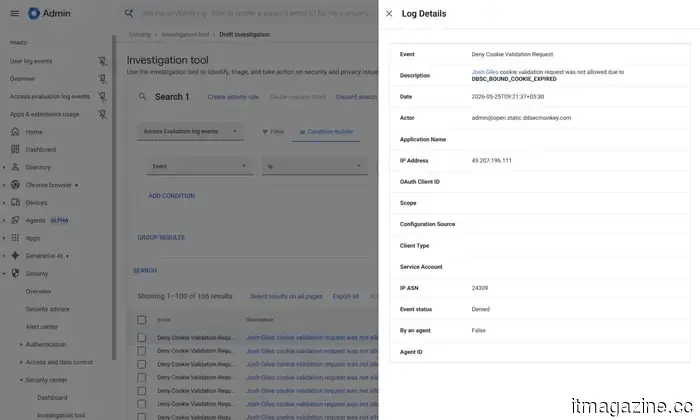
Device Bound Session Credentials, or DBSC, is now accessible on Chrome for Windows users, including both Google Workspace Individual subscribers and personal account holders. This feature is activated by default, requiring no adjustments to your settings.
What is DBSC and why is it important?
Whenever you log into a website, your browser saves a small file known as a session cookie for future visits, allowing you to bypass repeated credential entries on new pages.
However, the issue arises when your device is compromised by malware, which can capture these cookies and send them to an attacker who can then access your accounts without needing your password. This also allows them to circumvent two-factor authentication.
Such attacks are more frequent than many realize, and disappointingly, they can succeed even on accounts with higher security measures. The good news is that DBSC mitigates this risk by linking the session cookie to the specific device that created it.
An additional security layer in the background
Therefore, even if malware replicates the session information or cookie and passes it on to another party, the data becomes ineffective outside the device where it was generated. This enhanced security feature operates quietly in the background while you continue using Chrome.
In my view, DBSC represents a wider industry initiative to gradually eliminate traditional session cookies. The World Wide Web Consortium has had an open specification for this for approximately three years, and Microsoft is quietly outfitting Edge with the same standard.
For over five years, Shikhar has effectively distilled advancements in consumer technology and reported on them.
Microsoft is implementing a subtle but significant redesign for Copilot, which aims to enhance functionality without being obtrusive. The focus is on integrating it more seamlessly into users' workflows.
Throughout Microsoft 365, Copilot is being restructured to minimize visual clutter while maximizing utility. Rather than constantly vying for attention, it is designed to be present in the background when necessary, stepping in only when it can genuinely assist. This nuanced change may seem minor, but it significantly alters the perception of interruptions versus support in daily tasks.
In a neuro-robotics lab at the University of Southern California, a small mechanical hand successfully heard a melody for the first time and played it back after a single attempt, all without sheet music or extensive prior training. Known as the Musician Hand, it features four fingers operated by tendons linked to small electric motors, mimicking the natural action of human muscles. This project was developed by doctoral candidate Hesam Azadjou under Professor Francisco Valero-Cuevas’ guidance.
A recent collaborative study by computer and social scientists at UC Riverside indicates that while AI provides rapid answers, it may lead to the erosion of the internet's essence: human emotion and nuanced, opinion-based thinking. The research evaluated responses from AI systems like ChatGPT and Gemini to subjective inquiries as compared to traditional web searches. The study analyzed the reasoning behind their answers to opinion-laden questions, such as whether fossil-fuel cars should be banned or if the U.S. healthcare system needs reform.






Other articles
 The Chrome browser is receiving an unseen security upgrade that will be beneficial.
DBSC is now enabled by default in Chrome on Windows, linking your login session cookies to your particular device, which renders stolen cookies ineffective for attackers.
The Chrome browser is receiving an unseen security upgrade that will be beneficial.
DBSC is now enabled by default in Chrome on Windows, linking your login session cookies to your particular device, which renders stolen cookies ineffective for attackers.
 Apollo and Blackstone are negotiating a $36 billion debt agreement to acquire Anthropic and its assets.
Apollo and Blackstone are organizing a $36 billion financing deal to purchase Google TPUs and lease them to Anthropic, with Broadcom providing support for the senior debt.
Apollo and Blackstone are negotiating a $36 billion debt agreement to acquire Anthropic and its assets.
Apollo and Blackstone are organizing a $36 billion financing deal to purchase Google TPUs and lease them to Anthropic, with Broadcom providing support for the senior debt.
 Tesla aims to convince you of its self-driving technology, yet even its own AI trainers lack trust in it.
An investigation by Reuters revealed that Tesla's FSD safety statistics are deceptive, its robotaxi rollouts were meticulously choreographed, and the individuals responsible for training its AI would not put their lives in the technology's hands.
Tesla aims to convince you of its self-driving technology, yet even its own AI trainers lack trust in it.
An investigation by Reuters revealed that Tesla's FSD safety statistics are deceptive, its robotaxi rollouts were meticulously choreographed, and the individuals responsible for training its AI would not put their lives in the technology's hands.
 HSG, a former Sequoia China firm, is reported to be leading the bidding for a stake in Leica Camera.
HSG, previously known as Sequoia Capital China, is reported to be at the forefront of acquiring Blackstone’s 45% share in Leica Camera, with the deal estimated to value the company at nearly €1 billion.
HSG, a former Sequoia China firm, is reported to be leading the bidding for a stake in Leica Camera.
HSG, previously known as Sequoia Capital China, is reported to be at the forefront of acquiring Blackstone’s 45% share in Leica Camera, with the deal estimated to value the company at nearly €1 billion.
 How to stop restraining AI agents
According to Juras Jursenas, COO of Oxylabs, the actual limitation for agentic AI lies not in the quality of the models, but rather in a web that is designed to thwart automated access and enterprise data that is not adequately prepared for agents.
How to stop restraining AI agents
According to Juras Jursenas, COO of Oxylabs, the actual limitation for agentic AI lies not in the quality of the models, but rather in a web that is designed to thwart automated access and enterprise data that is not adequately prepared for agents.
 The Hulu app is on the verge of being discontinued, and you may soon find its collection available on Disney+.
Disney is said to be aiming to render the standalone Hulu app unnecessary by integrating more of Hulu’s content, profiles, viewing history, Live TV options, and DVR capabilities into Disney+.
The Hulu app is on the verge of being discontinued, and you may soon find its collection available on Disney+.
Disney is said to be aiming to render the standalone Hulu app unnecessary by integrating more of Hulu’s content, profiles, viewing history, Live TV options, and DVR capabilities into Disney+.
The Chrome browser is receiving a security enhancement that may not be visible, but it is definitely beneficial.
DBSC is now enabled by default in Chrome on Windows, linking your login session cookies to your individual device, which renders stolen cookies ineffective for attackers.