
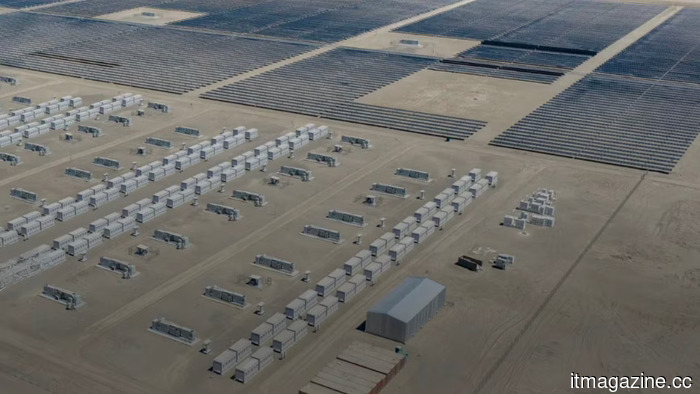
Chile's Atacama Desert is emerging as a worldwide center for battery production.
TL;DRContourGlobal has launched a $500 million solar-and-storage facility in Chile’s Atacama desert, which provides 200 megawatts of power for up to 6.5 hours at night. Currently, Chile has 3,072 MW of battery storage active and anticipates an additional 5,400 MW by December 2026.
ContourGlobal, an independent power producer supported by KKR, has opened a nearly $500 million solar-and-storage plant in Chile’s Atacama desert that captures daytime solar energy to supply power after dark. The Victor Jara hybrid facility features 231 megawatt-peak of photovoltaic capacity along with 1.3 gigawatt-hours of battery storage, making it capable of delivering 200 megawatts of electricity for up to 6.5 hours at night. ContourGlobal claims it is the longest-duration utility-scale battery system in Latin America.
Located in the Tarapacá region, the project is backed by a 15-year power purchase agreement for nighttime electricity with Copec EMOAC, which is the energy marketing and renewable power division of Empresas Copec, one of Chile’s largest industrial groups. This marks ContourGlobal’s second solar-and-storage initiative in Chile, following a similar project launched in Quillagua, located in the neighboring Antofagasta region last year. Together, these two projects provide a total of 452 megawatt-peak of solar power and 2.5 gigawatt-hours of battery storage.
Why the Atacama
The Atacama desert boasts some of the highest solar irradiance on Earth, making it one of the most effective areas globally for photovoltaic energy generation. However, the sun generates more electricity during the day than the Chilean grid can handle, leading to regular curtailment and wasted energy, as solar plants must shut down due to lack of demand. Additionally, transmission bottlenecks between the solar-abundant north and the demand-heavy south exacerbate this issue.
Battery storage addresses these challenges by capturing excess solar energy during daylight hours and releasing it at night, thus transforming solar energy into a dependable power source. Solar-plus-storage projects are increasingly designed to meet continuous power demands, including the rising needs from data centers for a consistent and predictable energy supply.
James Lee Stancampiano, ContourGlobal’s general manager for South America, highlighted that Chile is an attractive market in Latin America due to its regulatory environment, increasing electricity demand, and a strong pipeline of renewable energy and storage investments. The company is also exploring further projects in Chile, including some near the capital city of Santiago and potential wind projects in the central and southern regions.
A storage boom in numbers
According to the Coordinador Eléctrico Nacional (CEN), which operates the national grid, Chile currently boasts 3,072 megawatts of battery energy storage capacity, either operational or undergoing tests, with a majority of projects concentrated in the Atacama desert. CEN estimates that an additional 5,400 megawatts of storage capacity will begin operations by December 2026. Battery energy storage systems now constitute nearly 42% of Chile’s energy project capacity pipeline, marking the largest category.
The investment comes from multiple players, including AES Andes, Engie Energía Chile, and Enel Green Power Chile, all of which are developing storage projects in the nation. Atlas Renewable Energy, backed by BlackRock’s Global Infrastructure Partners, secured $510 million in funding last year for its hybrid Estepa project, one of the largest solar-plus-storage initiatives in Chile. Spanish developer Grenergy is also constructing the Oasis de Atacama complex, touted as the world's largest solar-plus-storage facility.
Mining, data centers, and the demand driver
Chile's industrial demand profile distinguishes it from other solar-rich markets. The nation’s mining sector, which produces about a quarter of the world’s copper and a significant portion of its lithium, is among the world's most energy-intensive industries, operating continuously and requiring reliable power. Additionally, these mines face growing demands to decarbonize operations from customers, regulators, and investors.
ContourGlobal’s CEO Antonio Cammisecra explained that the presence of a major energy-intensive industrial sector, notably mining, has spurred the demand for consistent, long-term renewable energy. He views storage as a pivotal technology that transforms renewable energy from an intermittent source into programmable energy solutions, crucial for lowering system costs, accelerating decarbonization, and scaling up the replacement of traditional generation.
Data centers represent an emerging demand driver. The global shift towards electrification, extending from industrial activities to AI computation, is generating new markets for continuous renewable energy. ContourGlobal anticipates growing demand from data centers requiring large amounts of constant electricity, and Chile’s combination of low-cost solar, storage infrastructure, and political stability positions it as an appealing site for facilities that might otherwise be established in the US or northern Europe.
The model that could scale globally
Other articles
 Talkdesk introduces proactive AI agents for the retail and banking sectors.
Talkdesk introduces proactive AI agents for retail and financial services, automating outbound interactions such as cart recovery, loan pre-qualification, and collections.
Talkdesk introduces proactive AI agents for the retail and banking sectors.
Talkdesk introduces proactive AI agents for retail and financial services, automating outbound interactions such as cart recovery, loan pre-qualification, and collections.
 Spotify and Netflix have signed a $100 million podcast deal with Jay Shetty.
Spotify and Netflix have signed Jay Shetty in a deal that could be valued at up to $100 million. The video edition of his On Purpose podcast will exclusively premiere on both platforms on July 13.
Spotify and Netflix have signed a $100 million podcast deal with Jay Shetty.
Spotify and Netflix have signed Jay Shetty in a deal that could be valued at up to $100 million. The video edition of his On Purpose podcast will exclusively premiere on both platforms on July 13.
 In 2025, funding for startups in France decreased by 5% as the focus on AI increased.
Les startups françaises ont levé 6,7 milliards d'euros en 2025, enregistrant une baisse de 5 % par rapport à l'année précédente. Mistral a attiré 25 % de l'ensemble des capitaux. L'intelligence artificielle a représenté 43 % du financement, tandis que les sorties ont atteint un plus bas de cinq ans à 5,3 milliards d'euros.
In 2025, funding for startups in France decreased by 5% as the focus on AI increased.
Les startups françaises ont levé 6,7 milliards d'euros en 2025, enregistrant une baisse de 5 % par rapport à l'année précédente. Mistral a attiré 25 % de l'ensemble des capitaux. L'intelligence artificielle a représenté 43 % du financement, tandis que les sorties ont atteint un plus bas de cinq ans à 5,3 milliards d'euros.
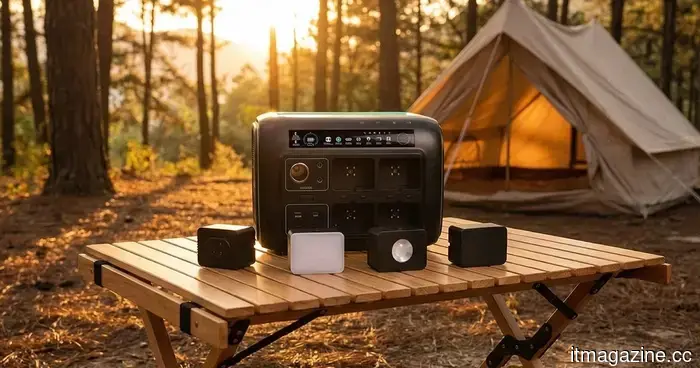 Beyond Power: The Impact of Modular Systems on Outdoor Living
As outdoor arrangements become increasingly intricate, power solutions are advancing to keep up. There was a period when venturing outside required minimal packing and complete disconnection from power sources. While that style of outdoor experience is still present, it no longer represents how many individuals currently enjoy their time outdoors. Nowadays, setups frequently incorporate cameras, drones, laptops, mobile internet, […]
Beyond Power: The Impact of Modular Systems on Outdoor Living
As outdoor arrangements become increasingly intricate, power solutions are advancing to keep up. There was a period when venturing outside required minimal packing and complete disconnection from power sources. While that style of outdoor experience is still present, it no longer represents how many individuals currently enjoy their time outdoors. Nowadays, setups frequently incorporate cameras, drones, laptops, mobile internet, […]
 Meta introduces AI chatbot subscription plans priced at $7.99 and $19.99.
Meta introduces AI chatbot subscriptions for the first time, offering Meta One Plus at $7.99 per month and Premium at $19.99 per month, launching in Singapore, Guatemala, and Bolivia.
Meta introduces AI chatbot subscription plans priced at $7.99 and $19.99.
Meta introduces AI chatbot subscriptions for the first time, offering Meta One Plus at $7.99 per month and Premium at $19.99 per month, launching in Singapore, Guatemala, and Bolivia.
 Dutch authorities have confiscated 800 servers associated with Russian cybercriminals.
Dutch authorities confiscated 800 servers and detained two individuals who offered hosting services to the Kremlin-affiliated group NoName057(16), known for conducting DDoS attacks throughout Europe.
Dutch authorities have confiscated 800 servers associated with Russian cybercriminals.
Dutch authorities confiscated 800 servers and detained two individuals who offered hosting services to the Kremlin-affiliated group NoName057(16), known for conducting DDoS attacks throughout Europe.
Chile's Atacama Desert is emerging as a worldwide center for battery production.
ContourGlobal opens a $500 million solar and storage facility in Chile's Atacama Desert. By the end of 2026, Chile anticipates a battery storage capacity of 8,400 MW.