
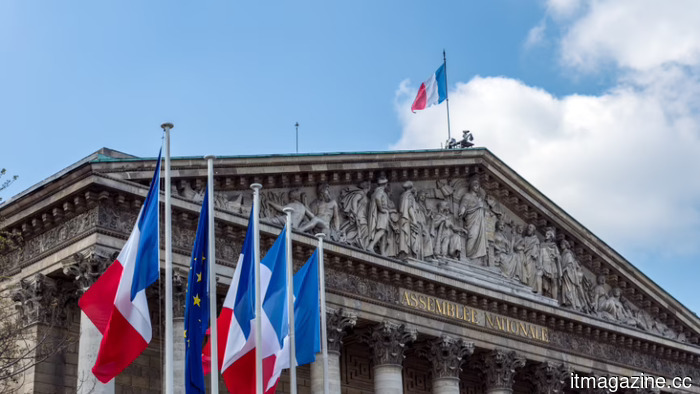
In 2025, funding for startups in France decreased by 5% as the focus on AI increased.
**TL;DR** French startups secured €6.7 billion in 2025, marking a 5% decrease from the previous year, while the US saw a 38% increase and Europe 12%. Mistral represented 25% of the total capital raised. AI facilitated 43% of the funding, defense tech surged by 148%, and exits reached a five-year low at €5.3 billion.
A recent report from Alexandre Dewez, a partner at venture firm 20VC, highlights the increasing dependence of the French tech ecosystem on a few AI companies while growth stalls in other areas. In 2025, French startups raised €6.7 billion across 411 funding rounds, reflecting a 5% drop in capital and a 21% decline in deal volume compared to the prior year. This stands in stark contrast to the US where startup funding increased by 38% and Europe overall saw a 12% rise.
According to the report, which features around 100 slides detailing funding, exits, unicorns, and sector trends, while France has created its first decacorn, it struggles to diversify its successes in a way that indicates a maturing ecosystem. Mistral’s Series C, at an €11.7 billion valuation, was the standout achievement in 2025, yet the AI lab accounted for 25% of the total capital raised by French startups. Excluding Mistral, the overall scenario appears significantly weaker.
AI is the predominant growth driver, representing 23% of funding rounds (up from 13% in 2024) and 43% of capital raised (up from 27% the previous year). Several significant seed rounds for foundational model companies occurred, including H at €212 million, Genesis at €97 million, Gradium at €64 million, and Bioptimus at €32 million.
However, the report notes that France lacks prominent category leaders in the most commercially valuable AI segments compared to other European countries. The UK features ElevenLabs in voice technology, Sweden has Lovable for vibe-coding, and Germany is home to Parloa in customer success and n8n in AI automation. Even Mistral, France's leading AI firm, struggles to compete with giants like OpenAI, Anthropic, Google, and Meta.
Mistral’s European identity offers a unique positioning for companies looking for a sovereign AI alternative, but this has become its main differentiator rather than technical excellence. The firm has lost its initial open-source advantage and is now competing against much larger US and Chinese players with greater capital and computational resources.
The report identifies fintech Pennylane as the top French startup for 2025. The accounting software firm surpassed €100 million in annual recurring revenue, a 130% increase year on year, and secured two rounds of funding within the same year, valued at €2 billion and €3.9 billion, respectively. Pennylane has transitioned from pure accounting software into an ERP and neobank catering to French SMEs and has begun operations in Germany. It stands out as a French startup successfully scaling growth with metrics appealing to top-tier international investors.
Following AI, the second most promising sector is defense, with European defense tech startups raising $1.6 billion in venture funding during 2025, a 148% increase from the prior year. In France, 18 defense startups collectively raised €228 million, marking a 25% rise compared to the previous year. A significant milestone occurred in January 2026 when Harmattan became France's first defense unicorn following a $200 million Series B round led by Dassault Aviation, the manufacturer of the Rafale fighter jet. Harmattan specializes in autonomy and mission-system software for defense aircraft, and French president Emmanuel Macron publicly acknowledged this achievement as beneficial for the country's strategic independence.
The growth in European defense tech is influenced by geopolitical tensions, prompting increased government spending in response to the Ukraine conflict and changing transatlantic security dynamics. Germany currently leads the European defense tech capital market, while France is establishing a foothold in AI-enhanced military systems.
A striking revelation in the report is the extent to which US funds now dominate French startup financing. American funds participated in rounds that represented 55% of total capital raised in 2025, heavily favoring AI companies, notably those developing foundational models such as Mistral, Genesis, and Gradium. At the Series A stage, only 30% of the top 20 rounds were led by French funds; Pan-European funds led 60%, and US funds accounted for 10%. Historically, only a few Pan-European firms like Index Ventures, Accel, and Balderton consistently led one or two French Series A rounds annually, but now at least 15 pan-European funds are similarly active.
French VC funds find themselves in what the report labels the “messy middle,” losing top Series A deals to international funds and premium pre-seed and seed investments to a growing
Other articles
 Ways QR Codes Can Contribute to Your Business Success
Incorporating a scannable code can enhance conversion rates for your business. Originally, QR codes were developed to overcome the restrictions of 1D barcodes, but their rise as a means for mobile devices to access extra information has transformed the operations of many companies. Recommended Videos QR codes, which stand for quick-response codes, provide customers with a method to […]
Ways QR Codes Can Contribute to Your Business Success
Incorporating a scannable code can enhance conversion rates for your business. Originally, QR codes were developed to overcome the restrictions of 1D barcodes, but their rise as a means for mobile devices to access extra information has transformed the operations of many companies. Recommended Videos QR codes, which stand for quick-response codes, provide customers with a method to […]
 Cognition secures $1 billion at a valuation of $26 billion for its AI coding agent.
Cognition AI has secured $1 billion at a valuation of $26 billion for Devin, its AI coding agent. The company's revenue has increased 13 times in a year, reaching $492 million, with Goldman Sachs and Mercedes-Benz among its clients.
Cognition secures $1 billion at a valuation of $26 billion for its AI coding agent.
Cognition AI has secured $1 billion at a valuation of $26 billion for Devin, its AI coding agent. The company's revenue has increased 13 times in a year, reaching $492 million, with Goldman Sachs and Mercedes-Benz among its clients.
 Your Roku TV is receiving its most significant home screen update in ten years, starting today.
Roku is launching a significant update to its home screen today, featuring AI-driven personalization, new genre-specific destinations, Quick Access, Top Picks for You, and a collapsible menu available on all devices in the US.
Your Roku TV is receiving its most significant home screen update in ten years, starting today.
Roku is launching a significant update to its home screen today, featuring AI-driven personalization, new genre-specific destinations, Quick Access, Top Picks for You, and a collapsible menu available on all devices in the US.
 ElevenLabs collaborates with Stan Lee Universe for AI voice technology.
ElevenLabs has incorporated Stan Lee's AI-generated voice and likeness into its platform via an agreement with Stan Lee Universe, introducing a book club, creative templates, and music filters.
ElevenLabs collaborates with Stan Lee Universe for AI voice technology.
ElevenLabs has incorporated Stan Lee's AI-generated voice and likeness into its platform via an agreement with Stan Lee Universe, introducing a book club, creative templates, and music filters.
 Chile's Atacama Desert is emerging as a worldwide center for battery production.
ContourGlobal opens a $500 million solar and storage facility in Chile's Atacama Desert. By the end of 2026, Chile anticipates a battery storage capacity of 8,400 MW.
Chile's Atacama Desert is emerging as a worldwide center for battery production.
ContourGlobal opens a $500 million solar and storage facility in Chile's Atacama Desert. By the end of 2026, Chile anticipates a battery storage capacity of 8,400 MW.
 Talkdesk introduces proactive AI agents for the retail and banking sectors.
Talkdesk introduces proactive AI agents for retail and financial services, automating outbound interactions such as cart recovery, loan pre-qualification, and collections.
Talkdesk introduces proactive AI agents for the retail and banking sectors.
Talkdesk introduces proactive AI agents for retail and financial services, automating outbound interactions such as cart recovery, loan pre-qualification, and collections.
In 2025, funding for startups in France decreased by 5% as the focus on AI increased.
Les startups françaises ont levé 6,7 milliards d'euros en 2025, enregistrant une baisse de 5 % par rapport à l'année précédente. Mistral a attiré 25 % de l'ensemble des capitaux. L'intelligence artificielle a représenté 43 % du financement, tandis que les sorties ont atteint un plus bas de cinq ans à 5,3 milliards d'euros.