
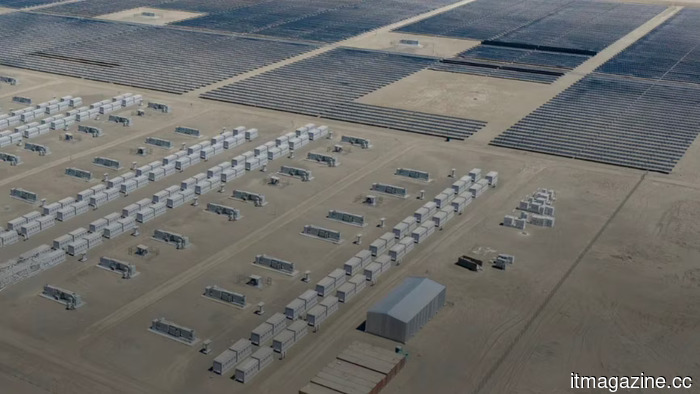
Chile's Atacama Desert is evolving into a global hub for battery production.
TL;DR: ContourGlobal has launched a $500 million solar and storage facility in Chile's Atacama desert, which provides 200 megawatts of power for up to 6.5 hours during the night. Currently, Chile has 3,072 MW of battery storage operational and anticipates an additional 5,400 MW by December 2026.
ContourGlobal, an independent power producer supported by KKR, has inaugurated a nearly $500 million solar-and-storage plant in the Atacama desert of Chile, which harnesses solar energy during the day for use at night. The Victor Jara hybrid facility combines 231 megawatt-peak of photovoltaic capacity with 1.3 gigawatt-hours of battery storage, offering 200 megawatts of power for as long as 6.5 hours after sundown. ContourGlobal describes it as the longest-duration utility-scale battery system in Latin America.
Located in the Tarapacá region, the project is supported by a 15-year power purchase agreement for nighttime electricity with Copec EMOAC, the renewable energy arm of Empresas Copec, one of Chile's largest industrial groups. This is ContourGlobal's second solar-and-storage investment in Chile, following a similar system launched last year in Quillagua in the Antofagasta region. Together, these two projects provide 452 megawatt-peak of solar power and 2.5 gigawatt-hours of battery storage.
Why the Atacama Desert?
The Atacama desert is known for its high levels of solar irradiance, ranking it among the best locations worldwide for photovoltaic energy generation. However, the issue arises as the daytime solar output exceeds what Chile’s grid can handle, leading to frequent curtailments and wasted energy from solar plants that must be shut down due to lack of demand. Additionally, transmission limitations between the solar-rich north and the demand-heavy southern regions exacerbate this issue.
Battery storage mitigates this problem by storing excess solar energy generated during the day and releasing it at night, effectively converting an intermittent energy source into a reliable one. Solar-plus-storage initiatives are increasingly designed to meet continuous energy demands, particularly from data centres that require a stable and predictable power supply.
James Lee Stancampiano, ContourGlobal’s general manager for South America, highlighted Chile’s advantages, such as its regulatory framework, rising electricity demand, and a pipeline of renewable energy and storage projects. The company is exploring more projects in Chile, including potential sites near the capital Santiago and wind projects in the central and southern regions.
Numbers behind the storage boom
Chile currently boasts 3,072 megawatts of battery energy storage capacity, either operational or in testing phases, with most projects located in the Atacama desert, according to the Coordinador Eléctrico Nacional (CEN), the national grid operator. CEN anticipates an additional 5,400 megawatts of storage capacity to come online by December 2026. Currently, battery energy storage systems constitute nearly 42% of Chile's energy project pipeline by capacity, the largest segment.
This investment landscape is diversified, with multiple players involved. Companies such as AES Andes, Engie Energía Chile, and Enel Green Power Chile are all pursuing storage projects in the country. Atlas Renewable Energy, supported by BlackRock’s Global Infrastructure Partners, obtained $510 million in financing last year for its Estepa project, one of the largest solar-plus-storage developments in Chile. Additionally, the Spanish firm Grenergy is constructing the Oasis de Atacama complex, which it claims will be the world's largest solar-plus-storage project.
Industrial demand as a key driver
What sets Chile apart from other solar-rich markets is its industrial demand profile. The mining sector, responsible for about a quarter of the world's copper and a large proportion of its lithium, is one of the most energy-intensive industries globally. Mines require reliable power around the clock, and there is increasing pressure from customers, regulators, and investors to decarbonize operations.
ContourGlobal’s CEO, Antonio Cammisecra, stated that the presence of a significant industrial base, especially in mining, has increased the demand for consistent long-term renewable energy. He emphasized that storage technology transitions renewables from intermittent sources to programmable energy solutions, which is crucial for reducing system costs, promoting decarbonization, and scaling up conventional generation replacements.
Data centres are emerging as another major source of demand. The global trend toward electrification across various sectors, including industrial processes and AI computing, is creating new markets for 24/7 renewable energy. ContourGlobal foresees growing demand from data centres that require substantial amounts of constant electricity; Chile’s mix of inexpensive solar, storage infrastructure, and political stability makes it an attractive location for such facilities that might otherwise be established in the US or northern Europe.
A scalable global model
Chile's strategy of developing large-scale solar capacity in the desert, combining it
Other articles
 Spotify and Netflix have signed a $100 million podcast deal with Jay Shetty.
Spotify and Netflix have signed Jay Shetty in a deal that could be valued at up to $100 million. The video edition of his On Purpose podcast will exclusively premiere on both platforms on July 13.
Spotify and Netflix have signed a $100 million podcast deal with Jay Shetty.
Spotify and Netflix have signed Jay Shetty in a deal that could be valued at up to $100 million. The video edition of his On Purpose podcast will exclusively premiere on both platforms on July 13.
 Dutch authorities have confiscated 800 servers associated with Russian cybercriminals.
Dutch authorities confiscated 800 servers and detained two individuals who offered hosting services to the Kremlin-affiliated group NoName057(16), known for conducting DDoS attacks throughout Europe.
Dutch authorities have confiscated 800 servers associated with Russian cybercriminals.
Dutch authorities confiscated 800 servers and detained two individuals who offered hosting services to the Kremlin-affiliated group NoName057(16), known for conducting DDoS attacks throughout Europe.
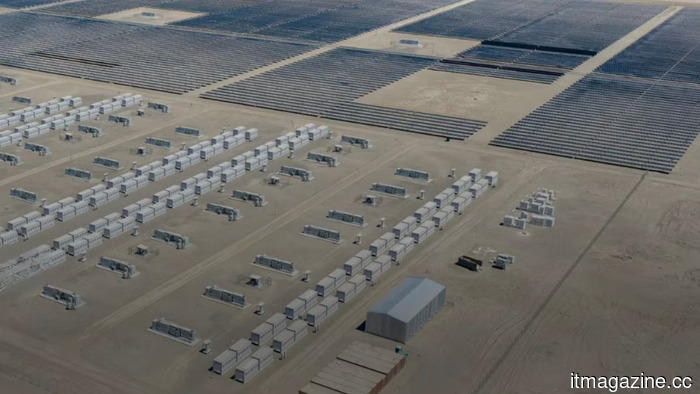 Chile's Atacama Desert is emerging as a global center for battery production.
ContourGlobal has officially opened a $500 million solar and storage facility in the Atacama Desert of Chile. By the end of 2026, Chile anticipates reaching 8,400 MW of battery storage capacity.
Chile's Atacama Desert is emerging as a global center for battery production.
ContourGlobal has officially opened a $500 million solar and storage facility in the Atacama Desert of Chile. By the end of 2026, Chile anticipates reaching 8,400 MW of battery storage capacity.
 Your Roku TV is receiving its most significant home screen update in ten years, and it begins today.
Roku is launching a significant update to its home screen today, featuring AI-driven personalization, new genre-specific destinations, Quick Access, Top Picks for You, and a collapsible menu for all devices in the US.
Your Roku TV is receiving its most significant home screen update in ten years, and it begins today.
Roku is launching a significant update to its home screen today, featuring AI-driven personalization, new genre-specific destinations, Quick Access, Top Picks for You, and a collapsible menu for all devices in the US.
 Talkdesk introduces proactive AI agents for the retail and banking sectors.
Talkdesk introduces proactive AI agents for retail and financial services, automating outbound interactions such as cart recovery, loan pre-qualification, and collections.
Talkdesk introduces proactive AI agents for the retail and banking sectors.
Talkdesk introduces proactive AI agents for retail and financial services, automating outbound interactions such as cart recovery, loan pre-qualification, and collections.
 Red Magic's latest gaming smartphone, featuring a large battery and liquid cooling system, is launching worldwide.
Red Magic's latest gaming smartphone showcases its cooling system, combining liquid cooling with a large battery and a seamless screen design.
Red Magic's latest gaming smartphone, featuring a large battery and liquid cooling system, is launching worldwide.
Red Magic's latest gaming smartphone showcases its cooling system, combining liquid cooling with a large battery and a seamless screen design.
Chile's Atacama Desert is evolving into a global hub for battery production.
ContourGlobal opens a $500 million solar and storage facility in Chile's Atacama Desert. By the end of 2026, Chile anticipates reaching 8,400 MW in battery storage capacity.