
Beyond Power: The Impact of Modular Systems on Outdoor Living
As outdoor setups become increasingly intricate, power solutions are adapting to keep up.
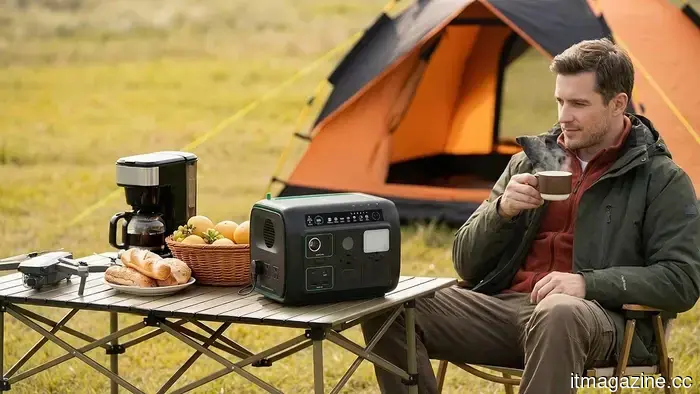
In the past, outdoor excursions typically meant traveling light and disconnecting entirely. While this traditional way of enjoying the outdoors still exists, it doesn't accurately represent how many individuals now spend their time outside. Modern setups frequently incorporate cameras, drones, laptops, mobile internet, and lighting that lasts well beyond sunset. Whether at a weekend campsite, a van parked off-grid, or a remote work session in the mountains, power needs have shifted from being occasional to constant and dynamic throughout the day.
This change has subtly transformed expectations. Relying on a single battery and hoping for it to last is no longer a dependable strategy.
The Limitations of Conventional Portable Power
Most portable power stations continue to adhere to a similar design: a standalone unit with a fixed battery and a limited number of ports. While this method is practical, it comes with compromises.
Users either carry everything, even if they only require a fraction of it, or they leave behind essential items and lose access altogether. For shorter excursions, the added weight can feel unnecessary. For more elaborate setups, the capacity may fall short or require extra planning.
This all-or-nothing mentality often compels individuals to prepare for the worst-case scenario. Consequently, they end up carrying more weight, bulk, and equipment than needed. This disconnect is becoming increasingly noticeable as outdoor activities diversify.
The Move Towards Modular Outdoor Systems
In outdoor gear, a modular design is gaining popularity. Camera systems now utilize interchangeable rigs and mounts, lighting setups consist of smaller, movable components, and batteries in tools and e-bikes are designed to be swapped, stacked, and adjusted based on the task. The concept is straightforward: instead of relying on one fixed arrangement, users construct what they need for the moment.
Power solutions are beginning to follow this trend.
Instead of depending on a single device for all power needs, newer systems are exploring ways to distribute energy across smaller components that can function together or independently. It's less about a singular power source and more about creating a flexible network.
Why Modular Power Is Gaining Popularity
Several factors are contributing to this transition.
Firstly, energy consumption has become less predictable. A brief hike may only necessitate a phone charger and a light, while a basecamp setup could require cooking equipment, cameras, and overnight lighting. A fixed system rarely provides an efficient solution for both scenarios.
Secondly, mobility has become increasingly important. Lighter, more compact components are easier to transport, especially when plans are subject to change throughout the day.
There is also a practical aspect. Distributing power across multiple units decreases dependence on a single source. If one component depletes or fails, others can still function.
Lastly, different environments require varying setups. What works for a campsite may not be suitable for a power outage at home or a mobile work arrangement. Flexibility should be an integral part of the design rather than an afterthought.
Case Study: NjoyNook X-Sphere
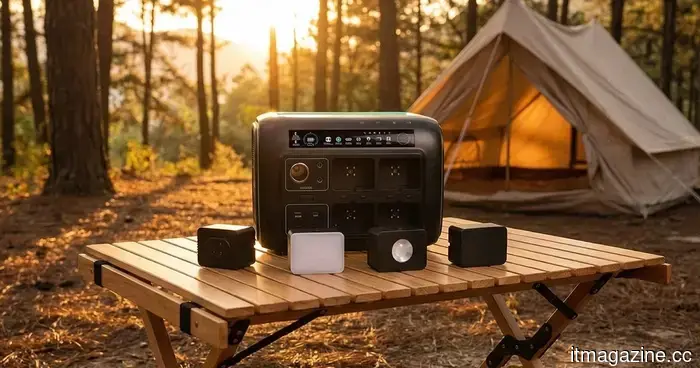
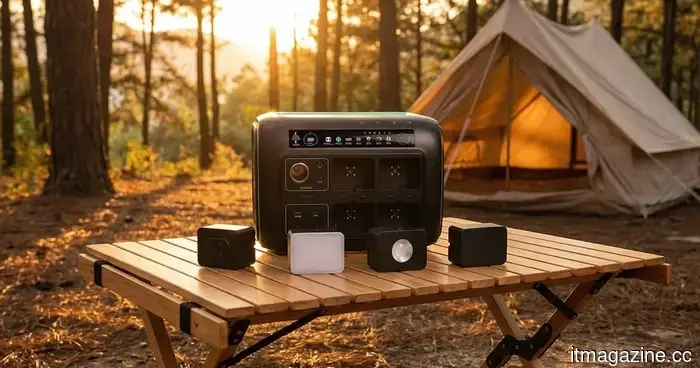
NjoyNook, a company currently working on implementing modular architecture in portable energy systems, has developed the NjoyNook portable power station, which features distinct components with built-in batteries, allowing them to operate independently from the main power station.
The four detachable components include a spotlight, a panel light, a Bluetooth speaker, and a power bank. The overall power station boasts a steady input of 800W and a 1600W surge, ten outlets, a 12-protection safety system, and an LFP battery capable of supporting up to 4,000 life cycles.
In practical terms, this means that unlike traditional integrated power stations, if one module runs out of power, it won’t stop the others from functioning as long as their batteries are still operational.
The modular design enables users to utilize only the features they require while keeping the others available for reattachment as needed. Additionally, because the system employs detachable battery-powered modules, the power supply is distributed rather than centralized.
How the System Works Together
For modularity to be effective, it must feel seamless. The X-Sphere employs secure quick-mount connectors and intelligent battery management to facilitate easy attachment and detachment of modules. Each component has its dedicated battery, meaning it does not rely on the hub for functionality. When docked, modules recharge efficiently without complicating the overall setup.
The hot swap capability allows users to make changes without powering down the entire system, resulting in a setup that feels dynamic rather than mechanical.
Real-World Implications for Everyday Use
This evolution becomes evident when observing how people utilize their gear. A short hike might require just a compact battery and a small light instead of an entire power station. Upon returning to camp, that same setup can be expanded with additional lighting or other devices connected to a central hub.
In emergencies, distributing power across various areas can make a significant difference. Rather than relying on a single source in one location, smaller components can provide light or charging where

Other articles
 In 2025, funding for startups in France decreased by 5% as the focus on AI increased.
Les startups françaises ont levé 6,7 milliards d'euros en 2025, enregistrant une baisse de 5 % par rapport à l'année précédente. Mistral a attiré 25 % de l'ensemble des capitaux. L'intelligence artificielle a représenté 43 % du financement, tandis que les sorties ont atteint un plus bas de cinq ans à 5,3 milliards d'euros.
In 2025, funding for startups in France decreased by 5% as the focus on AI increased.
Les startups françaises ont levé 6,7 milliards d'euros en 2025, enregistrant une baisse de 5 % par rapport à l'année précédente. Mistral a attiré 25 % de l'ensemble des capitaux. L'intelligence artificielle a représenté 43 % du financement, tandis que les sorties ont atteint un plus bas de cinq ans à 5,3 milliards d'euros.
 Daylight is extending MDR into Claude Enterprise to tackle new AI security threats.
Daylight is among the first MDR providers to track AI-native threats within enterprise AI platforms, beginning with the audit telemetry for Anthropic's Claude Enterprise.
Daylight is extending MDR into Claude Enterprise to tackle new AI security threats.
Daylight is among the first MDR providers to track AI-native threats within enterprise AI platforms, beginning with the audit telemetry for Anthropic's Claude Enterprise.
 Your Roku TV is receiving its most significant home screen update in ten years, and it begins today.
Roku is launching a significant update to its home screen today, featuring AI-driven personalization, new genre-specific destinations, Quick Access, Top Picks for You, and a collapsible menu for all devices in the US.
Your Roku TV is receiving its most significant home screen update in ten years, and it begins today.
Roku is launching a significant update to its home screen today, featuring AI-driven personalization, new genre-specific destinations, Quick Access, Top Picks for You, and a collapsible menu for all devices in the US.
 Meta introduces AI chatbot subscription plans priced at $7.99 and $19.99.
Meta introduces AI chatbot subscriptions for the first time, offering Meta One Plus at $7.99 per month and Premium at $19.99 per month, launching in Singapore, Guatemala, and Bolivia.
Meta introduces AI chatbot subscription plans priced at $7.99 and $19.99.
Meta introduces AI chatbot subscriptions for the first time, offering Meta One Plus at $7.99 per month and Premium at $19.99 per month, launching in Singapore, Guatemala, and Bolivia.
 Dutch authorities have confiscated 800 servers associated with Russian cybercriminals.
Dutch authorities confiscated 800 servers and detained two individuals who offered hosting services to the Kremlin-affiliated group NoName057(16), which has been executing DDoS attacks throughout Europe.
Dutch authorities have confiscated 800 servers associated with Russian cybercriminals.
Dutch authorities confiscated 800 servers and detained two individuals who offered hosting services to the Kremlin-affiliated group NoName057(16), which has been executing DDoS attacks throughout Europe.
 Beyond Power: The Impact of Modular Systems on Outdoor Living
As outdoor configurations become increasingly intricate, power solutions are advancing to meet these demands. There was a period when venturing outdoors required minimal packing and complete disconnection from power sources. That way of experiencing the outdoors still exists, but it no longer mirrors the reality of how many individuals engage with nature today. Modern setups frequently comprise cameras, drones, laptops, mobile internet, […]
Beyond Power: The Impact of Modular Systems on Outdoor Living
As outdoor configurations become increasingly intricate, power solutions are advancing to meet these demands. There was a period when venturing outdoors required minimal packing and complete disconnection from power sources. That way of experiencing the outdoors still exists, but it no longer mirrors the reality of how many individuals engage with nature today. Modern setups frequently comprise cameras, drones, laptops, mobile internet, […]
Beyond Power: The Impact of Modular Systems on Outdoor Living
As outdoor arrangements become increasingly intricate, power solutions are advancing to keep up. There was a period when venturing outside required minimal packing and complete disconnection from power sources. While that style of outdoor experience is still present, it no longer represents how many individuals currently enjoy their time outdoors. Nowadays, setups frequently incorporate cameras, drones, laptops, mobile internet, […]