
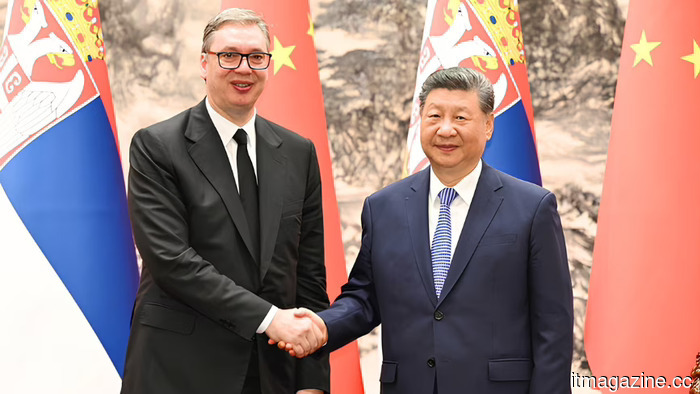
Vučić traveled to Beijing for a $1.1 billion Chinese investment, as Belgrade was engulfed in chaos.
China's $1.1 billion investment package in AI, robotics, and electric vehicles for Serbia was announced just four days after 34,000 protesters gathered in the capital demanding early elections. So far, Brussels has not formulated a clear response to these developments.
On Saturday, police estimated that tens of thousands of Serbian citizens participated in a rally in central Belgrade, with estimates reaching as high as 34,300. They called for early elections, accountability for the November 2024 collapse of the Novi Sad railway station that resulted in 16 fatalities, and an end to what the student movement has been labeling state capture for the past eighteen months.
Riot police resorted to using pepper spray against demonstrators, and the state-owned railway halted all train services to and from Belgrade to prevent more protesters from arriving. President Aleksandar Vučić attributed the unrest to "foreign powers."
Three days later, he traveled to Beijing, where he signed over 20 cooperation agreements with Xi Jinping, including the $1.1 billion investment package focused on artificial intelligence infrastructure, robotics joint ventures, and electric vehicle manufacturing in Serbia.
This new investment follows a $1.5 billion highway contract currently under construction with Shandong Hi-Speed Group, as well as various defense-related partnerships, and a significant Huawei telecommunications presence in Serbian state infrastructure that has been developing quietly over nearly a decade.
The timing of these developments is not coincidental. A government facing the most extensive and sustained protest movement since the post-Milošević era chose this moment, with cameras focused on central Belgrade, to showcase that it has alternatives beyond Brussels.
The European Union is officially expected to be concerned about both the protests and the investment package. Serbia is an EU candidate state, and the accession framework provides Brussels with formal influence over issues such as judicial independence, media freedom, electoral integrity, and the dependencies created by foreign technological investments like the $1.1 billion Chinese package.
However, these instruments have mostly led to a concerning drift away from these ideals. The grievances raised by the student movement mirror those identified in the European Commission's annual rule-of-law reports over the years.
Since 2023, a Sino-Serbian strategic corridor has been evidently developing, yet Brussels has observed without taking action.
The technological aspect marks a significant change from 2023 to 2026. Early investments from China's Belt and Road Initiative primarily involved physical infrastructure like highways and ports. In contrast, the 2026 focus centers on silicon, sensors, and software. The recently signed $1.1 billion package aligns with what Beijing describes as “new productive forces,” emphasizing the integration of AI, robotics, electric vehicles, and green technology as Beijing’s strategy for economic growth in the latter part of the decade. A Chinese data center in Serbia represents more than just a road; it signifies an infrastructure deeply intertwined with Chinese hardware, software, standards, and, eventually, governance of supply chains. Once established, it is challenging to disentangle from.
This is precisely why it appeals to Beijing and why Brussels needs to pay closer attention than it has been.
The harsh reality is that Vučić’s strategy of diversification is logical in its context. EU accession talks have stagnated for years, and his government is not solely to blame; Brussels has lost enthusiasm for further enlargement after 2007, and that sentiment has not significantly changed.
A Serbian president looking at a lengthy 15-year accession process amid domestic political demands for immediate change has ample motivation to show that the country has alternatives. Beijing is ready to offer these alternatives without the prerequisites of independent media, eliminating election irregularities, or prosecuting corruption, all conditions that the EU requires.
As a result, the competing offer is not primarily based on economic factors but rather on political ones.
What stands out in the European response thus far is its lack of substance. Bloomberg reported last week that the Commission has been “quietly raising concerns” with Belgrade, a term indicative of a diplomatic approach not aimed at achieving significant results. The EU’s recently published Tech Sovereignty Package makes no mention of technology partnerships with candidate countries.
The bloc’s broader stance on Chinese technology, including chip export controls and regulatory measures, has not been applied to the enlargement context at all. Serbia exists in a regulatory gray area, and Brussels has yet to determine how to engage with a country that is using this ambiguity to reinforce the very dependencies the EU seeks to mitigate within its own borders.
Students in Belgrade grasp the implications of these developments more clearly than the Commission appears to. Their demands focus on domestic issues: rule of law, accountability for the Novi Sad collapse, and fair elections. However, they also understand that each Chinese-funded data center and Huawei telecom upgrade complicates their fight for these demands by bolstering the patronage networks that the protests are opposing and diminishing the leverage any future reformist government would have over the nation’s crucial infrastructure.
The $1.1 billion deal signed in Beijing this week constitutes more
Otros artículos
 Next month, the taxation on Samsung's Galaxy flagship could become more burdensome.
Samsung’s premium smartphones in Greece may experience a price increase starting in June, as a report suggests that the Galaxy S, Galaxy Z, and Galaxy FE models could rise by at least €100.
Next month, the taxation on Samsung's Galaxy flagship could become more burdensome.
Samsung’s premium smartphones in Greece may experience a price increase starting in June, as a report suggests that the Galaxy S, Galaxy Z, and Galaxy FE models could rise by at least €100.
 The broader perspective on property valuation: e2Value explains the significance of historical context in a new age of AI.
Todd Rissel, CEO of e2Value, discusses how decades of changes in economics, construction methods, and consumer expectations render historical context crucial for precise AI-based property valuation.
The broader perspective on property valuation: e2Value explains the significance of historical context in a new age of AI.
Todd Rissel, CEO of e2Value, discusses how decades of changes in economics, construction methods, and consumer expectations render historical context crucial for precise AI-based property valuation.
 The CEO of Barnes & Noble believes that AI-generated books are acceptable. He is mistaken.
The CEO of Barnes & Noble claims he has no issues with selling books written by AI. This may seem reasonable at first glance, but it's actually problematic, and here's why it poses a threat to all authors.
The CEO of Barnes & Noble believes that AI-generated books are acceptable. He is mistaken.
The CEO of Barnes & Noble claims he has no issues with selling books written by AI. This may seem reasonable at first glance, but it's actually problematic, and here's why it poses a threat to all authors.
 Spotify has simplified the process of keeping up with lengthy reads without the need to read them yourself.
Spotify is launching over 650 narrated magazine articles from publications such as Rolling Stone, Vogue, WIRED, and others. Premium subscribers can begin listening to these articles using their audiobook allowance starting today.
Spotify has simplified the process of keeping up with lengthy reads without the need to read them yourself.
Spotify is launching over 650 narrated magazine articles from publications such as Rolling Stone, Vogue, WIRED, and others. Premium subscribers can begin listening to these articles using their audiobook allowance starting today.
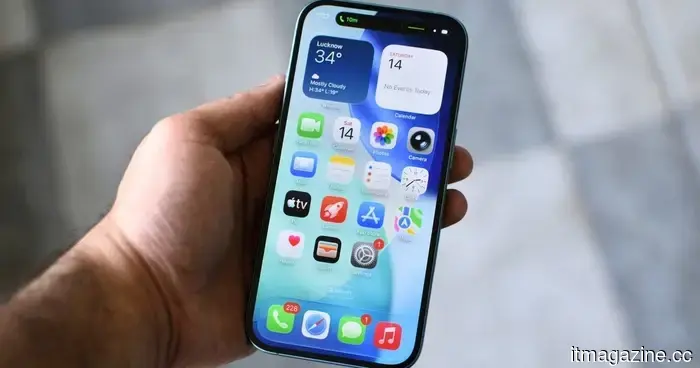 Apple might adopt Android’s most effective anti-theft feature for upcoming iPhones.
Apple is said to be working on a theft detection feature that utilizes motion sensors, AI, and proximity data from the Apple Watch to automatically lock stolen iPhones.
Apple might adopt Android’s most effective anti-theft feature for upcoming iPhones.
Apple is said to be working on a theft detection feature that utilizes motion sensors, AI, and proximity data from the Apple Watch to automatically lock stolen iPhones.
 Vincent Bolloré turns down Ackman's $64 billion offer for Universal Music.
Vincent Bolloré has officially declined Bill Ackman's $64 billion offer from Pershing Square for Universal Music Group, bringing an end to the biggest take-private proposal in the history of the music industry.
Vincent Bolloré turns down Ackman's $64 billion offer for Universal Music.
Vincent Bolloré has officially declined Bill Ackman's $64 billion offer from Pershing Square for Universal Music Group, bringing an end to the biggest take-private proposal in the history of the music industry.
Vučić traveled to Beijing for a $1.1 billion Chinese investment, as Belgrade was engulfed in chaos.
China's $1.1 billion investment in AI and robotics in Serbia comes just four days after the biggest protests against Vučić in months. Brussels has not yet formulated a consistent response to either situation.