
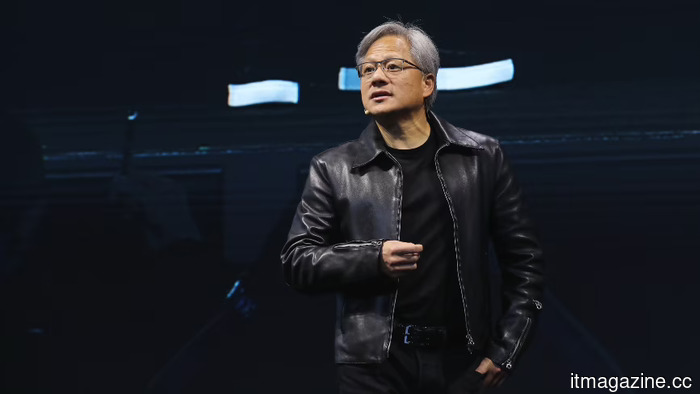
NVIDIA's Jensen Huang refers to Taiwan as the 'epicenter' of the AI revolution, noting that spending has reached $150 billion annually.
NVIDIA's CEO Jensen Huang addressed an audience in Taipei during Computex 2026 on Wednesday, stating that Taiwan is the “epicenter” of the AI revolution, with the company's annual expenditure on the island projected to be around $150 billion. This figure, which Huang has revealed as the highest specific spending amount related to Taiwan, surpasses the GDP of most EU member countries.
Huang's keynote largely detailed the supply chain behind this figure, with the Vera Rubin platform being a prime example. He described this next-generation AI platform as “probably the largest product launch in the history of Taiwan.” Each Vera Rubin system comprises nearly 2 million components, constructed in collaboration with 150 ecosystem partners, predominantly within Taiwanese enterprises. TSMC is responsible for the foundational logic, while assembly is managed by firms like Foxconn, Quanta, and Wistron. Additionally, SK Hynix, although based in Seoul, has a significant presence in Taiwan and provides the HBM4 memory required for the platform to achieve 22 TB/s bandwidth.
The implications of Huang's statements are significant politically as well as technically. The Trump administration's second-term tariff policies have exerted pressure on NVIDIA and other U.S. chip manufacturers to relocate more of their production capabilities to the United States. By disclosing the Taiwan spending, Huang signals to Washington the substantial costs associated with that transition while reinforcing to Taipei NVIDIA’s steadfast commitment to the island.
His recent comments about the potential use of Huawei chips for DeepSeek, which he deemed a “horrible outcome” for the U.S., indicate NVIDIA’s clear alignment with the U.S. in the ongoing tech cold war.
Notably, Huang did not disclose any specifics regarding new fabrication plants, packaging facilities, or supply assurances. The $150 billion represents an aggregate figure flowing through the existing Taiwanese supply chain rather than a distinct capital investment plan. The ramp-up for Rubin has already been putting pressure on that ecosystem, with TSMC reportedly working overtime to fulfill NVIDIA’s Rubin orders, and the $150 billion-a-year projection further intensifies that pressure.
For Taiwan, the political implications are significant as the Lai Ching-te administration has been advocating in Washington to highlight the island's critical role in the U.S. AI development as a strategic advantage rather than a burden. Huang’s “epicenter” reference bolsters that narrative.
In contrast, for Beijing, which has been tightening its AI policies in 2026, Huang's keynote serves as additional evidence of the geographical concentration of the global AI supply chain rather than its dispersion.
Computex 2026, with the theme “AI Together,” continues throughout the week. Huang’s keynote was the main highlight, with AMD's Lisa Su also scheduled to present later, both likely to outline their respective strategies ahead of 2027, when NVIDIA’s Rubin Ultra and AMD’s MI400-series are set to be released in significant volumes.
Other articles
 My lawn was once an ongoing weekend chore until the LEBOSBO V3 came into play.
Many homeowners aspire to have a pristine, well-kept outdoor area, but the effort involved in maintaining that ideal lawn is frequently underestimated. The demanding weekend mowing routines and ongoing maintenance can easily become burdensome. The LEBOSBO V3 addresses this challenge with smart automation, wireless ease, and a significantly more hands-off mowing experience that necessitates minimal to no manual effort.
My lawn was once an ongoing weekend chore until the LEBOSBO V3 came into play.
Many homeowners aspire to have a pristine, well-kept outdoor area, but the effort involved in maintaining that ideal lawn is frequently underestimated. The demanding weekend mowing routines and ongoing maintenance can easily become burdensome. The LEBOSBO V3 addresses this challenge with smart automation, wireless ease, and a significantly more hands-off mowing experience that necessitates minimal to no manual effort.
 PlayStation Plus subscribers can expect a month focused on co-op games in June following the increase in prices.
PlayStation Plus will offer a co-op-focused lineup for June following the price increase, featuring Grounded, Darktide, and Nickelodeon All-Star Brawl 2 as the highlights.
PlayStation Plus subscribers can expect a month focused on co-op games in June following the increase in prices.
PlayStation Plus will offer a co-op-focused lineup for June following the price increase, featuring Grounded, Darktide, and Nickelodeon All-Star Brawl 2 as the highlights.
 Aurzen merges Roku TV with SGS-certified brightness for large-screen applications.
The D1R lineup from Aurzen features a built-in Roku TV, native 1080P resolution, and confirmed brightness ratings, offering a more practical approach to contemporary home projection.
SpaceX secures a $2.29 billion contract from the Space Force for the Golden Dome infrastructure.
The US Space Force has granted SpaceX $2.29 billion to develop the Space Data Network Backbone on Starshield satellites, which will serve as the communications backbone for the Golden Dome missile defense system.
Aurzen merges Roku TV with SGS-certified brightness for large-screen applications.
The D1R lineup from Aurzen features a built-in Roku TV, native 1080P resolution, and confirmed brightness ratings, offering a more practical approach to contemporary home projection.
SpaceX secures a $2.29 billion contract from the Space Force for the Golden Dome infrastructure.
The US Space Force has granted SpaceX $2.29 billion to develop the Space Data Network Backbone on Starshield satellites, which will serve as the communications backbone for the Golden Dome missile defense system.
 Europe's efforts to reduce the control of Big Tech face challenges from its own internal divisions.
The EU’s Tech Sovereignty Package, set to be released on Wednesday, has been moderated by internal discussions between advocates of European preferences and supporters of interoperability.
Europe's efforts to reduce the control of Big Tech face challenges from its own internal divisions.
The EU’s Tech Sovereignty Package, set to be released on Wednesday, has been moderated by internal discussions between advocates of European preferences and supporters of interoperability.
 My lawn used to be an endless weekend task until the LEBOSBO V3 came along.
Many homeowners aspire to have a well-maintained and polished outdoor area, but the effort involved in achieving that ideal lawn is frequently underestimated. From tiring weekend mowing to ongoing maintenance, the task can rapidly become daunting. The LEBOSBO V3 addresses this challenge with smart automation, wireless convenience, and a much more hands-off mowing process that demands minimal manual involvement.
My lawn used to be an endless weekend task until the LEBOSBO V3 came along.
Many homeowners aspire to have a well-maintained and polished outdoor area, but the effort involved in achieving that ideal lawn is frequently underestimated. From tiring weekend mowing to ongoing maintenance, the task can rapidly become daunting. The LEBOSBO V3 addresses this challenge with smart automation, wireless convenience, and a much more hands-off mowing process that demands minimal manual involvement.
NVIDIA's Jensen Huang refers to Taiwan as the 'epicenter' of the AI revolution, noting that spending has reached $150 billion annually.
During Computex 2026, Jensen Huang announced that Nvidia's annual expenditure in Taiwan will hit $150 billion, positioning Taiwan as the "epicenter" of the AI revolution.