

From video comprehension to edge deployment, Om AI focuses on practical applications of artificial intelligence.
Credit: BEYOND EXPO
In the evolving landscape where competition in large models is transitioning from parameter scale to practical deployment capabilities, a number of Chinese companies specializing in edge AI are gaining prominence, with Om AI Technology among them. Established in 2021, the firm has opted not to focus on excessively large cloud-based models but instead prioritizes edge-side general-purpose multimodal vision models, with the goal of integrating AI into tangible devices like PCs, cameras, and robots.
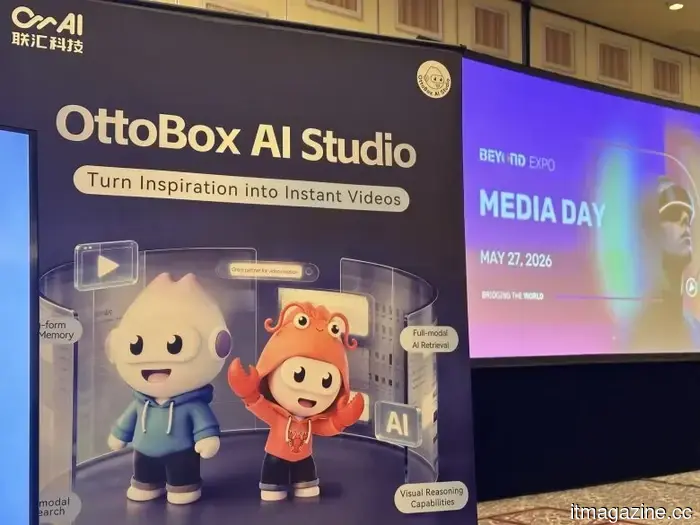
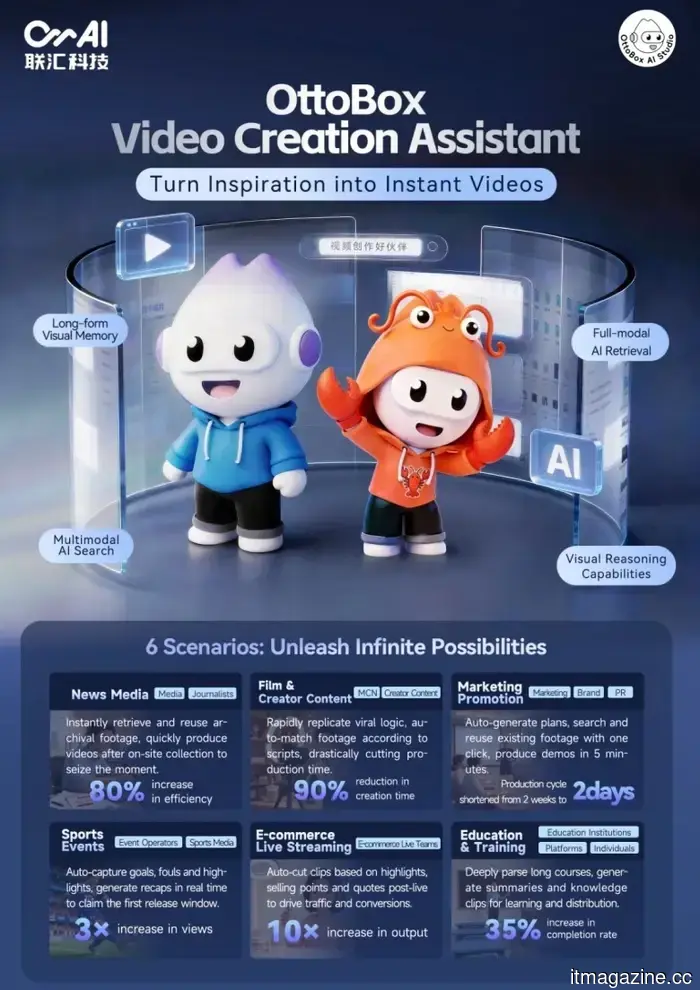
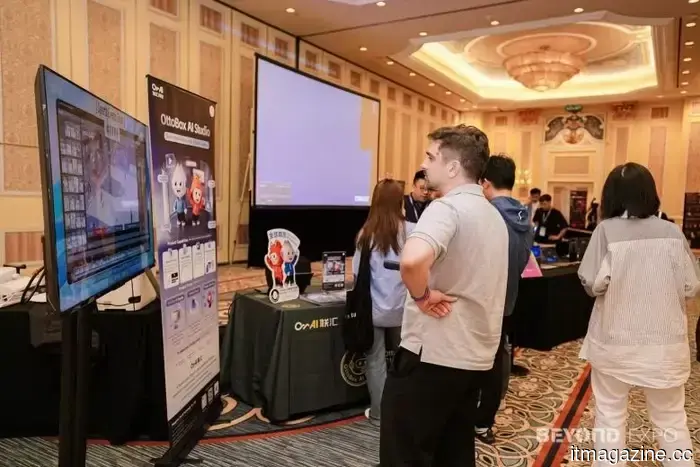
During the media day at BEYOND Expo 2026, Om AI Technology introduced its AI-native content creation tool, OttoBox AI Studio. Tailored for media professionals and content creators, it utilizes local AI computing power to offer features such as video analysis, asset matching, script generation, and expedited video production. The company positions this as a content creation partner for the AI-native era aimed at enhancing creative efficiency.
In contrast to many AI firms that evolve from general-purpose models into application layers, Om AI adopts a more industry-oriented approach from the start. The team has extensive experience in the media and audiovisual sectors, which influences their focus on developing models that address real-world issues rather than forcing applications into pre-existing frameworks.
Dr. Zhao Tiancheng, CEO of Om AI, remarked that their extensive industry experience facilitates faster model deployment and grants them access to substantial high-quality real-world data. They believe that true multimodal capability encompasses an understanding of video, audio, and text simultaneously, not merely the recognition of images and text.
A significant technical emphasis for the company is on video understanding with low-parameter models. Unlike traditional methods that depend on high parameter counts and cloud-based GPU resources, Om AI focuses on a compact, accurate, and efficient edge-model strategy. By minimizing model size, AI can operate directly on local devices, thereby lowering inference costs and reducing the need for data uploads, while also alleviating concerns related to data security and privacy for enterprises.
This edge deployment benefit is especially noteworthy in extensive video analysis contexts. The company asserts that its models can achieve millisecond-level inference speeds, making them well-suited for real-time applications such as security, industrial inspection, and AIoT analytics. Currently, Om AI's AI initiatives encompass three primary areas: AI PCs, AIoT, and embodied intelligence. Besides partnerships with major companies like Apple, Lenovo, and HP, its models are implemented in robots, robotic dogs, and drones, enabling these devices to make autonomous decisions and take actions.
Om AI is also investigating inclusive AI solutions. For instance, its Homer App, aimed at visually impaired users, allows for object search and assisted navigation through smartphones or AI glasses.
The premier version of OttoBox AI Studio has forged strong partnerships with leading PC manufacturers such as Apple, Lenovo, and HP, solidifying its role in the AI PC market and offering professional users an immediate, ready-to-use experience. This year, the company’s primary strategic focus is on launching its next-generation edge multimodal model VLX, which seeks to further enhance video comprehension and decision-making while consistently decreasing operational costs. As the AI sector transitions from cloud-centric competition to on-device deployment, companies like Om AI are poised to be significant drivers of real-world multimodal AI adoption.
Jessie Wu is a tech journalist based in Shanghai, specializing in consumer electronics, semiconductors, and the gaming industry for TechNode. You can reach her via e-mail: jessie.wu@technode.com.

Other articles
 Xiaomi could be looking to adopt Samsung's anti-snoop feature, but without the costly display technology.
Xiaomi is said to be working on a Privacy Display-like feature for HyperOS 4, allowing users to prevent screen snooping without relying on Samsung's latest hardware.
Xiaomi could be looking to adopt Samsung's anti-snoop feature, but without the costly display technology.
Xiaomi is said to be working on a Privacy Display-like feature for HyperOS 4, allowing users to prevent screen snooping without relying on Samsung's latest hardware.
 At the BEYOND Expo 2026, the CEO of XREAL forecasts a groundbreaking moment for AI glasses, comparable to the launch of the iPhone.
As large AI models quickly integrate with wearable technology, smart glasses are once again capturing the attention of the tech sector. This includes AI glasses from Meta.
At the BEYOND Expo 2026, the CEO of XREAL forecasts a groundbreaking moment for AI glasses, comparable to the launch of the iPhone.
As large AI models quickly integrate with wearable technology, smart glasses are once again capturing the attention of the tech sector. This includes AI glasses from Meta.
 Xiaomi might be aiming to replicate Samsung's anti-snoop feature, but without the costly display technology.
Xiaomi is said to be working on a Privacy Display-like feature for HyperOS 4, which will allow users to prevent screen peeking without the necessity of Samsung's new hardware.
Xiaomi might be aiming to replicate Samsung's anti-snoop feature, but without the costly display technology.
Xiaomi is said to be working on a Privacy Display-like feature for HyperOS 4, which will allow users to prevent screen peeking without the necessity of Samsung's new hardware.
 At BEYOND Expo 2026, the CEO of XREAL anticipates a pivotal moment for AI glasses akin to that of the iPhone.
As large AI models quickly integrate with wearable technology, smart glasses are once again at the center of attention for the tech industry. This includes Meta’s AI glasses.
At BEYOND Expo 2026, the CEO of XREAL anticipates a pivotal moment for AI glasses akin to that of the iPhone.
As large AI models quickly integrate with wearable technology, smart glasses are once again at the center of attention for the tech industry. This includes Meta’s AI glasses.
 From video comprehension to edge implementation, Om AI aims for practical AI solutions.
In the ongoing phase where competition among large models is transitioning from the scale of parameters to actual deployment effectiveness, a number of Chinese companies
From video comprehension to edge implementation, Om AI aims for practical AI solutions.
In the ongoing phase where competition among large models is transitioning from the scale of parameters to actual deployment effectiveness, a number of Chinese companies
From video comprehension to edge deployment, Om AI focuses on practical applications of artificial intelligence.
In the present stage, as the competition among large models transitions from focusing on parameter scale to practical deployment ability, a coalition of Chinese firms...