
Google unveils the Gemini Spark agentic AI assistant during I/O 2026.
Google has introduced Gemini Spark, a constantly available personal AI assistant capable of receiving tasks through a specific Gmail address, browsing the internet via Chrome, and operating continuously without the need for users to keep their laptops powered on. The announcement was made at the I/O 2026 developer conference on Monday, framing it as Google's most ambitious effort in the competitive landscape of autonomous digital assistants.
Gemini Spark is constructed on the Gemini 3.5 architecture and utilizes the Antigravity agent harness, which is Google's enhanced framework for developing agentic software. It operates on dedicated virtual machines within Google Cloud, allowing it to carry out prolonged tasks in the background without monopolizing a user's device. CEO Sundar Pichai referred to it as a "personal AI agent that helps you navigate your digital life."
A key characteristic of the product is its seamless integration with Google’s ecosystem. Users can communicate with Spark through a dedicated Gmail address, similar to messaging a human co-worker, and the assistant can derive context from Gmail, Google Docs, and other Workspace applications without any manual configuration. This inherent connectivity gives Google a structural advantage over competitors whose agents depend on third-party integrations to access similar services.
Josh Woodward, VP of the Gemini app, Google Labs, and AI Studio, has overseen the product's development. Under his guidance, the Gemini app now has over 900 million users across 230 countries. Additionally, Spark supports the Model Context Protocol (MCP), an open standard enabling it to connect with various external services beyond Google’s offerings.
On mobile devices, users will be able to track the activities of their assistant through Android Halo, a new notification feature that displays live status updates at the top of the phone screen. Google has stated that Halo will launch later this year with Android 17, essentially transforming the operating system into a dashboard for continuous AI agents.
This launch comes amid a surge of competing agent-based products. OpenAI recently combined ChatGPT and Codex into a single platform under co-founder Greg Brockman, while Anthropic’s Claude Cowork allows users to delegate tasks that the AI then completes by controlling a desktop. Salesforce has also entered the competition by evolving Slackbot into an agentic system with over 30 new AI features.
Google believes its differentiating factor lies in the depth of integration. Given its control over the operating system, browser, email client, and cloud infrastructure, Spark can seamlessly function across all these layers without the challenges that standalone agents encounter when trying to coordinate different tools. The effectiveness of this advantage will be determined by Spark's performance once it transitions from Google's internal testing.
Currently, Gemini Spark is being tested internally at Google, with plans to launch it as a beta for Google AI Ultra subscribers in the United States next week. The AI Ultra tier, which Google has also lowered from $250 to $100 per month, offers five times the usage limits of the existing AI Pro plan, alongside 20 terabytes of cloud storage and YouTube Premium.
Other articles
 Google substitutes the search box with AI agents at I/O 2026.
At I/O 2026, Google revealed its most significant Search overhaul in 25 years, featuring information agents, a generative user interface, and mini-apps driven by Gemini 3.5 Flash.
GitLab reduces its workforce by 7% as part of a restructuring in the 'agentic era'.
GitLab reduces its workforce, decreases its presence in various countries by 30%, and restructures its R&D into 60 independent teams as CEO Bill Staples invests in AI agents for software development.
Google substitutes the search box with AI agents at I/O 2026.
At I/O 2026, Google revealed its most significant Search overhaul in 25 years, featuring information agents, a generative user interface, and mini-apps driven by Gemini 3.5 Flash.
GitLab reduces its workforce by 7% as part of a restructuring in the 'agentic era'.
GitLab reduces its workforce, decreases its presence in various countries by 30%, and restructures its R&D into 60 independent teams as CEO Bill Staples invests in AI agents for software development.
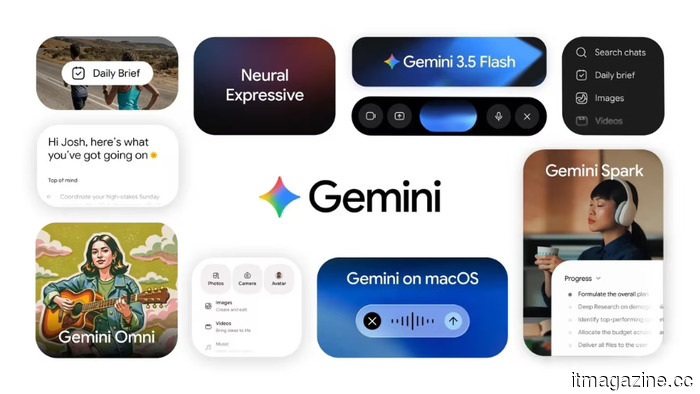 Google Gemini introduces Daily Brief and a redesign of Neural Expressive at I/O 2026.
At I/O 2026, Google introduces Daily Brief, a redesigned Neural Expressive, and a Spark AI agent for Gemini's 900 million users, intensifying its competition with ChatGPT and Claude.
Google Gemini introduces Daily Brief and a redesign of Neural Expressive at I/O 2026.
At I/O 2026, Google introduces Daily Brief, a redesigned Neural Expressive, and a Spark AI agent for Gemini's 900 million users, intensifying its competition with ChatGPT and Claude.
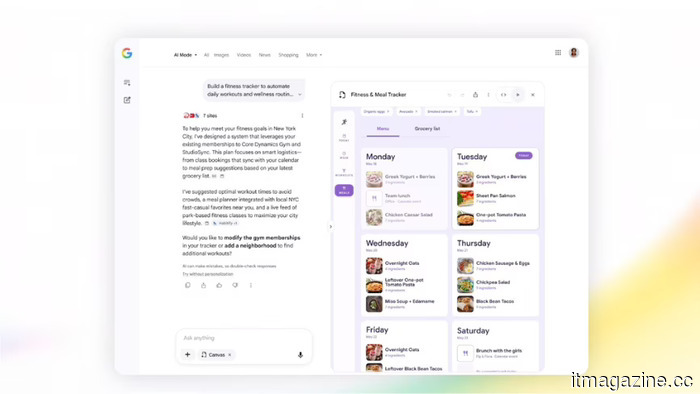 Google introduces always-on information agents in Search during I/O 2026.
Google's updated information agents operate around the clock in AI Mode, consolidating news, monitoring prices, and sending alerts, thereby replacing the previous Google Alerts system with intelligent AI.
Google introduces always-on information agents in Search during I/O 2026.
Google's updated information agents operate around the clock in AI Mode, consolidating news, monitoring prices, and sending alerts, thereby replacing the previous Google Alerts system with intelligent AI.
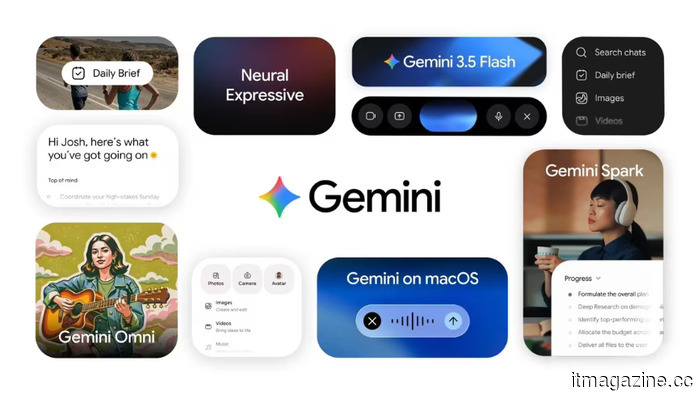 At I/O 2026, Google Gemini introduces Daily Brief and a redesign of Neural Expressive.
At I/O 2026, Google introduced Daily Brief, a redesigned Neural Expressive, and the Spark AI agent for Gemini's 900 million users, intensifying its competition with ChatGPT and Claude.
At I/O 2026, Google Gemini introduces Daily Brief and a redesign of Neural Expressive.
At I/O 2026, Google introduced Daily Brief, a redesigned Neural Expressive, and the Spark AI agent for Gemini's 900 million users, intensifying its competition with ChatGPT and Claude.
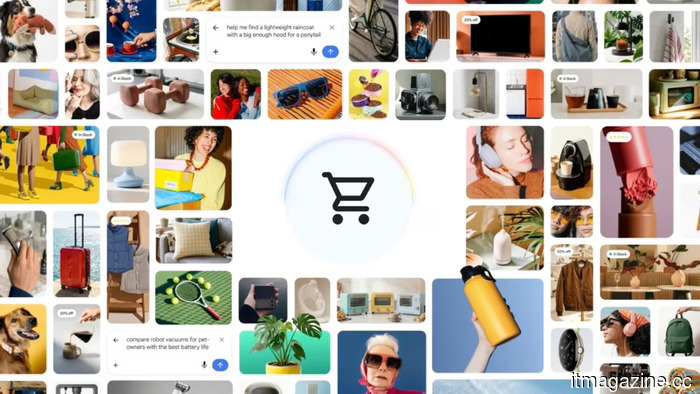 Google introduces Universal Cart and enhances AP2 at I/O 2026.
Google introduced Universal Cart, an AI shopping center that integrates Search, Gemini, YouTube, and Gmail, while also updating its Agent Payments Protocol for automated purchases.
Google introduces Universal Cart and enhances AP2 at I/O 2026.
Google introduced Universal Cart, an AI shopping center that integrates Search, Gemini, YouTube, and Gmail, while also updating its Agent Payments Protocol for automated purchases.
Google unveils the Gemini Spark agentic AI assistant during I/O 2026.
At I/O 2026, Google introduced Gemini Spark, an AI agent that is always active and can handle tasks through Gmail, navigate in Chrome, and operates continuously on cloud VMs for AI Ultra subscribers.