
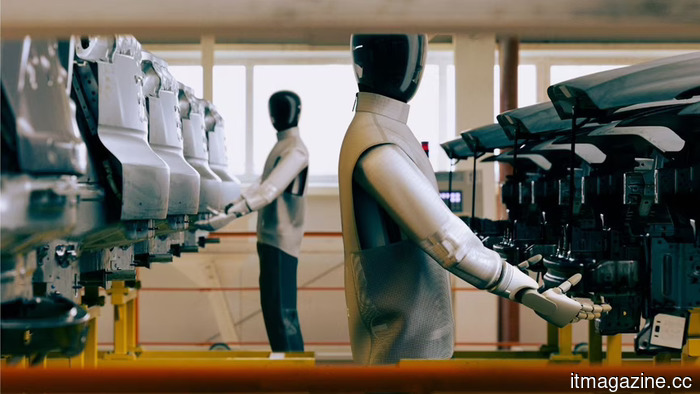
Barclays reports that humanoid robots could compensate for 60% of the 37 million worker shortage in China by the year 2035.
The new report from the British bank suggests that humanoid robots could compensate for 60% of the anticipated decline in the labor force by 2035, with an expected decrease of 37 million in China's workforce over the next decade. This would require the deployment of up to 24 million humanoid robots.
Barclays released a research note that indicates the introduction of humanoid robots in China could counterbalance as much as 60% of the country's forecasted labor-force reduction by 2035.
The calculations behind this estimate provide clarity on the issue. According to Barclays’ demographic projections, with an assumed 65% participation rate, China’s working-age population is likely to decrease by 37 million within the next ten years.
Manufacturing constitutes about a quarter of China's economy, so a drop of 37 million workers is framed by the bank as an urgent industrial risk rather than a slow-acting demographic issue. It presents a challenge that is expected to manifest within a decade.
The broader Barclays report titled "Robots Roll Out, Economies Rewire" assesses that China would need nearly 24 million humanoid robots integrated into the workforce by the mid-2030s, which corresponds to roughly 4% of the nation’s current labor force, to address the projected output gap instead of merely replacing nominal employment.
What makes the Barclays report noteworthy is the production realities on which the analysts are basing their assumptions. China has become the center of the global humanoid-robot supply chain, as measured by all available shipping metrics.
In 2025, Unitree shipped around 5,500 humanoid units, outperforming any other global manufacturer; Agibot from Shanghai followed with 5,168 units, while UBTech produced approximately 1,000. The Chinese government has set a target through MIIT for the integration of humanoids into manufacturing supply chains by 2027, with a goal for a domestic humanoid-robot market worth 300 billion yuan ($41 billion) by 2035.
The figure of ‘up to 24 million robots’ that Barclays cites represents a maximum substitution estimate rather than a baseline projection. Research from MERICS on China's embodied AI strategy provides greater context.
The bank’s forecast operates under the assumption of a continued decline in costs for humanoid units (with Unitree’s industrial models already available for under $20,000 in some configurations), ongoing government support for pilot programs collaborating humanoid-robot firms with state-owned enterprises, and the continuation of the existing 6-8% annual wage growth in manufacturing in eastern China, fueling the basis for automation.
However, the note becomes more cautious regarding the customer side of the supply chain. According to current independent surveys, the Chinese humanoid market is served by over 150 active manufacturers, but only 23% of customers report being satisfied with their purchases.
The operational data prompts a reality check, indicating that Barclays' need for a 24-million-unit rollout to achieve a 60% offset faces commercial readiness challenges that the existing supply curve does not evidently resolve.
The geopolitical and corporate context forms the third component. Tesla's Optimus program is reportedly ramping up production at the Shanghai Gigafactory, with the third-generation humanoid making its debut at AWE 2026 in Shanghai this year.
The competitive scenario described in the Barclays report suggests that Chinese humanoids are not only set to replace human workers in China but also to compete against Western humanoid options (such as Tesla Optimus and Figure 02, 1X Neo) for factory floor deployment opportunities.
The cost differences observed at an industrial scale, based on unit economics data available over the last two quarters, act as the key driver.
From a macroeconomic perspective, Barclays presents a uniquely Chinese argument. While the trade-off between labor-force decline and automation occurs in Japan, South Korea, Germany, and many Eastern European nations, China stands out as the only major economy experiencing (a) demographic decline on such a large scale, (b) domestic robot-production capabilities, and (c) a policy framework actively linking these two elements. The Barclays report serves as the formal sell-side explanation of the significance of this combination at the level of economic forecasts.
However, the report does not address the distinction between absorbed and displaced labor. A humanoid robot replacing a production line worker is considered a productivity gain in formal terms. The 60% offset figure presupposes that the remaining 40% of the labor-force decline can be absorbed by the rest of the Chinese economy.
The two-decade demographic timeline used by Barclays is adequate to make this assumption viable at a macroeconomic level. Conversely, at the social policy level, this same assumption is a critical question that Beijing's planning agencies will be addressing throughout the decade.
Other articles
 Sony no longer aims for “PlayStation exclusive” games to be released on PC.
According to reports, Sony is reducing its PC releases of significant single-player PlayStation titles, indicating a considerable change in strategy following years of growth in the PC market.
Sony no longer aims for “PlayStation exclusive” games to be released on PC.
According to reports, Sony is reducing its PC releases of significant single-player PlayStation titles, indicating a considerable change in strategy following years of growth in the PC market.
 The Apple Watch may soon introduce a new feature for sensing blood pressure.
The Apple Watch currently alerts users regarding potential hypertension, but Apple could be developing a more sophisticated blood pressure function for its upcoming premium model.
The Apple Watch may soon introduce a new feature for sensing blood pressure.
The Apple Watch currently alerts users regarding potential hypertension, but Apple could be developing a more sophisticated blood pressure function for its upcoming premium model.
 The 100W INIU Cougar P63 may serve as a substitute for your bulky charger during travel, work, and gaming.
With the rapid demands of remote work, constant travel, and gaming, the worry about battery life has become increasingly difficult to overlook. To address this concern, the INIU Cougar P63 presents a new solution with its lightweight 100W 25,000mAh power bank, which offers effortless charging for laptops, creative equipment, and gaming gadgets without adding the weight of another cumbersome charging brick to your bag.
The 100W INIU Cougar P63 may serve as a substitute for your bulky charger during travel, work, and gaming.
With the rapid demands of remote work, constant travel, and gaming, the worry about battery life has become increasingly difficult to overlook. To address this concern, the INIU Cougar P63 presents a new solution with its lightweight 100W 25,000mAh power bank, which offers effortless charging for laptops, creative equipment, and gaming gadgets without adding the weight of another cumbersome charging brick to your bag.
 Hypershell secures an additional $50 million in a $120 million Series B round as consumer exoskeletons move beyond a niche market.
Hypershell has secured $50 million in a Series B+ round co-led by Ant Group and Meituan Dragonball, with Sofina and Granite Asia participating as well. The total funding for the Series B has reached $120 million, valuing the company at nearly $400 million ahead of the X-Series launch on Wednesday.
Hypershell secures an additional $50 million in a $120 million Series B round as consumer exoskeletons move beyond a niche market.
Hypershell has secured $50 million in a Series B+ round co-led by Ant Group and Meituan Dragonball, with Sofina and Granite Asia participating as well. The total funding for the Series B has reached $120 million, valuing the company at nearly $400 million ahead of the X-Series launch on Wednesday.
 This 100W INIU Cougar P63 Might Be a Compact Alternative to Your Bulky Charger for Travel, Work, and Gaming.
With the rapid demands of remote work, travel, and gaming, battery anxiety has become increasingly difficult to overlook. Addressing this concern, the INIU Cougar P63 presents a new solution in the form of its compact 100W 25,000mAh power bank, which provides effortless charging for laptops, creator equipment, and gaming gadgets without adding the bulk of another charging brick to your bag.
This 100W INIU Cougar P63 Might Be a Compact Alternative to Your Bulky Charger for Travel, Work, and Gaming.
With the rapid demands of remote work, travel, and gaming, battery anxiety has become increasingly difficult to overlook. Addressing this concern, the INIU Cougar P63 presents a new solution in the form of its compact 100W 25,000mAh power bank, which provides effortless charging for laptops, creator equipment, and gaming gadgets without adding the bulk of another charging brick to your bag.
 Nintendo rises 6.8% as Japanese investors shift away from AI.
Nintendo's stock rose by as much as 6.8% on Tuesday, marking the third consecutive day of increases, while Bandai Namco and Konami each saw gains exceeding 9%, as Japanese investors shifted their focus away from AI-related companies.
Nintendo rises 6.8% as Japanese investors shift away from AI.
Nintendo's stock rose by as much as 6.8% on Tuesday, marking the third consecutive day of increases, while Bandai Namco and Konami each saw gains exceeding 9%, as Japanese investors shifted their focus away from AI-related companies.
Barclays reports that humanoid robots could compensate for 60% of the 37 million worker shortage in China by the year 2035.
According to Barclays, the use of humanoid robots in China might compensate for up to 60% of the anticipated decline of 37 million workers in the labor force by 2035, necessitating the deployment of as many as 24 million humanoid robots.