
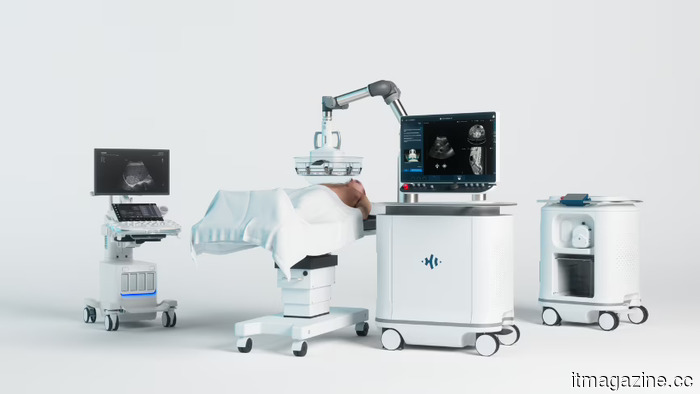
HistoSonics has obtained TFDA approval in Taiwan for its Edison Histotripsy System, boosting its expansion efforts in Asia.
HistoSonics has obtained approval from Taiwan’s Food and Drug Administration for its Edison Histotripsy System, a non-invasive focused ultrasound technology designed to eliminate tumors without the need for cuts or radiation. Valued at $2.25 billion, the company is expanding its presence in Asia while seeking authorization from the US FDA for treating kidney tumors.
The TFDA approval, announced on May 18, represents a significant milestone in HistoSonics’ Asian expansion, adding Taiwan to an expanding roster of markets where the technology is commercially available. This approval comes after a review process that concluded with unanimous agreement among committee members. HistoSonics has already established a clinical footprint in Taiwan, with the National Taiwan University Hospital being the first institution in the country to install the system, where doctors have successfully treated patients under research protocols and achieved one of the fastest global clinical adoption rates.
Histotripsy is a non-thermal mechanical technique that utilizes accurately focused sound waves to induce controlled acoustic cavitation—creating microscopic bubbles that expand and collapse forcefully, thereby destroying targeted tissue at a subcellular level. Unlike thermal ablation methods that burn tumors or radiation therapy that harms DNA, histotripsy mechanically liquefies tissue without heating the surrounding areas, allowing the body’s immune system to naturally absorb and eliminate the destroyed tissue.
HistoSonics developed the Edison system over more than 20 years, building on research from the University of Michigan. In October 2023, the system received its initial US FDA De Novo approval for non-invasive destruction of liver tumors, including those that cannot be surgically removed. This made Edison the sole histotripsy platform available in the United States. One year of clinical data from principal trials indicates a 90% tumor control rate, which has garnered interest from oncologists treating patients who are not candidates for surgery.
The technology is part of a rapidly growing field where AI and advanced technology are transforming healthcare, though histotripsy is unique as it represents a physical intervention with demonstrable clinical outcomes rather than being a software-based diagnostic solution. Its sound-based mechanism allows for potential outpatient treatments with minimal recovery times, appealing to healthcare systems looking to reduce costs and shorten hospital stays.
HistoSonics, established in 2009 in Ann Arbor, Michigan, is not a fledgling startup. In August 2025, the company was valued at $2.25 billion when a group of investors, including K5 Global, Bezos Expeditions, and Wellington Management, acquired a majority share. This deal appointed CEO Mike Blue as the board chairman and was followed two months later by a highly subscribed $250 million growth financing round led by K5 Global, joined by Thiel Bio and Founders Fund. Overall, the company has raised over $560 million from 11 funding rounds.
The list of investors resembles a who's who of tech-related capital, with Jeff Bezos’s investment firm and Peter Thiel’s biotech fund representing unconventional sources for medtech backing. Their involvement suggests a belief that histotripsy is a foundational technology with potential applications beyond liver treatment, including kidney, pancreatic, and prostate tumors. Samsung’s acquisition of French AI ultrasound startup Sonio for €86 million exemplifies a broader trend of large tech and healthcare companies investing in ultrasound-based technologies, albeit HistoSonics’ therapeutic application is more ambitious than simple diagnostic imaging.
The TFDA approval is strategically important for two key reasons: Taiwan boasts a sophisticated healthcare system and strong institutional research capabilities, making it an ideal location for generating clinical data that other Asian regulatory bodies will seek. Furthermore, this approval aligns with HistoSonics' aim to achieve multiple regulatory and clinical milestones concurrently.
Taipei Veterans General Hospital has already procured an Edison system, with its director comparing the technology to a legendary weapon and announcing intentions to provide free treatment to 50 liver cancer patients within six months as part of clinical trials. This acquisition was reportedly inspired by Hong Kong billionaire Li Ka-shing’s donation of a histotripsy system to the University of Hong Kong in 2024, highlighting how philanthropic actions can expedite commercial adoption in new markets.
HistoSonics plans to enhance collaborations with physicians and institutions across Taiwan and the Asia-Pacific region, emphasizing the production of clinical data, expanding treatment indications through research, and developing training programs for medical professionals. The company claims to have treated over 2,000 patients at more than 50 active centers globally.
A week prior to Taiwan's approval, on May 11, HistoSonics submitted a De Novo application to the US FDA to broaden the Edison system’s indication for kidney tumors. This request is backed by the HOPE4KIDNEY pivotal trial, which enrolled 67 patients and finished recruitment in June 2025. CEO Mike Blue characterized this application as a crucial step in extending histotripsy’s applications beyond liver tumors and into the kidney sector, which seeks organ-preserving and nephron-sparing options for patients.
The kidney
Other articles
 Do you long for the classic PC days? This website allows you to navigate Wikipedia as if you’re using Windows XP.
A new web project transforms Wikipedia into a Windows XP-style desktop, allowing categories, articles, and Wikimedia Commons to resemble folders that can be browsed instead of just pages to search through.
Omnia and Casa dos Ventos finalize a $2 billion power agreement to support TikTok's data center in Brazil.
Omnia and Casa dos Ventos have finalized a renewable-energy supply agreement worth approximately $2 billion, which will support TikTok's $9.8 billion data center in Pecém, Ceará, marking ByteDance's inaugural dedicated facility in Latin America.
Do you long for the classic PC days? This website allows you to navigate Wikipedia as if you’re using Windows XP.
A new web project transforms Wikipedia into a Windows XP-style desktop, allowing categories, articles, and Wikimedia Commons to resemble folders that can be browsed instead of just pages to search through.
Omnia and Casa dos Ventos finalize a $2 billion power agreement to support TikTok's data center in Brazil.
Omnia and Casa dos Ventos have finalized a renewable-energy supply agreement worth approximately $2 billion, which will support TikTok's $9.8 billion data center in Pecém, Ceará, marking ByteDance's inaugural dedicated facility in Latin America.
 Experts are concerned that as AI becomes more intelligent, we may become less so.
As AI transforms intelligence into a service that is available on demand, specialists caution that immediate responses may diminish the curiosity, critical examination, and source verification behaviors that enhance human thinking.
Experts are concerned that as AI becomes more intelligent, we may become less so.
As AI transforms intelligence into a service that is available on demand, specialists caution that immediate responses may diminish the curiosity, critical examination, and source verification behaviors that enhance human thinking.
 Pope Leo XIV will release the AI encyclical titled Magnifica Humanitas on May 25, featuring Anthropic co-founder Christopher Olah.
The encyclical, issued on the 135th anniversary of Rerum Novarum, is anticipated to denounce the use of AI in warfare and discuss its effects on workers' rights. Olah is at the forefront of interpretability research at Anthropic.
Pope Leo XIV will release the AI encyclical titled Magnifica Humanitas on May 25, featuring Anthropic co-founder Christopher Olah.
The encyclical, issued on the 135th anniversary of Rerum Novarum, is anticipated to denounce the use of AI in warfare and discuss its effects on workers' rights. Olah is at the forefront of interpretability research at Anthropic.
 Grafana Labs rejects ransom demand after hackers obtain code that is already open source.
Grafana Labs has revealed that hackers obtained its source code by exploiting a compromised GitHub token and have requested a ransom.
Omnia and Casa dos Ventos have signed a $2 billion power agreement to support TikTok's data center in Brazil.
Omnia and Casa dos Ventos have entered into a renewable energy supply agreement valued at approximately $2 billion, which will support TikTok's $9.8 billion data center in Pecém, Ceará, marking ByteDance's first dedicated facility in Latin America.
Grafana Labs rejects ransom demand after hackers obtain code that is already open source.
Grafana Labs has revealed that hackers obtained its source code by exploiting a compromised GitHub token and have requested a ransom.
Omnia and Casa dos Ventos have signed a $2 billion power agreement to support TikTok's data center in Brazil.
Omnia and Casa dos Ventos have entered into a renewable energy supply agreement valued at approximately $2 billion, which will support TikTok's $9.8 billion data center in Pecém, Ceará, marking ByteDance's first dedicated facility in Latin America.
HistoSonics has obtained TFDA approval in Taiwan for its Edison Histotripsy System, boosting its expansion efforts in Asia.
The non-invasive focused ultrasound technology eliminates liver tumors without the need for surgery or radiation. Supported by Bezos Expeditions and valued at $2.25 billion, HistoSonics also filed with the FDA for kidney tumors on May 11.