
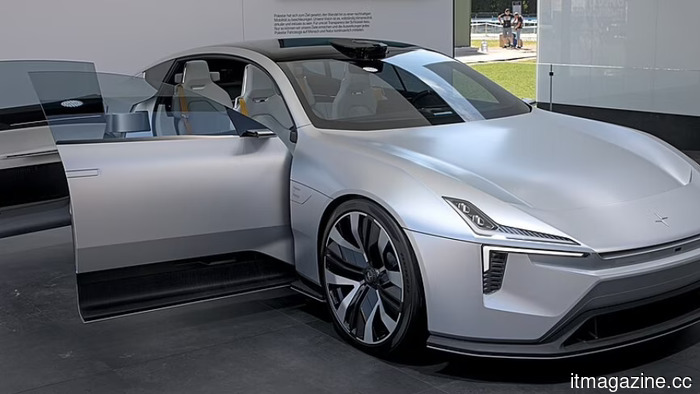
Polestar's CEO claims that 'pump anxiety' is fueling the demand for electric vehicles as fuel prices rise due to the war in Iran.
Polestar CEO Michael Lohscheller mentioned to CNBC that "pump anxiety" has overtaken range anxiety as the primary concern for consumers, driven by increasing fuel prices due to the Iran war and the closure of the Strait of Hormuz, leading to a notable increase in electric vehicle (EV) demand. In March, EV registrations in the EU rose by 51%. Polestar also reported a widening net loss of $383 million for Q1, while revenue remained steady at $633 million, despite record deliveries of 13,126 vehicles. The company's gross margins turned negative due to factors like pricing pressure, tariffs, and currency fluctuations.
For years, range anxiety was the major issue in the electric vehicle market. However, according to Lohscheller, consumer focus has shifted to the cost of fuel, as he introduced the term “pump anxiety” to reflect this change. The context is clear: following US and Israeli strikes on Iran on February 28, the Strait of Hormuz has been largely closed to commercial shipping, causing Brent crude prices to exceed $100 per barrel. In the UK, prices for petrol have jumped by over 25 pence per litre since early March, with diesel prices increasing nearly 45 pence, according to RAC Fuel Watch. Several markets in the EU are now seeing petrol prices above €2 per litre, prompting a widespread reevaluation of driving costs.
Lohscheller claims that the cost dynamics have shifted significantly. He noted that previously people leaned towards EVs for idealistic reasons, but now financial considerations dominate their choices. This assertion is backed by data showing a 51% increase in EU electric vehicle registrations in March compared to the previous year, with Italy experiencing a 65.7% rise and Germany at 41.3%. In the UK, Polestar's market, both Chinese and European EV manufacturers are reporting increased online inquiries and test-drive requests.
However, this trend isn't consistent across all regions. In the US, where petrol prices have surpassed $4 per gallon for the first time in four years, the response has been less pronounced. While used EV sales increased by 12% year-on-year in the first quarter, new EV sales haven't shown a comparable rise. Lohscheller highlighted the withdrawal of federal tax incentives and overall consumer uncertainty as factors limiting demand in the US.
Polestar finds itself under pressure amidst these developments. The company, which operates under Geely and is based in Sweden, reported a net loss of $383 million in the first quarter, significantly higher than the $166 million loss from the same period a year prior. Revenue remained unchanged at $633 million, even with a 7% increase in vehicle deliveries reaching a record 13,126 units. Gross margins fell to negative 3.2% from a positive 10.3% last year, a decline attributed to pricing pressures, tariffs in the EU and US, reduced carbon-credit sales, and unfavorable currency trends due to a weakening yuan.
The financial scenario reflects a paradox within the EV industry. While demand is climbing, competing costs are also increasing. Since Polestar manufactures primarily in China, its vehicles face US and EU tariffs intended to counteract China's production advantages. The company labeled the domestic Chinese market as "hyper competitive" and suggested that Europe needs to accelerate its responses.
Lohscheller, who has led Opel and Vauxhall previously, stated that range anxiety is no longer a concern. The least expensive Polestar 2 now offers 344 miles of range according to the WLTP test cycle, while the dual-motor Polestar 3 SUV reaches 402 miles. Charging an 82-kilowatt-hour Polestar 2 overnight in the UK costs roughly £15, significantly lower than the fuel cost for equivalent petrol vehicles at current rates.
However, the lower operational costs have not yet alleviated the apprehension about purchasing. Lohscheller acknowledged that the resale values of EVs remain problematic, trailing behind those of internal combustion vehicles. Market pressures from manufacturers needing to comply with the UK’s zero-emission vehicle quotas have led to aggressive pricing strategies that further depress used EV values. "I'm asking for stability," he noted regarding the regulatory landscape, expressing that frequent changes in rules are unhelpful.
The impact of rising fuel prices is transforming automotive markets beyond Polestar’s segment. In March alone, BYD exported over 120,000 electric and hybrid vehicles, marking a 65% increase year-on-year. Renault has indicated that the conflict in the Middle East has initiated a "seismic shift" in EV adoption. The head of the International Energy Agency, Fatih Birol, remarked that countries may turn to renewables to mitigate geopolitical risks, calling the disruption in Hormuz the largest supply disturbance in the history of the global oil market.
Ironically, the crisis that could hasten the shift to electric vehicles may also hinder the companies leading it. Increased energy costs elevate production expenses. Tariff barriers heighten competition costs across
Other articles
 Palantir is experiencing a departure of investors and a rejection from the German military as its narrative begins to unravel.
Retail investors sold off $82 million worth of Palantir shares as they shifted their focus to memory chips, while Germany removed the company from its defense cloud. Karp referred to the discussion as 'witchcraft'.
Palantir is experiencing a departure of investors and a rejection from the German military as its narrative begins to unravel.
Retail investors sold off $82 million worth of Palantir shares as they shifted their focus to memory chips, while Germany removed the company from its defense cloud. Karp referred to the discussion as 'witchcraft'.
 Framework is increasing the prices of RAM and storage modules once more.
The monthly pricing update from Framework has arrived, and storage is experiencing the largest decrease. The low-cost 2025 inventory is almost depleted, and a complete price revision will take place next month.
Framework is increasing the prices of RAM and storage modules once more.
The monthly pricing update from Framework has arrived, and storage is experiencing the largest decrease. The low-cost 2025 inventory is almost depleted, and a complete price revision will take place next month.
 OpenAI is gearing up for legal action against Apple as the collaboration between ChatGPT and Siri falls apart.
OpenAI claims that Apple has hidden ChatGPT within Siri and did not actively promote it. Currently, its legal team is exploring breach-of-contract possibilities as Apple introduces Claude and Gemini in iOS 27.
OpenAI is gearing up for legal action against Apple as the collaboration between ChatGPT and Siri falls apart.
OpenAI claims that Apple has hidden ChatGPT within Siri and did not actively promote it. Currently, its legal team is exploring breach-of-contract possibilities as Apple introduces Claude and Gemini in iOS 27.
 Meta is experimenting with an AI bot aimed at replicating the same online foolishness that AskGrok has on X.
Meta is experimenting with an AI bot on Threads that functions similarly to Grok on X, interacting publicly with user mentions during discussions.
Meta is experimenting with an AI bot aimed at replicating the same online foolishness that AskGrok has on X.
Meta is experimenting with an AI bot on Threads that functions similarly to Grok on X, interacting publicly with user mentions during discussions.
 Flo Health introduces perimenopause resources as a survey reveals that 66% of women felt better equipped for puberty.
Flo Health's new perimenopause suite aims at a user base of 80 million, offering symptom assessments, timeline monitoring, and relief solutions. A Wakefield survey revealed that the majority of women feel less equipped to handle perimenopause compared to puberty.
Flo Health introduces perimenopause resources as a survey reveals that 66% of women felt better equipped for puberty.
Flo Health's new perimenopause suite aims at a user base of 80 million, offering symptom assessments, timeline monitoring, and relief solutions. A Wakefield survey revealed that the majority of women feel less equipped to handle perimenopause compared to puberty.
 Thrive Capital invests $100 million in Shopify, taking a rare public-market gamble on AI commerce.
Joshua Kushner's Thrive Capital, an investor in OpenAI and SpaceX, has acquired a $100 million stake in Shopify while the stock is currently 40% lower than its peak for the year. The rationale behind this investment is the belief that AI will transform commerce.
Thrive Capital invests $100 million in Shopify, taking a rare public-market gamble on AI commerce.
Joshua Kushner's Thrive Capital, an investor in OpenAI and SpaceX, has acquired a $100 million stake in Shopify while the stock is currently 40% lower than its peak for the year. The rationale behind this investment is the belief that AI will transform commerce.
Polestar's CEO claims that 'pump anxiety' is fueling the demand for electric vehicles as fuel prices rise due to the war in Iran.
The CEO of Polestar states that elevated fuel prices have shifted the focus of EVs to financial concerns. While EU registrations saw a 51% increase in March, the company's losses for the first quarter expanded to $383 million.