
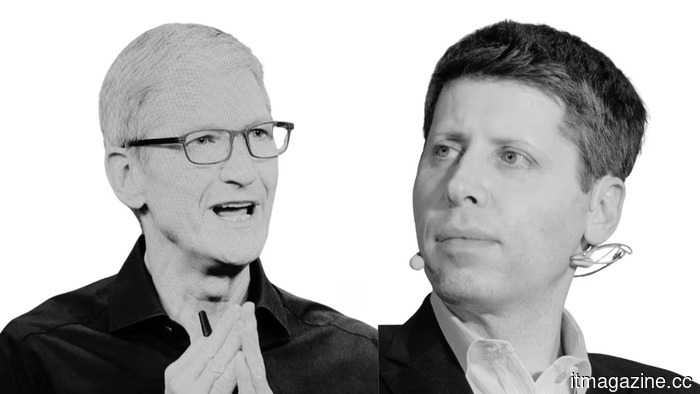
OpenAI is gearing up for legal action against Apple as the collaboration between ChatGPT and Siri falls apart.
**TL;DR** OpenAI is considering potential legal action against Apple regarding their two-year-old ChatGPT-Siri collaboration, which OpenAI claims has not generated the anticipated subscription revenue. Lawyers for OpenAI are consulting with an external firm on options, which may include sending a breach-of-contract notice. OpenAI expected the partnership to yield billions annually; however, Apple’s implementation of ChatGPT has been obstructive, leading users to prefer the standalone app. Meanwhile, Apple is opening iOS 27 to competing AI models (Claude, Gemini), has signed a $1 billion yearly deal with Google for Siri's core AI, and settled a $250 million class action lawsuit over misleading AI features. OpenAI's acquisition of Jony Ive's device startup introduces a hardware rivalry to the existing legal tensions.
OpenAI's partnership with Apple, which was announced with much excitement in June 2024, is deteriorating. According to Bloomberg sources, OpenAI's legal team is exploring options, potentially including a formal breach-of-contract notice. No lawsuit has been initiated yet, and OpenAI still hopes to resolve the issue amicably. However, the company believes that Apple has not adhered to the terms of a deal that was intended to incorporate ChatGPT as a default feature within a highly valuable consumer ecosystem.
The main complaint is about distribution. OpenAI anticipated that integrating ChatGPT into Siri, Writing Tools, and Image Playground would drive many iPhone users toward paid subscriptions, possibly generating billions annually. Instead, Apple's implementation has complicated access, requiring users to specifically mention "ChatGPT" to engage OpenAI's models, with responses given in limited windows. User studies indicate that Apple customers largely prefer the standalone ChatGPT app.
**What went wrong**
The deal was established at a time when Apple was eager to catch up in the generative AI space, granting iPhone users access to ChatGPT results via Siri, enabling text generation, image analysis with Visual Intelligence, and creating images in Image Playground. Apple would take a share of the subscription revenue from these features. OpenAI expected to gain significant visibility within an ecosystem of over a billion active devices.
However, this anticipated visibility did not materialize. An anonymous OpenAI executive informed Bloomberg that Apple had not genuinely promoted the integration. OpenAI now feels that the implementation has negatively impacted its brand, with the limited responses creating a perception of lower capability compared to the full ChatGPT experience.
During initial discussions in 2024, Apple compared the opportunity to its lucrative search deal with Google in Safari, which generates billions for both parties. However, this analogy has proven misguided. The same executive noted that OpenAI was urged to place its trust in Apple, and the result has been disappointing.
**A relationship under pressure from all sides**
The discord with Apple is occurring alongside OpenAI's ongoing legal battle with Elon Musk regarding its transition from a nonprofit to a for-profit organization, which could involve damages of up to $150 billion. OpenAI recently revised its exclusive agreement with Microsoft, limiting revenue-sharing to $38 billion until 2030 and transitioning to a non-exclusive licensing structure that allows it to serve clients on any cloud platform. At the same time, Amazon has increased its investment in Anthropic by an additional $5 billion.
Apple has its own concerns, particularly regarding OpenAI's privacy practices. Furthermore, OpenAI's $6.5 billion acquisition of io, a startup co-founded by former Apple design chief Jony Ive, poses a direct competitive challenge. The company, now operated by former Apple executives Tang Tan and Evans Hankey, is working on an alternative to the iPhone. Apple executives have reportedly expressed frustration over OpenAI recruiting Apple hardware engineers by offering stock packages significantly more lucrative than Apple’s.
According to Bloomberg's sources, any legal action from OpenAI is unlikely before the conclusion of the Musk trial, suggesting that OpenAI is carefully managing its legal exposure to avoid a two-front dispute.
**Apple's shift away from OpenAI**
The partnership's decline coincides with Apple’s intent to reduce OpenAI’s role in its software. iOS 27, set to be revealed at the Worldwide Developers Conference on June 8, will introduce a system called Extensions that allows users to install competing AI chatbots from the App Store and direct Siri queries, text tasks, and image generation through the chosen model. Apple is testing integrations with both Anthropic's Claude and Google's Gemini.
Separately, Apple secured a deal late last year to utilize Google’s Gemini models as the basis for its own AI capabilities, committing around $1 billion annually for a tailored 1.2-trillion-parameter model to enhance Siri. OpenAI was considered for a deeper integration but opted not to participate, feeling dissatisfied with the initial relationship.
An OpenAI executive explained to Bloomberg that the adoption of alternative providers by Apple is not driving the legal conflict because the partnership was never intended to be exclusive. The new Extensions system could even enhance ChatGPT's visibility through a
Другие статьи
 After a misstep with Siri, Apple intends to offer AI agents on the App Store.
Developers lack confidence in Apple's pledge regarding Siri's commission. Apple is unsure of how to effectively approve AI agents securely. With WWDC just three weeks away, a resolution needs to be found.
After a misstep with Siri, Apple intends to offer AI agents on the App Store.
Developers lack confidence in Apple's pledge regarding Siri's commission. Apple is unsure of how to effectively approve AI agents securely. With WWDC just three weeks away, a resolution needs to be found.
 Palantir is experiencing a departure of investors and a rejection from the German military as its narrative begins to unravel.
Retail investors sold off $82 million in Palantir shares as they shifted their focus to memory chips, while Germany removed the company from its defense cloud initiative. Karp refers to the ongoing discussion as 'witchcraft'.
Palantir is experiencing a departure of investors and a rejection from the German military as its narrative begins to unravel.
Retail investors sold off $82 million in Palantir shares as they shifted their focus to memory chips, while Germany removed the company from its defense cloud initiative. Karp refers to the ongoing discussion as 'witchcraft'.
 Dell is introducing Alienware laptops aimed at budget-conscious gamers, even if that involves using older processors.
Dell has introduced the Alienware 15 in conjunction with the Dell 14S and 16S, emphasizing more affordable pricing, AI capabilities, and a well-rounded performance catering to various user groups.
Dell is introducing Alienware laptops aimed at budget-conscious gamers, even if that involves using older processors.
Dell has introduced the Alienware 15 in conjunction with the Dell 14S and 16S, emphasizing more affordable pricing, AI capabilities, and a well-rounded performance catering to various user groups.
 Canva's report indicates that almost all marketers are utilizing AI, yet consumers continue to prefer a personal touch.
Canva's report for 2026 reveals that 97% of marketers utilize AI on a daily basis, yet 78% of consumers favor advertisements created by humans. References to "AI slop" have increased nine times.
Canva's report indicates that almost all marketers are utilizing AI, yet consumers continue to prefer a personal touch.
Canva's report for 2026 reveals that 97% of marketers utilize AI on a daily basis, yet 78% of consumers favor advertisements created by humans. References to "AI slop" have increased nine times.
 Flo Health introduces perimenopause tools following a survey that reveals 66% of women felt better equipped for puberty.
Flo Health's latest perimenopause suite aims at an 80 million user base, offering symptom scoring, timeline monitoring, and options for relief. A survey by Wakefield revealed that many women feel less equipped to handle perimenopause compared to puberty.
Flo Health introduces perimenopause tools following a survey that reveals 66% of women felt better equipped for puberty.
Flo Health's latest perimenopause suite aims at an 80 million user base, offering symptom scoring, timeline monitoring, and options for relief. A survey by Wakefield revealed that many women feel less equipped to handle perimenopause compared to puberty.
 Meta is experimenting with an AI bot aimed at replicating the same online foolishness that AskGrok has on X.
Meta is experimenting with an AI bot on Threads that functions similarly to Grok on X, interacting publicly with user mentions during discussions.
Meta is experimenting with an AI bot aimed at replicating the same online foolishness that AskGrok has on X.
Meta is experimenting with an AI bot on Threads that functions similarly to Grok on X, interacting publicly with user mentions during discussions.
OpenAI is gearing up for legal action against Apple as the collaboration between ChatGPT and Siri falls apart.
OpenAI claims that Apple has hidden ChatGPT within Siri and did not actively promote it. Currently, its legal team is exploring breach-of-contract possibilities as Apple introduces Claude and Gemini in iOS 27.