
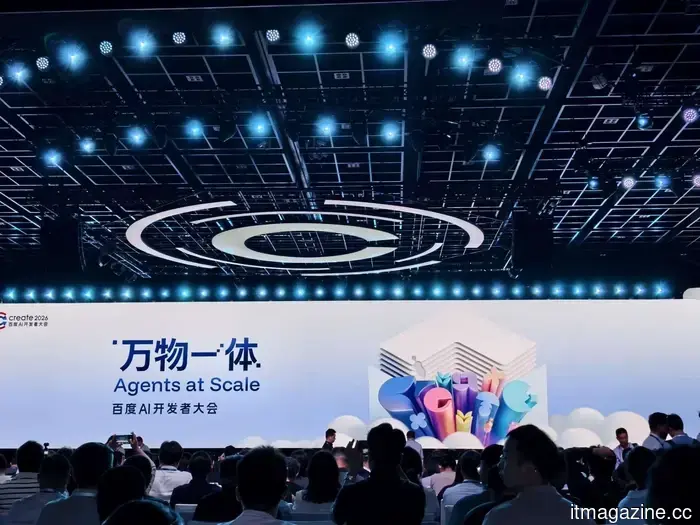
Baidu Create 2026: The CEO indicates that the emphasis in AI is shifting from models to AI agents and anticipates the emergence of super individuals.
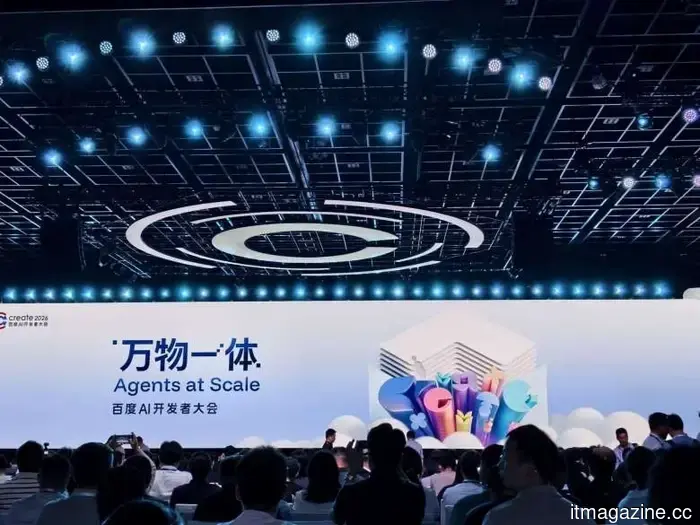
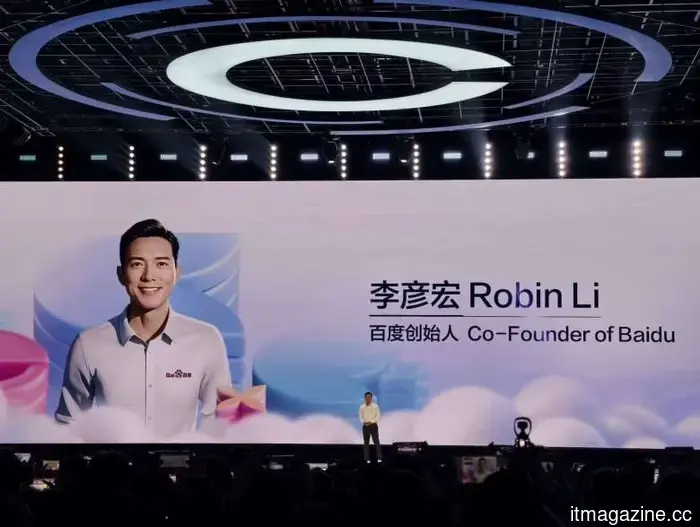
On Wednesday, the Create 2026 Baidu AI Developer Conference, themed "Agents at Scale," commenced in Beijing. During the opening ceremony, Robin Li, Baidu's founder, presented a keynote speech focused on self-evolution, which he identified as a key theme of the AI era. The company also revealed various AI products aimed at intelligent agents and enterprise applications.
Li highlighted the transition in AI from competition among large models to competition among AI agents, emphasizing that intelligent agents are becoming the focal point of the AI industry's next phase.
He noted that recent significant advancements in the AI sector have primarily stemmed from enhancements in foundational model capabilities. However, this year, the dynamics behind popular AI products have altered. "For the first time, what really made AI go viral was not the model, but the application," he stated. According to Li, the emerging AI products are not reliant on a specific model but are constructed as agent systems that can operate continuously and perform tasks over time.
In his perspective, this represents a shift in the AI industry from competing on model scale and capability to competing on the execution of tasks. What users are now willing to pay for is less about whether AI can think, but rather about its ability to accomplish tasks, he remarked. AI is evolving from simple chatbots into digital workers, task agents, and autonomous collaborative systems capable of using tools, breaking down tasks, and executing workflows.
During his address, Li introduced the concept of self-evolution, asserting that transformations in the AI era will occur across three dimensions: the self-evolution of intelligent agents, individuals, and enterprise organizations.
At the agent level, Li indicated that AI will move beyond merely responding to commands. Instead, it will continuously learn from its surroundings, independently verify outcomes, and iteratively enhance its execution processes. Once AI can establish a closed-loop capacity for verification, error correction, and optimization, its dependence on human oversight will significantly diminish.
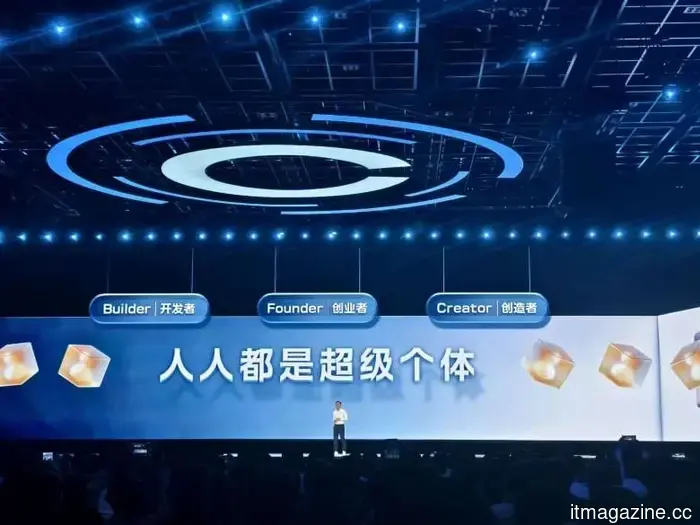
On the individual side, he suggested that AI is fostering the emergence of the super individual era. Previously, the smallest productive unit within companies was a team, but this could evolve into an individual supported by a network of intelligent agents. As advancements in code generation, content creation, and task execution continue, the productivity potential of regular developers and creators will be greatly increased.
From an organizational standpoint, Li stated that AI will transform management structures within companies. Organizations are anticipated to become more streamlined, with managers overseeing more individuals directly. The nature of management will shift from supervision and control to goal alignment and collaboration based on authorization. In this agent era, the major challenge for companies will not be the deployment of AI itself, but the integration of data, workflows, and systems to allow AI to function within a verifiable, closed-loop, and continuously optimizing framework, he noted.
Li also introduced the concept of Daily Active Agents (DAA), drawing a comparison to DAU (Daily Active Users) from the mobile internet era. He mentioned that tokens merely represent costs and not true value, as they reflect input rather than output. He forecasted that the number of global daily active agents might surpass 10 billion in the future. He pointed out that the success of platforms will no longer be measured by the amount of time users spend, but by the number of agents actively completing tasks and producing results for users.
Li further emphasized the influence of AI on the software industry. As the process of code generation advances, the barriers and costs associated with software development are rapidly declining, facilitating the creation of one-time software and disposable applications. Users might soon be able to generate software on demand for specific needs and discard it after use, a development he suggested could usher in a new growth phase for the software industry.
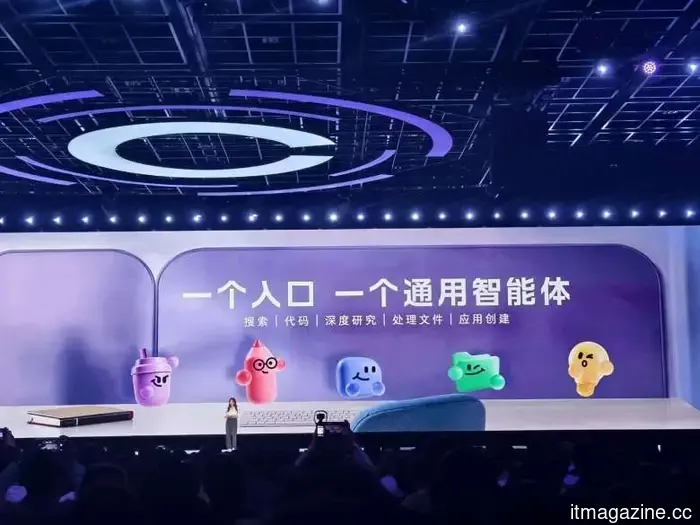
At the conference, Baidu launched a variety of AI products focused on agents. DuMate, a general-purpose AI agent, was officially introduced alongside a mobile application. This product can perform tasks such as resolving customer service issues, analyzing data, and generating posters. The Miaoda app and its enterprise version were also presented, with the product reportedly generating approximately 90% of its own code. Additionally, Baidu unveiled Baidu YiJing, a multi-agent digital human platform designed for livestreaming, video generation, and real-time interaction scenarios.
Other articles
 I played like a scavenger in Arc Raiders, and the loot was incredibly impressive.
Following a particularly enduring run by Stella Montis that transformed a free loadout into several weapon blueprints, I finally grasped why players of Arc Raiders are debating about rats, free kits, and risk.
I played like a scavenger in Arc Raiders, and the loot was incredibly impressive.
Following a particularly enduring run by Stella Montis that transformed a free loadout into several weapon blueprints, I finally grasped why players of Arc Raiders are debating about rats, free kits, and risk.
 I played like a rat in Arc Raiders, and the loot was incredibly good.
After one infuriatingly patient run by Stella Montis transformed a free loadout into various weapon blueprints, I finally grasped why Arc Raiders players are debating about rats, free kits, and risk.
I played like a rat in Arc Raiders, and the loot was incredibly good.
After one infuriatingly patient run by Stella Montis transformed a free loadout into various weapon blueprints, I finally grasped why Arc Raiders players are debating about rats, free kits, and risk.
 A leak about Assassin’s Creed Hexe suggests the comeback of a legendary hero, and I’m eagerly anticipating it.
Recent leaks regarding Assassin’s Creed Hexe indicate that Ezio Auditore may make a comeback as a mentor associated with the protagonist Anika and the Auditore lineage.
A leak about Assassin’s Creed Hexe suggests the comeback of a legendary hero, and I’m eagerly anticipating it.
Recent leaks regarding Assassin’s Creed Hexe indicate that Ezio Auditore may make a comeback as a mentor associated with the protagonist Anika and the Auditore lineage.
 The bottleneck in software engineering is no longer in the coding process.
AI coding tools can now develop more quickly than teams can make decisions, causing judgment to become the new bottleneck in software engineering.
The bottleneck in software engineering is no longer in the coding process.
AI coding tools can now develop more quickly than teams can make decisions, causing judgment to become the new bottleneck in software engineering.
 The limiting factor in software engineering is no longer the code itself.
AI coding tools can now create code more quickly than teams can reach decisions, turning judgment into the new bottleneck in software development.
The limiting factor in software engineering is no longer the code itself.
AI coding tools can now create code more quickly than teams can reach decisions, turning judgment into the new bottleneck in software development.
 I'm not completely convinced about Googlebook's future, but it definitely has two significant successes that I can't overlook.
Googlebook appears to be an ambitious new category of laptops focused on Gemini Intelligence, with its most compelling features likely being the Magic Pointer and the ability to access native Android apps.
I'm not completely convinced about Googlebook's future, but it definitely has two significant successes that I can't overlook.
Googlebook appears to be an ambitious new category of laptops focused on Gemini Intelligence, with its most compelling features likely being the Magic Pointer and the ability to access native Android apps.
Baidu Create 2026: The CEO indicates that the emphasis in AI is shifting from models to AI agents and anticipates the emergence of super individuals.
On Wednesday, the Create 2026 Baidu AI Developer Conference, with the theme "Agents at Scale," commenced in Beijing. At the opening ceremony, Robin Li, the founder of