
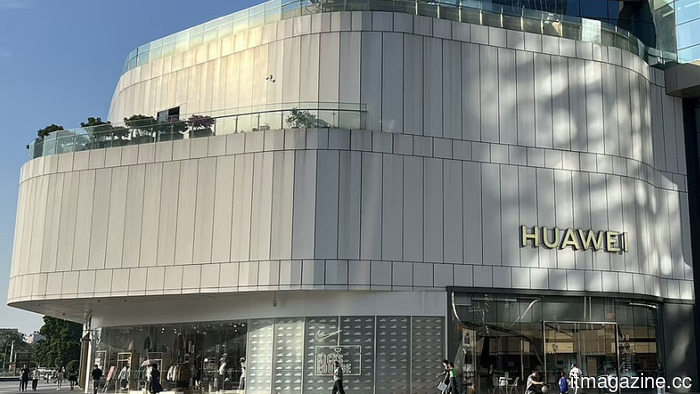
Two days before Trump's arrival, Beijing showcased Huawei's secret chip laboratory on national television. The intended audience was not the Chinese public.
TL;DR: Beijing showcased Huawei's secret chip laboratory on prime-time TV just two days before Trump's state visit, indicating that US export controls have fortified China's semiconductor goals under a national champion that the US cannot influence.
On Friday night, China Central Television’s top news program aired previously unseen footage of the Chip Fundamental Technology Research Laboratory located at Huawei’s Lianqiu Lake campus in Shanghai. The segment featured Huawei founder Ren Zhengfei welcoming Vice-Premier Ding Xuexiang to the facility, but it did not reveal what the lab is working on. The timing of the broadcast spoke volumes beyond the technical details.
President Donald Trump is set to arrive in Beijing on Tuesday for a three-day state visit as his first trip to China during his second term, accompanied by Elon Musk, Tim Cook, Larry Fink, and Boeing’s Kelly Ortberg. The visit's agenda includes discussions around trade, the Iran situation, Taiwan, and semiconductors. Beijing deliberately aired Huawei’s covert chip research facility on national television just 48 hours ahead of the American delegation's arrival, signaling that the intended audience was not the Chinese populace, but the visiting delegation.
The Lianqiu Lake campus serves as Huawei’s largest research and development center globally. It spans 2,600 acres in Jinze, a town within Shanghai’s Qingpu district, and cost roughly 10 billion yuan, or about 1.4 billion dollars, to construct over three years. This facility consists of eight blocks, 104 buildings, and over 40,000 offices, complete with an internal railway system. It surpasses the size of both Apple Park and Microsoft’s Redmond campus together. Huawei anticipates housing 35,000 researchers focused on semiconductors, wireless networks, smartphones, autonomous vehicles, and energy systems.
Nestled within this complex is the chip laboratory. While its existence was already known to analysts and semiconductor industry observers, it had never been featured in Chinese state media before. Ren Zhengfei, who rarely appears publicly, personally escorted the Vice-Premier through the facility. Ding Xuexiang oversees China’s science and technology policy, and this visit was more an endorsement than an inspection.
Huawei has been on the US trade blacklist since 2019, preventing it from acquiring advanced chips or the equipment necessary to manufacture them. The export controls aimed to dismantle the company's capacity to produce competitive semiconductors. Seven years later, forecasts indicate Huawei's AI chip revenue will reach 12 billion dollars in 2026, reflecting a 60 percent rise from 2025. The firm aims to produce 1.6 million Ascend dies across its product range this year.
The Ascend 910C, produced by SMIC using a 7-nanometre process without extreme ultraviolet lithography, achieves approximately 60 percent of the inference performance of Nvidia’s H100. The more advanced Ascend 920, fabricated on SMIC’s 6-nanometre node, delivers 900 teraflops and four terabytes per second of memory bandwidth. The Ascend 950PR began mass production in March 2026, and Huawei has nearly 800,000 orders for this new chip, in addition to a similar volume of older chips it plans to ship.
In late April, DeepSeek launched its V4 models, with Huawei’s latest Ascend chips receiving immediate compatibility. DeepSeek spent months modifying its core code to function with Huawei’s CANN framework, moving away from Nvidia’s CUDA ecosystem, which has been fundamental to AI advancement for two decades. The chip lab featured on CCTV is not merely conducting theoretical research; it is creating the hardware that powers China's most advanced AI models.
In the first half of 2025, Huawei invested 96.9 billion yuan in research and development, which constituted 22.7 percent of its revenue—a record percentage that resulted in a 32 percent drop in net profit. The company has invested in over 60 Chinese semiconductor firms through Hubble, its wholly-owned investment platform launched in 2019, the same year it was blacklisted by the US. Ren Zhengfei has claimed leadership of a network of over 2,000 Chinese companies working towards achieving 70 percent semiconductor self-sufficiency across the entire value chain by 2028.
Huawei’s R&D intensity is remarkable by any standard. The company is committing more than one-fifth of its revenue to chip research while being unable to access the most advanced manufacturing technologies worldwide. SMIC’s most capable process, the 7-nanometre node used for the Ascend 910C, was developed by repurposing older deep ultraviolet lithography machines in ways they were not designed for. Yield rates are lower than those of TSMC, and production costs are higher, meaning the chips are less powerful than Nvidia’s latest offerings. However, this context was secondary to the message Beijing conveyed on Friday night.
The broadcast serves as a negotiating tactic disguised
Other articles
 JPMorgan has submitted a second tokenized money market fund on Ethereum as the competition among Wall Street firms in blockchain technology intensifies.
JPMorgan has submitted an application for its second tokenized money market fund on Ethereum, entering into competition with BlackRock to create blockchain-based finance within the Genius Act framework.
n8n integrated into SAP Joule Studio as an AI orchestration layer leads to a valuation increase to $5.2 billion.
SAP has integrated n8n within Joule Studio to link its 200 AI agents with non-SAP systems. The Berlin-based workflow automation startup is now recognized as Germany's most valuable AI firm.
JPMorgan has submitted a second tokenized money market fund on Ethereum as the competition among Wall Street firms in blockchain technology intensifies.
JPMorgan has submitted an application for its second tokenized money market fund on Ethereum, entering into competition with BlackRock to create blockchain-based finance within the Genius Act framework.
n8n integrated into SAP Joule Studio as an AI orchestration layer leads to a valuation increase to $5.2 billion.
SAP has integrated n8n within Joule Studio to link its 200 AI agents with non-SAP systems. The Berlin-based workflow automation startup is now recognized as Germany's most valuable AI firm.
 OpenAI acquires Tomoro as a foundational element of a $14 billion deployment firm.
Tomoro, the Edinburgh-based AI company established in partnership with OpenAI, is set to be the first acquisition of a $14 billion subsidiary that will place engineers within businesses. Accenture's shares dropped by 3%.
SAP introduces the Autonomous Enterprise featuring over 200 AI agents and a partnership with Anthropic at Sapphire 2026.
SAP introduced the Autonomous Enterprise during Sapphire 2026, incorporating over 200 AI agents in finance, supply chain, and HR, and collaborating with Anthropic. Its stock has declined by 41%.
OpenAI acquires Tomoro as a foundational element of a $14 billion deployment firm.
Tomoro, the Edinburgh-based AI company established in partnership with OpenAI, is set to be the first acquisition of a $14 billion subsidiary that will place engineers within businesses. Accenture's shares dropped by 3%.
SAP introduces the Autonomous Enterprise featuring over 200 AI agents and a partnership with Anthropic at Sapphire 2026.
SAP introduced the Autonomous Enterprise during Sapphire 2026, incorporating over 200 AI agents in finance, supply chain, and HR, and collaborating with Anthropic. Its stock has declined by 41%.
 OpenAI purchases Tomoro as the initial component of a $14 billion Deployment Company.
Tomorrow, the Edinburgh-based AI company established in collaboration with OpenAI, is set to be the inaugural acquisition of a $14 billion subsidiary that places engineers within businesses. Accenture saw a decline of 3%.
OpenAI purchases Tomoro as the initial component of a $14 billion Deployment Company.
Tomorrow, the Edinburgh-based AI company established in collaboration with OpenAI, is set to be the inaugural acquisition of a $14 billion subsidiary that places engineers within businesses. Accenture saw a decline of 3%.
 Bristol Myers Squibb has finalized a $15.2 billion agreement for a pharmaceutical collaboration with China's Hengrui as the threat of patent expirations approaches.
BMS is set to pay Hengrui $15.2 billion for 13 early-stage drugs in the fields of oncology and immunology. This agreement highlights how the patent cliff faced by Big Pharma has rendered Chinese innovation essential.
Bristol Myers Squibb has finalized a $15.2 billion agreement for a pharmaceutical collaboration with China's Hengrui as the threat of patent expirations approaches.
BMS is set to pay Hengrui $15.2 billion for 13 early-stage drugs in the fields of oncology and immunology. This agreement highlights how the patent cliff faced by Big Pharma has rendered Chinese innovation essential.
Two days before Trump's arrival, Beijing showcased Huawei's secret chip laboratory on national television. The intended audience was not the Chinese public.
China showcased Huawei's clandestine chip laboratory on national television just days prior to Trump's visit to Beijing. This airing indicates that US export restrictions have strengthened rather than stifled China's ambitions in the semiconductor sector.