
The Canvas breach affected students at the most inconvenient moment, serving as a wake-up call for educational institutions everywhere.
A cyberattack on Canvas could not have occurred at a more inconvenient time. The learning platform, utilized by educational institutions for assignments, exams, grades, lecture materials, and communication, went offline during finals week, leaving both students and instructors in search of alternatives.
This incident has been associated with ShinyHunters, a hacking group recognized for data theft and extortion. As reported by BleepingComputer, login portals for Canvas at numerous institutions were vandalized with a ransom-style message threatening the release of stolen student data unless the attackers were contacted. The group asserted that it had acquired data related to millions of students, educators, and staff across thousands of schools.
What went wrong within Canvas?
Instructure, the company that operates Canvas, stated that hackers took advantage of a vulnerability related to its Free-for-Teacher accounts, leading to a temporary shutdown of the platform for investigation. This outage caused significant disruption during the finals season, as students and educators were abruptly locked out of the system.
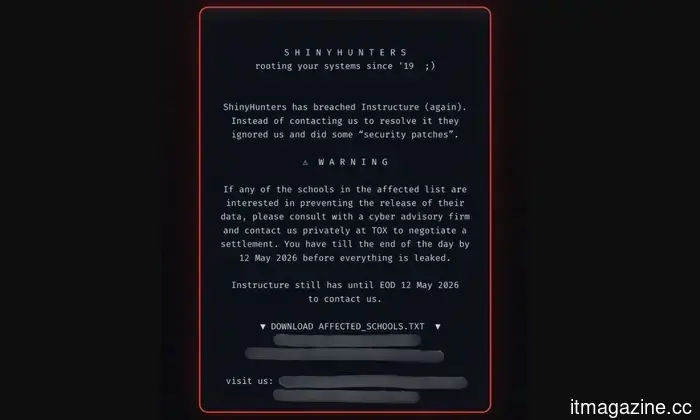
During the initial outage, the Canvas login screen allegedly showed a message from ShinyHunters claiming it had breached Instructure "again” and warned schools to make contact by a May 12, 2026, deadline to avert the publication of stolen data. The message also listed affected schools, clearly indicating that the attack was part of an extortion scheme.
Why did this impact students so severely?
This hack forced some institutions to postpone exams while others instructed faculty to be flexible with deadlines and course requirements. For students already in the midst of finals, the outage added stress surrounding study materials, submissions, and exam schedules.
Although Instructure has stated that passwords or financial information were not compromised in this attack, hackers did gain access to millions of usernames, email addresses, student IDs, and internal messages. Such information could readily be used for phishing attempts that reference real classes, schools, or instructors.
Haven’t we seen ShinyHunters before?
ShinyHunters has been linked to several significant breaches in the past, including incidents involving Ticketmaster and Rockstar. Instructure has previously encountered this hacker group as well. In September 2025, ShinyHunters targeted Instructure’s Salesforce environment through social engineering to breach business systems, although Instructure reported that no Canvas product data was accessed and that the exposed information primarily consisted of public business contact details.
What now?
The return of Canvas does not resolve the issue. Hackers continue to hold data from millions of users for ransom, meaning the risk persists. However, ShinyHunters has allegedly removed Instructure from its “Pay or Leak” portal, indicating that negotiations may be taking place.
This attack should serve as a wake-up call for every educational institution that depends on a limited number of digital platforms for conducting classes, exams, and communication. These tools have become crucial to school operations, necessitating stronger cybersecurity measures to safeguard student data and develop backup plans for potential future outages or attacks.

Other articles
 The iPhone Air demonstrates why smaller phones remain the preferable choice.
The iPhone Air is an intelligent solution to the bulkiness of flagship phones, yet using it reminded me that being thin and lightweight still doesn't address the fundamental issue of a standard tall phone.
The iPhone Air demonstrates why smaller phones remain the preferable choice.
The iPhone Air is an intelligent solution to the bulkiness of flagship phones, yet using it reminded me that being thin and lightweight still doesn't address the fundamental issue of a standard tall phone.
 5 excellent free films to enjoy on New Year’s Day
From light, entertaining films to those that allow you to really immerse yourself, these free movies cater to various moods on New Year’s Day. Each one can be streamed without a subscription, so you can begin watching without any hassle.
5 excellent free films to enjoy on New Year’s Day
From light, entertaining films to those that allow you to really immerse yourself, these free movies cater to various moods on New Year’s Day. Each one can be streamed without a subscription, so you can begin watching without any hassle.
 Apple may introduce automatic tab groups in Safari for iOS 27 and macOS.
Apple is said to be experimenting with AI-driven automatic tab grouping for Safari in iOS 27 and macOS 27, aiming to assist users in organizing their browsing sessions more effectively.
Apple may introduce automatic tab groups in Safari for iOS 27 and macOS.
Apple is said to be experimenting with AI-driven automatic tab grouping for Safari in iOS 27 and macOS 27, aiming to assist users in organizing their browsing sessions more effectively.
 macOS 27 aims to refine the Liquid Glass design concept, albeit with no significant changes.
Apple is said to be enhancing the Liquid Glass interface in macOS 27 to boost readability, transparency effects, and overall user experience without significant design alterations.
macOS 27 aims to refine the Liquid Glass design concept, albeit with no significant changes.
Apple is said to be enhancing the Liquid Glass interface in macOS 27 to boost readability, transparency effects, and overall user experience without significant design alterations.
 Apple may introduce automatic tab groups in Safari for iOS 27 and macOS.
Apple is said to be experimenting with AI-driven automatic tab grouping for Safari in iOS 27 and macOS 27 to assist users in organizing their browsing sessions more effectively.
Apple may introduce automatic tab groups in Safari for iOS 27 and macOS.
Apple is said to be experimenting with AI-driven automatic tab grouping for Safari in iOS 27 and macOS 27 to assist users in organizing their browsing sessions more effectively.
 AnimeKai, a major site for pirated anime streaming, has ceased operations.
AnimeKai, the well-known anime piracy website, is closing down following recent problems and a fire at its data center, prompting users to search for backups and other options.
AnimeKai, a major site for pirated anime streaming, has ceased operations.
AnimeKai, the well-known anime piracy website, is closing down following recent problems and a fire at its data center, prompting users to search for backups and other options.
The Canvas breach affected students at the most inconvenient moment, serving as a wake-up call for educational institutions everywhere.
A platform that numerous schools rely on for examinations, grades, and daily assignments experienced a shutdown at an incredibly inopportune time. With hackers asserting that they possess millions of student records, the Canvas breach is provoking critical concerns regarding digital security in the education sector.