
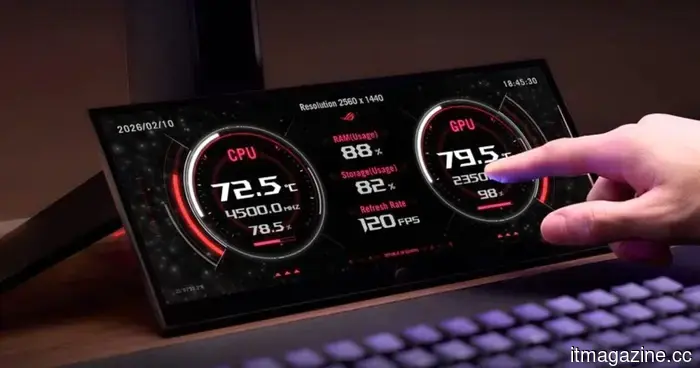
Asus introduces the ROG Strix XG129C, a small secondary display aimed at competing with Elgato’s gaming offerings.
The secondary display market has long awaited a product that effectively integrates a quality screen, genuine color accuracy, and gaming ecosystem compatibility into a single compact unit.
Asus has answered the call for those who desire a specific screen for monitoring their system’s performance, chat applications, or streaming controls, without interrupting the primary monitor setup.
The ROG Strix XG129C is a 12.3-inch secondary display equipped with a touchscreen, intended to be placed beneath your main monitor to manage notifications and other distractions, priced at $199.
So, what features does the Strix XG129C offer?
The Strix XG129C boasts a 1920 x 720 IPS display with a 24:9 aspect ratio, resulting in a wide but short screen that fits neatly under a typical monitor without taking up vertical desk space.
This 10-point capacitive touchscreen supports multi-touch gestures, app shortcuts, hotkey operations, and streaming overlays. Remarkably, for a secondary display, the color accuracy is quite impressive, covering 125% of the sRGB color space and 90% of DCI-P3.
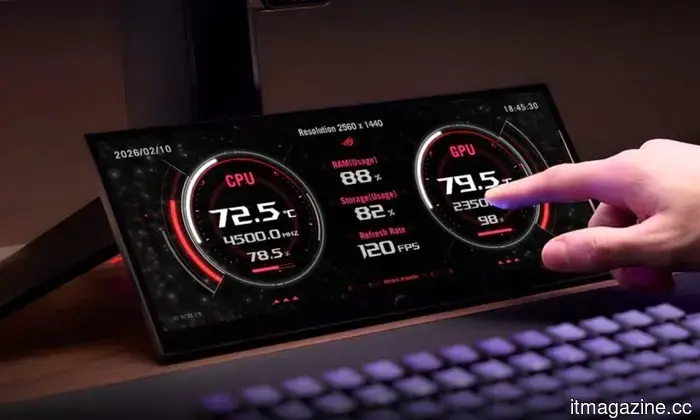
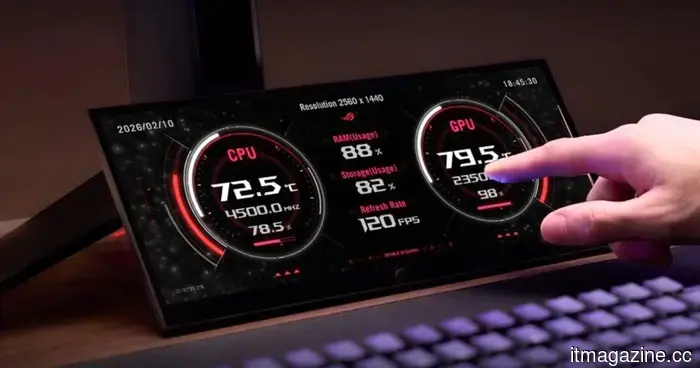
Asus is also providing a one-year subscription to AIDA64 Extreme, transforming the display into a live hardware monitoring dashboard that tracks GPU usage, CPU temperature, and fan speeds through exclusive ROG SensorPanel themes.
A single USB-C cable is all that's needed for power, video, and touch functionalities, ensuring a tidy setup. Additionally, there’s another USB-C (20W PD) and HDMI 1.2 ports for enhanced compatibility.
How does it compare to competitors?
Unlike Elgato’s Stream Deck, which features physical buttons without a true display, the Strix XG129C offers a complete touchscreen that not only looks sleek and modern but also enhances control.
Its closest rival is the Corsair Xeneon Edge, which measures 14.5 inches and is similarly priced. However, the XG129C’s more compact aspect ratio and integration with the ROG ecosystem make it a more attractive choice for those already within the ROG environment.
This idea reminds me of the secondary screens found on the Zephyrus Duo laptops. Asus has effectively adapted the ScreenPad experience for desktop use, presenting it with a more polished and deliberate focus.
Over the past five years, Shikhar has been adept at clarifying developments in consumer technology and communicating them…
AI-dependent graduates are struggling in finance positions due to their superficial insights.
It appears that ChatGPT cannot excel in every finance interview.
While artificial intelligence is revolutionizing the financial sector, certain firms are starting to resist a growing trend: graduates who overly depend on AI tools without showcasing deeper analytical skills. A report from The Financial Times highlighted this concern as expressed by experienced finance professionals, including a financier in New York who described his company’s 2025 interns as the first cohort of “genuine AI natives.” These students, raised with digital platforms and generative AI, initially seemed very capable during the hiring process.
A cyberattack on Canvas occurred at the most inopportune moment, exposing vulnerabilities in digital education.
The Canvas hacking incident revealed critical weaknesses in online classrooms.
A cyberattack targeting Canvas happened during finals week, which was particularly detrimental. This platform, used by educational institutions for assignments, grades, lecture resources, and communication, was rendered inaccessible, forcing students and instructors to look for alternatives. This breach has been attributed to ShinyHunters, a hacking group notorious for data theft and extortion. Reports from BleepingComputer indicate that login portals at multiple institutions were defaced with a ransom-style notification threatening the release of stolen student data unless the attackers were contacted. The group claims to possess information related to millions of students, educators, and staff from thousands of schools.
Counterfeit DDR5 RAM sticks are now utilizing plastic chips to deceive buyers.
The PC hardware market continues to face alarming challenges.
As if DDR5 prices weren’t already problematic, counterfeit RAM is now emerging. Some fake memory sticks are reported to be convincing enough to mislead buyers, featuring plastic components masquerading as DRAM chips.





Other articles
 Apple may introduce automatic tab groups in Safari for iOS 27 and macOS.
Apple is said to be experimenting with AI-driven automatic tab grouping for Safari in iOS 27 and macOS 27 to assist users in organizing their browsing sessions more effectively.
Apple may introduce automatic tab groups in Safari for iOS 27 and macOS.
Apple is said to be experimenting with AI-driven automatic tab grouping for Safari in iOS 27 and macOS 27 to assist users in organizing their browsing sessions more effectively.
 The iPhone Air demonstrates why smaller phones remain the superior choice.
The iPhone Air is a smart response to bulky flagship devices, but my experience with it reminded me that being slim and lightweight doesn’t address the fundamental issue of a standard tall phone.
The iPhone Air demonstrates why smaller phones remain the superior choice.
The iPhone Air is a smart response to bulky flagship devices, but my experience with it reminded me that being slim and lightweight doesn’t address the fundamental issue of a standard tall phone.
 Counterfeit DDR5 RAM modules are now incorporating plastic chips to deceive consumers.
Reports indicate that counterfeit DDR5 RAM sticks, complete with fake labels and even dummy plastic chips, are saturating PC markets as memory prices increase.
Counterfeit DDR5 RAM modules are now incorporating plastic chips to deceive consumers.
Reports indicate that counterfeit DDR5 RAM sticks, complete with fake labels and even dummy plastic chips, are saturating PC markets as memory prices increase.
 The iPhone Air demonstrates why smaller phones remain the preferable choice.
The iPhone Air is an intelligent solution to the bulkiness of flagship phones, yet using it reminded me that being thin and lightweight still doesn't address the fundamental issue of a standard tall phone.
The iPhone Air demonstrates why smaller phones remain the preferable choice.
The iPhone Air is an intelligent solution to the bulkiness of flagship phones, yet using it reminded me that being thin and lightweight still doesn't address the fundamental issue of a standard tall phone.
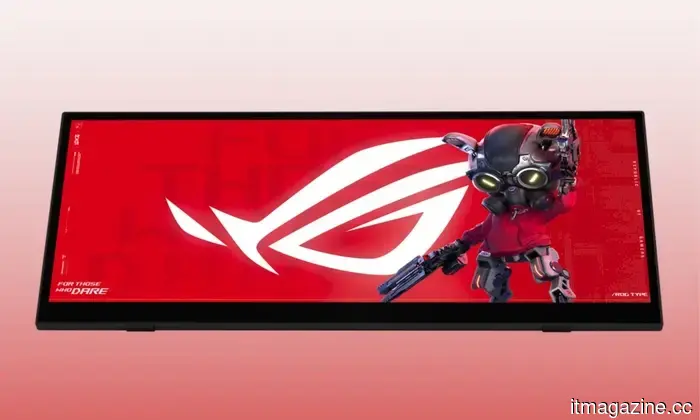
 Asus unveils the ROG Strix XG129C, a small secondary monitor aimed at competing with Elgato's offerings for gamers.
The Asus ROG Strix XG129C is a 12.3-inch touchscreen that conveniently sits beneath your main monitor, supports 125% sRGB, and includes a one-year subscription to AIDA64 Extreme for real-time hardware monitoring.
Asus unveils the ROG Strix XG129C, a small secondary monitor aimed at competing with Elgato's offerings for gamers.
The Asus ROG Strix XG129C is a 12.3-inch touchscreen that conveniently sits beneath your main monitor, supports 125% sRGB, and includes a one-year subscription to AIDA64 Extreme for real-time hardware monitoring.
 Mercedes-Benz builds excitement for the forthcoming AMG.EA, positioning it as an electric vehicle worth the wait.
George Russell stated the power was "very easy" to handle. The engineering team referred to it as the most challenging project in AMG's history. Both statements are accurate.
Mercedes-Benz builds excitement for the forthcoming AMG.EA, positioning it as an electric vehicle worth the wait.
George Russell stated the power was "very easy" to handle. The engineering team referred to it as the most challenging project in AMG's history. Both statements are accurate.
Asus introduces the ROG Strix XG129C, a small secondary display aimed at competing with Elgato’s gaming offerings.
The Asus ROG Strix XG129C is a 12.3-inch touchscreen that conveniently sits underneath your main monitor, offers 125% sRGB coverage, and includes a one-year subscription to AIDA64 Extreme for real-time hardware monitoring.