
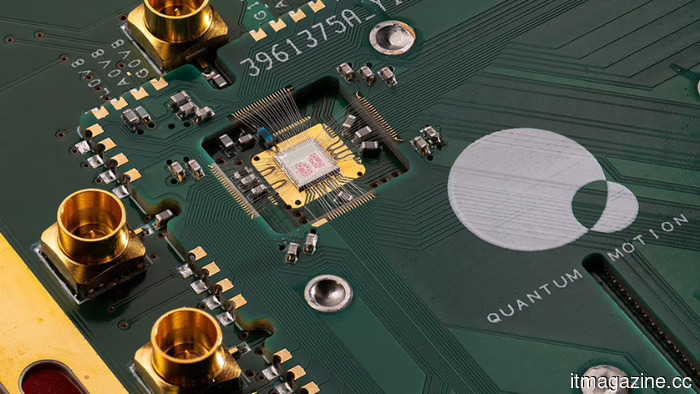
Quantum Motion secures $160 million in the EU's initial significant late-stage investment.
The London-based company specializing in silicon-CMOS spin qubits has established a solid technical reputation within the realm of European quantum hardware. The announcement of the EU's first significant late-stage investment post-Brexit, specifically its chosen investee, is noteworthy in itself.
Bloomberg reported on Wednesday that the European Union’s new Scaleup Europe Fund has made its inaugural investment by leading a $160 million funding round in UK-based Quantum Motion. This transaction marks the largest single funding round secured by any European silicon-spin-qubit company to date and represents the first major late-stage investment by the EU entity, which has been under development at the European Investment Fund for nearly two years.
The selection of Quantum Motion is significant structurally. Founded in 2017 in London by Professor John Morton (UCL) and Professor Simon Benjamin (Oxford), the company operates outside the EU’s regulatory framework following Brexit.
The Scaleup Europe Fund, as outlined by the European Innovation Council, explicitly targets strategic technology sectors, including quantum, and its eligibility criteria extend beyond strictly EU-based companies to include strategically aligned entities across the broader European tech ecosystem. The choice of Quantum Motion makes the operational definition of that perimeter clear for the first time.
Quantum Motion's technical foundation has been increasingly evident. Their unique strategy involves developing qubits using standard silicon-CMOS—the manufacturing process that the larger semiconductor industry employs. This approach involves trading short-term performance for long-term scalability. Most existing cutting-edge quantum systems utilize customized processes, like superconducting qubits and trapped ions, which are challenging to scale for mass production.
While Quantum Motion’s silicon-CMOS spin qubits may take longer to develop, they hold the potential to be produced by any advanced foundry without needing specialized capital equipment. In the past nine months, operational milestones have transitioned their technical proposition from theoretical to actionable. In September 2025, the company presented a complete silicon-CMOS quantum computer to the UK’s National Quantum Computing Centre, which has been highlighted as the first fully integrated delivery of its kind.
In November 2025, DARPA advanced the company to QBI Stage B, one of only 11 firms to progress, noting that its silicon-based fault-tolerant design was credible for achieving utility-scale quantum computing by the 2030s. Previously, Quantum Motion received more modest funding—a £42 million Series B round in 2023 led by Bosch Ventures and Porsche Automobil Holding, bringing total disclosed funding to over £62 million.
Thus, the new $160 million round approximately doubles the total capital raised in a single transaction, reflecting investor confidence in the silicon-spin-qubit concept, especially as other competing modalities, such as superconducting and trapped-ion methods, also initiate substantial funding rounds.
The Scaleup Europe Fund itself is part of a wider EU initiative addressing the gap in late-stage technology funding compared to the United States. The European Investment Fund's €15 billion fund-of-funds program, launched concurrently, aims at around 100 late-stage venture capital funds and is the largest initiative of its kind in European history. Its predecessor, the European Tech Champions Initiative, secured 12 large funds, each exceeding €1 billion, collectively funding 35 European technology scale-ups, including nine unicorns.
The Scaleup Europe Fund represents the next phase of commitment, designed to invest directly in companies rather than through fund-of-funds structures. The broader European quantum funding environment also adds context. This week, QuantWare secured €152 million in Series B funding from Intel Capital and In-Q-Tel, marking one of the significant European quantum hardware funding rounds this year.
Alongside eleQtron’s €57 million Series A from Schwarz Digits and the SAP-Prior Labs’ €1 billion frontier AI lab announcement, the funding round for Quantum Motion underscores a European deeptech funding cycle that is finally yielding late-stage rounds at scales comparable to those raised by US counterparts over the years.
The Scaleup Europe Fund’s choice to invest in this category, instead of in the more typical AI-software sectors that have dominated venture activity in 2026, signals the EU's focus on strategic sovereignty issues.
However, the round does not resolve the operational aspects. Quantum Motion has outlined credible specifications, delivered a system to the NQCC, and received advancement to DARPA QBI Stage B. Yet, it has yet to demonstrate a commercially viable system at scale, or prove the kind of utility-scale fault tolerance that the $160 million commitment from the Scaleup Europe Fund implicitly supports.
The 2030s timeline approved by DARPA will be the key consideration. The next 18 to 24 months will reveal whether Quantum Motion can keep pace with the more ambitious timelines set by US-based quantum firms, and whether the EU’s first major late-stage commitment can compare to the collective investment raised by Anthropic, OpenAI, and other prominent US AI laboratories in a shorter timeframe.
Other articles
 Brussels reaches an agreement to simplify the AI Act and prohibit nudification applications.
Parliament and the Council have reached an agreement to extend the deadline for high-risk classifications under the EU AI Act to December 2027 and to prohibit AI nudification tools, resolving a prolonged stalemate.
Brussels reaches an agreement to simplify the AI Act and prohibit nudification applications.
Parliament and the Council have reached an agreement to extend the deadline for high-risk classifications under the EU AI Act to December 2027 and to prohibit AI nudification tools, resolving a prolonged stalemate.
 Skyroot has become India’s inaugural space-tech unicorn prior to the Vikram-1 launch in June.
Skyroot Aerospace has completed a funding round that achieved unicorn valuation, supported by funds managed by GIC and BlackRock, in anticipation of the scheduled launch of Vikram-1 in June.
Skyroot has become India’s inaugural space-tech unicorn prior to the Vikram-1 launch in June.
Skyroot Aerospace has completed a funding round that achieved unicorn valuation, supported by funds managed by GIC and BlackRock, in anticipation of the scheduled launch of Vikram-1 in June.
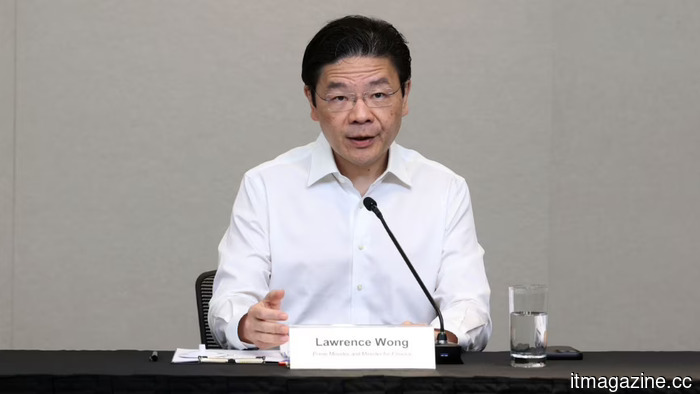 Lawrence Wong stands firm: AI will not lead to jobless growth in Singapore.
Singapore's parliament has reiterated Prime Minister Lawrence Wong's commitment made in February that the nation will not face jobless growth.
Lawrence Wong stands firm: AI will not lead to jobless growth in Singapore.
Singapore's parliament has reiterated Prime Minister Lawrence Wong's commitment made in February that the nation will not face jobless growth.
 Skyroot is hailed as India’s first space-tech unicorn, just before the Vikram-1 launch scheduled for June.
Skyroot Aerospace has completed a funding round that reached unicorn valuation, supported by funds managed by GIC and BlackRock, in anticipation of the scheduled launch of Vikram-1 in June.
Skyroot is hailed as India’s first space-tech unicorn, just before the Vikram-1 launch scheduled for June.
Skyroot Aerospace has completed a funding round that reached unicorn valuation, supported by funds managed by GIC and BlackRock, in anticipation of the scheduled launch of Vikram-1 in June.
 Brussels has reached an agreement to modify the AI Act and prohibit nudification applications.
Parliament and the Council have reached an agreement to extend the EU AI Act's high-risk deadline to December 2027 and prohibit AI nudification tools, resolving a lengthy impasse.
Brussels has reached an agreement to modify the AI Act and prohibit nudification applications.
Parliament and the Council have reached an agreement to extend the EU AI Act's high-risk deadline to December 2027 and prohibit AI nudification tools, resolving a lengthy impasse.
 Brussels reaches an agreement to streamline the AI Act and ban nudification applications.
The Parliament and Council have reached an agreement to extend the EU AI Act's high-risk deadline to December 2027 and to prohibit AI nudification tools, resolving a prolonged stalemate.
Brussels reaches an agreement to streamline the AI Act and ban nudification applications.
The Parliament and Council have reached an agreement to extend the EU AI Act's high-risk deadline to December 2027 and to prohibit AI nudification tools, resolving a prolonged stalemate.
Quantum Motion secures $160 million in the EU's initial significant late-stage investment.
The new Scaleup Europe Fund of the European Union has spearheaded a $160 million investment round in Quantum Motion, a UK-based company specializing in silicon-CMOS spin-qubits.