
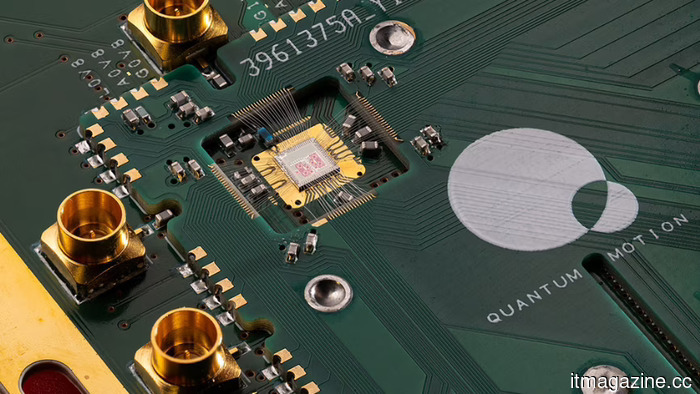
Quantum Motion secures $160 million in the EU's inaugural significant late-stage investment.
The London-based company developing silicon-CMOS spin qubits has established itself as a credible player in the European quantum hardware sector. The selection of this company for the EU’s inaugural major late-stage venture investment, announced after Brexit, is noteworthy in itself.
The European Union’s new Scaleup Europe Fund has made its first investment by leading a $160 million funding round for the UK-based Quantum Motion, as reported by Bloomberg on Wednesday. This deal marks the largest single funding round obtained by any European silicon-spin-qubit firm to date and represents the first significant late-stage commitment from the EU fund, which has been in the works at the European Investment Fund for nearly two years.
The choice of Quantum Motion as the investee is structurally significant. Founded in 2017 by Professor John Morton (UCL) and Professor Simon Benjamin (Oxford), this London company operates outside the EU’s regulatory framework following Brexit.
The latest updates from the EU tech landscape, along with a story from our founder Boris and some dubious AI-generated art, are available weekly in your inbox for free. Sign up now! The Scaleup Europe Fund, guided by the European Innovation Council, explicitly targets strategic technology areas, including quantum, allowing investments not only in EU-based companies but also in strategically aligned organizations across the broader European tech ecosystem. Quantum Motion’s selection clarifies this operational boundary for the first time.
The technical case supporting Quantum Motion has been gaining noticeable strength. The company's unique strategy involves constructing qubits using standard silicon-CMOS, the same manufacturing technique employed across the broader semiconductor industry at scale. This choice prioritizes long-term scalability over immediate performance.
Currently, most leading-edge quantum systems rely on specialized processes, such as superconducting qubits and trapped ions, that are challenging to produce in large quantities. Quantum Motion’s silicon-CMOS spin qubits may take longer to develop but, in theory, can be manufactured by any advanced foundry without the need for custom capital equipment.
Over the past nine months, operational milestones have shifted the technical case from theoretical to practical. In September 2025, the company delivered a complete silicon-CMOS quantum computer to the UK’s National Quantum Computing Centre, which was noted in industry reports as the first comprehensive delivery of its kind.
In November 2025, DARPA promoted the company to QBI Stage B, positioning it among just 11 companies to advance, based on the belief that its silicon-based fault-tolerant design is viable for pursuing utility-scale quantum computing by the 2030s.
Quantum Motion’s earlier funding was more modest, with a £42 million Series B round in 2023 led by Bosch Ventures and Porsche Automobil Holding, bringing the total disclosed funding to over £62 million. The new $160 million round effectively doubles the total capital raised at once and demonstrates investor confidence in the silicon-spin-qubit hypothesis, particularly at a time when several competing modalities, such as superconducting and trapped-ion approaches, are also raising significant amounts.
The Scaleup Europe Fund is part of a broader EU initiative addressing the funding gap for late-stage technologies compared to the United States. The €15 billion fund-of-funds program from the European Investment Fund aims to target about 100 late-stage venture capital funds and is the largest initiative of its kind in European history.
The previous European Tech Champions Initiative anchored 12 mega-funds, each exceeding €1 billion, which collectively supported 35 European tech scale-ups, including nine unicorns. The Scaleup Europe Fund represents the next phase of investment, designed to directly fund companies rather than through fund-of-fund structures.
The broader European quantum funding landscape provides context for this development. Earlier this week, QuantWare secured €152 million in a Series B round led by Intel Capital and In-Q-Tel, making it one of the larger European quantum hardware fundraising events this year. Additionally, eleQtron raised €57 million in a Series A from Schwarz Digits, while the SAP-Prior Labs announced a €1 billion frontier AI lab, combining with the Quantum Motion funding round to illustrate a European deep tech funding cycle that is generating late-stage rounds comparable to those raised by US counterparts for several years.
The Scaleup Europe Fund’s first investment in this sector, rather than in more traditional AI-software targets that have dominated venture activity in 2026, signals the EU’s perspective on strategic sovereignty priorities.
What remains unresolved, however, is the operational aspect. While Quantum Motion has established credible specifications, delivered a system to the NQCC, and received DARPA’s QBI Stage B advancement, it has yet to demonstrate a large-scale commercial system or the kind of utility-scale fault tolerance that the Scaleup Europe Fund’s $160 million investment implies.
The timeline approved by DARPA for the 2030s is the relevant horizon. The next 18 to 24 months will indicate whether Quantum Motion can match the more ambitious timelines proposed by US quantum companies and whether the EU's first significant late-stage commitment can
Other articles
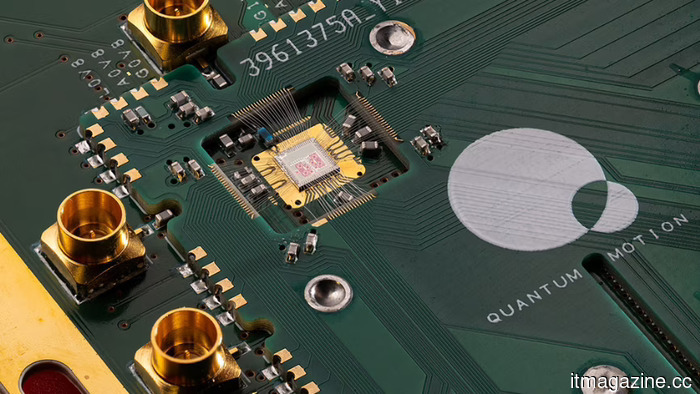 Quantum Motion secures $160 million in the EU's initial significant late-stage investment.
The European Union's newly established Scaleup Europe Fund has directed a $160 million investment into Quantum Motion, a UK-based company specializing in silicon-CMOS spin-qubit technology.
Moonshot AI’s $20 billion valuation confirms it as one of the fastest-growing AI funding journeys in China.
Moonshot AI, the Beijing-based creator of the Kimi chatbot, is concluding a $2 billion funding round with a post-money valuation exceeding $20 billion.
Quantum Motion secures $160 million in the EU's initial significant late-stage investment.
The European Union's newly established Scaleup Europe Fund has directed a $160 million investment into Quantum Motion, a UK-based company specializing in silicon-CMOS spin-qubit technology.
Moonshot AI’s $20 billion valuation confirms it as one of the fastest-growing AI funding journeys in China.
Moonshot AI, the Beijing-based creator of the Kimi chatbot, is concluding a $2 billion funding round with a post-money valuation exceeding $20 billion.
 Amazon steps back from the grocery sector in Singapore, focusing more on cross-border operations instead.
Amazon will discontinue Amazon Fresh and local fulfillment in Singapore on July 6, 2026, resulting in a limited number of layoffs.
Amazon steps back from the grocery sector in Singapore, focusing more on cross-border operations instead.
Amazon will discontinue Amazon Fresh and local fulfillment in Singapore on July 6, 2026, resulting in a limited number of layoffs.
 Brussels has reached an agreement to modify the AI Act and prohibit nudification applications.
Parliament and the Council have reached an agreement to extend the EU AI Act's high-risk deadline to December 2027 and prohibit AI nudification tools, resolving a lengthy impasse.
Brussels has reached an agreement to modify the AI Act and prohibit nudification applications.
Parliament and the Council have reached an agreement to extend the EU AI Act's high-risk deadline to December 2027 and prohibit AI nudification tools, resolving a lengthy impasse.
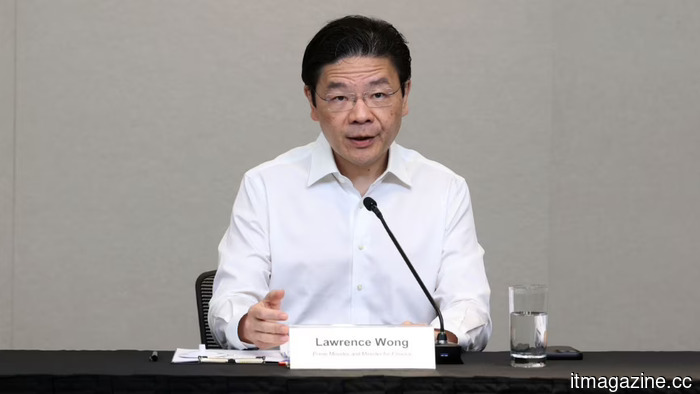 Lawrence Wong remains firm: AI will not lead to jobless growth in Singapore.
Singapore's parliament has reconfirmed Prime Minister Lawrence Wong's commitment made in February, stating that the nation will not undergo jobless growth.
Lawrence Wong remains firm: AI will not lead to jobless growth in Singapore.
Singapore's parliament has reconfirmed Prime Minister Lawrence Wong's commitment made in February, stating that the nation will not undergo jobless growth.
 Amazon steps back from the Singapore grocery market, focusing more on cross-border operations instead.
Amazon will discontinue Amazon Fresh and local fulfillment services in Singapore on July 6, 2026, resulting in a limited number of job cuts.
Amazon steps back from the Singapore grocery market, focusing more on cross-border operations instead.
Amazon will discontinue Amazon Fresh and local fulfillment services in Singapore on July 6, 2026, resulting in a limited number of job cuts.
Quantum Motion secures $160 million in the EU's inaugural significant late-stage investment.
The new Scaleup Europe Fund of the European Union has spearheaded a $160 million funding round for Quantum Motion, a UK-based company specializing in silicon-CMOS spin-qubits.