
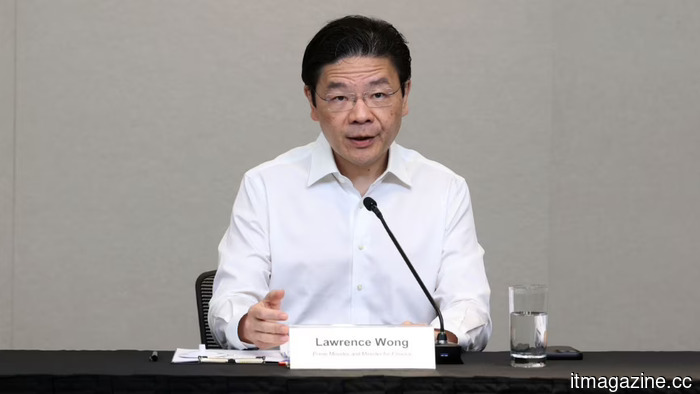
Lawrence Wong remains firm: AI will not lead to jobless growth in Singapore.
Singapore's parliament has assured that the nation will avoid jobless growth as artificial intelligence transforms the economy, according to a Bloomberg report on Tuesday referencing Channel NewsAsia.
This announcement reinforces the stance Prime Minister Lawrence Wong articulated in February during the parliamentary discussion on the 2026 Budget and marks the clearest commitment by a significant Asian economy regarding the intersection of AI and employment thus far.
Wong has maintained a consistent message. In his speech on February 26, the Prime Minister informed MPs that the government intends to leverage AI to foster economic growth while ensuring that such growth leads to quality jobs and increased wages. “These concerns are real and must be taken seriously,” he stated in response to questions from the opposition and backbenchers about workers' anxieties related to AI implementation.
The critical issue is whether Singapore can fulfill this commitment. Wong highlighted three particular concerns raised by MPs: the possibility that increased AI usage might lead to lesser investment in employee training by employers, that older workers re-entering the workforce could face significant challenges, and that entry-level professional and technical jobs might be diminished before appropriate structural responses are enacted. He assured that the government would take preventative measures early rather than reacting post facto.
Currently, the labor market indicators are positive. The share of permanent employees in Singapore has reached a record nearly 91 percent, with improvements across most industries. There are more job vacancies than job seekers, with over 40 percent of positions being entry-level roles for professionals, managers, executives, and technicians. This backdrop supports the feasibility of a no-jobless-growth promise. The more challenging question is whether this trend can be sustained as AI integration increases.
Wong has combined his verbal commitments with tangible program funding. The Champions of AI initiative aims to offer customized assistance, including business transformation and workforce training, to companies looking to implement extensive AI-driven changes. Four national AI missions have been identified in the fields of advanced manufacturing, connectivity and logistics, finance, and healthcare, overseen by a National AI Council at the national level.
The labor movement has also put forward its own policy requests. Labor MPs affiliated with the National Trades Union Congress are advocating for AI-ready career paths, enhanced job-transition support for affected workers, and specific measures to guarantee that AI-enhanced workplaces remain accessible to older and lower-skilled employees. The NTUC has historically aligned closely with the ruling People’s Action Party, and its approach to the AI issue complements rather than challenges Wong's position.
The broader economic backdrop is also important. Wong's February budget was contextualized within a narrative of "a more dangerous world," explicitly mentioning global trade fragmentation, tensions between the U.S. and China, and the overall disruption AI is causing in white-collar job markets across advanced economies.
His speech at the May Day Rally continued to frame AI and employment as key components of the government’s medium-term policy strategy.
However, the pledge does not define what constitutes "jobless growth" or what would prompt government action if such a situation arises. This technical definition is significant because Singapore's labor market is particularly adaptable to government-led adjustments, with active labor market programs, employer subsidies, and migration policies all available as policy tools.
Wong’s promise effectively indicates that these instruments will be utilized proactively if the AI deployment cycle begins to create the structural challenges the pledge seeks to avoid.
The credibility of this commitment will be tested in practice. If Singapore's overall employment rate, real wage growth, and entry-level hiring consistently hold up in the coming years of AI deployment, the no-jobless-growth pledge will seem insightful. On the other hand, if those metrics falter, Wong's government will confront the political challenge of whether the policy framework is adequately responsive to realize this commitment. Wednesday's reaffirmation in parliament implies that the government views this issue as a long-term dedication rather than a mere rhetorical stance.
Other articles
 Amazon withdraws from the Singapore grocery market, focusing more on cross-border services instead.
Amazon will discontinue Amazon Fresh and local fulfillment services in Singapore on July 6, 2026, resulting in a limited number of job reductions.
Amazon withdraws from the Singapore grocery market, focusing more on cross-border services instead.
Amazon will discontinue Amazon Fresh and local fulfillment services in Singapore on July 6, 2026, resulting in a limited number of job reductions.
 A Samsung patent reveals a laptop featuring an innovative touch-sensitive palm rest designed for shortcuts.
Samsung's concept might allow a single key to perform two functions, based on whether your hand is placed on the laptop or is hovering over it.
A Samsung patent reveals a laptop featuring an innovative touch-sensitive palm rest designed for shortcuts.
Samsung's concept might allow a single key to perform two functions, based on whether your hand is placed on the laptop or is hovering over it.
 Quantum Motion secures $160 million in the EU's inaugural significant late-stage investment.
The European Union's newly established Scaleup Europe Fund has participated in a $160 million funding round for Quantum Motion, a UK-based company specializing in silicon-CMOS spin-qubits.
Quantum Motion secures $160 million in the EU's inaugural significant late-stage investment.
The European Union's newly established Scaleup Europe Fund has participated in a $160 million funding round for Quantum Motion, a UK-based company specializing in silicon-CMOS spin-qubits.
 Quantum Motion secures $160 million in the EU's initial significant late-stage investment.
The European Union's newly established Scaleup Europe Fund has directed a $160 million investment into Quantum Motion, a UK-based company specializing in silicon-CMOS spin-qubit technology.
Moonshot AI’s valuation of $20 billion marks one of the quickest funding paths in China's AI sector.
Moonshot AI, the Beijing-based developer of the Kimi chatbot, is finalizing a $2 billion funding round with a post-money valuation exceeding $20 billion.
Quantum Motion secures $160 million in the EU's initial significant late-stage investment.
The European Union's newly established Scaleup Europe Fund has directed a $160 million investment into Quantum Motion, a UK-based company specializing in silicon-CMOS spin-qubit technology.
Moonshot AI’s valuation of $20 billion marks one of the quickest funding paths in China's AI sector.
Moonshot AI, the Beijing-based developer of the Kimi chatbot, is finalizing a $2 billion funding round with a post-money valuation exceeding $20 billion.
 Why Nexus Luxembourg has established itself as a mainstay in Europe's AI agenda.
Nexus Luxembourg will take place from 10-11 June 2026, featuring over 150 speakers, 250 competing startups, and a grand prize of €100,000.
Why Nexus Luxembourg has established itself as a mainstay in Europe's AI agenda.
Nexus Luxembourg will take place from 10-11 June 2026, featuring over 150 speakers, 250 competing startups, and a grand prize of €100,000.
Lawrence Wong remains firm: AI will not lead to jobless growth in Singapore.
Singapore's parliament has reconfirmed Prime Minister Lawrence Wong's commitment made in February, stating that the nation will not undergo jobless growth.