

Research reveals that online advertisements are revealing more about your private life than you anticipated.
AI can recreate your personal profile just from the advertisements you encounter online.
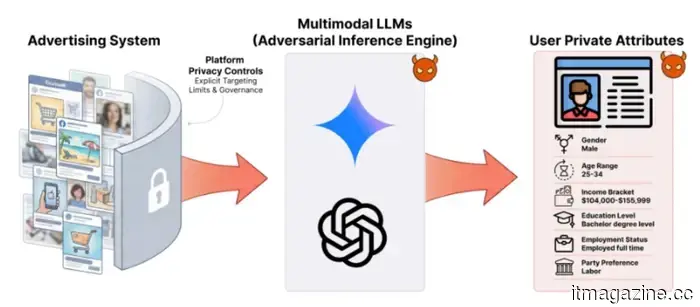
You may consider the ads you come across daily as mere background noise, but recent research indicates they have a far greater impact than just promoting products. The study shows that AI can evaluate the advertisements presented to you online and reconstruct sensitive personal information about you (according to UNSW).
This information includes your political views, educational background, employment status, age, gender, and overall financial situation. What’s alarming is that you don’t even need to click on the ads; simply viewing them suffices.
How does this process operate?
Researchers examined over 435,000 Facebook ads shown to 891 users, gathered through a citizen science project known as the Australian Ad Observatory. They inputted these ad streams into commonly accessible large language models, similar to those used by many as daily AI assistants, and the findings were remarkable.
The AI was able to create comprehensive personal profiles based solely on brief browsing sessions. It didn’t require your search history or any information you actively provided. This method was also over 200 times less expensive and 50 times quicker than employing human analysts for the same purpose.
The effectiveness of this approach lies in the fact that ad delivery systems are not random. Platforms optimize the ads you see based on inferred profiles derived from your behavior, leaving behind a type of fingerprint that AI can interpret.
Why current privacy measures fall short
Despite major platforms prohibiting advertisers from directly targeting sensitive categories, the study reveals that these characteristics are still indirectly incorporated into ad delivery patterns.
Researchers noted that common browser extensions, such as ad blockers or coupon finders, could discreetly gather this data in the background without any warning signs.
To minimize risk, researchers advise users to restrict browser extension permissions and modify ad personalization settings. However, they emphasize that this is not a challenge individuals can address alone. The weakness is embedded in the ad ecosystem itself, and enhanced platform-level protections are necessary to combat it.
Manisha Priyadarshini is a technology and entertainment writer with more than nine years of editorial experience.
Next-gen DDR6 memory with incredible speeds is under development, but there’s a long wait ahead.
Samsung, SK Hynix, and Micron are already progressing on your next PC's memory upgrade. The commercial rollout of DDR5 began in 2021 as it gradually became the prevailing standard, and the industry is now focusing on what’s next. According to TheElec, Samsung Electronics, SK Hynix, and Micron have started early development of DDR6, the forthcoming generation of memory protocol. The three companies have shared their designs with substrate manufacturers, who are currently creating initial prototypes and conducting verification tests.
Asus Zenbook A16 Review: Is it a sleek MacBook challenger from the Windows camp?
This light and stylish 16-inch powerhouse boasts reliable battery life. What more could you want?
How to use WhatsApp Web
We’ll guide you on how to access WhatsApp on your desktop or laptop.
As one of the leading messaging platforms, you’ve likely come across WhatsApp. From its modest beginnings in 2009—two years before Apple launched iMessage—to its acquisition by Facebook (now Meta) in 2014, WhatsApp has evolved into the premier messaging service worldwide. In recent years, it has become even more powerful with features such as video messages, self-destructing voice messages, the option to edit sent messages, and more. We even finally received a WhatsApp iPad app in May 2025.






Other articles
 Researchers have discovered a concealed galaxy within the Milky Way, which they have named Loki.
A recent study indicates that the Milky Way absorbed an ancient dwarf galaxy billions of years ago, and its stellar remnants may still be integrated within our galaxy.
Researchers have discovered a concealed galaxy within the Milky Way, which they have named Loki.
A recent study indicates that the Milky Way absorbed an ancient dwarf galaxy billions of years ago, and its stellar remnants may still be integrated within our galaxy.
 The hopes for a face unlock feature on the Pixel 11 that could rival the iPhone appear to be dashed.
Google's rumored competitor to Face ID might not make it into the Pixel 11 series, causing Pixel enthusiasts to wait even longer for the secure, hardware-supported face unlock feature they've desired since the Pixel 4.
The hopes for a face unlock feature on the Pixel 11 that could rival the iPhone appear to be dashed.
Google's rumored competitor to Face ID might not make it into the Pixel 11 series, causing Pixel enthusiasts to wait even longer for the secure, hardware-supported face unlock feature they've desired since the Pixel 4.
 Researchers have discovered a concealed galaxy within the Milky Way, which they have named Loki.
A recent study indicates that the Milky Way absorbed an ancient dwarf galaxy billions of years ago, and its stellar remnants may still be integrated within our galaxy.
Researchers have discovered a concealed galaxy within the Milky Way, which they have named Loki.
A recent study indicates that the Milky Way absorbed an ancient dwarf galaxy billions of years ago, and its stellar remnants may still be integrated within our galaxy.
 5 fantastic Netflix series to enjoy on New Year’s Day and later.
Whether you're looking for something easygoing that you can keep on in the background or a series to dive into, these five selections offer both, providing you with choices that are simple to begin and rewarding to stick with throughout the day.
5 fantastic Netflix series to enjoy on New Year’s Day and later.
Whether you're looking for something easygoing that you can keep on in the background or a series to dive into, these five selections offer both, providing you with choices that are simple to begin and rewarding to stick with throughout the day.
 The hopes for a face unlock feature on the Pixel 11 that could rival the iPhone's seem to be all but over.
Google's speculated alternative to Face ID might not be included in the Pixel 11 series, causing Pixel enthusiasts to wait even longer for the secure, hardware-based face unlock feature they have desired since the Pixel 4.
The hopes for a face unlock feature on the Pixel 11 that could rival the iPhone's seem to be all but over.
Google's speculated alternative to Face ID might not be included in the Pixel 11 series, causing Pixel enthusiasts to wait even longer for the secure, hardware-based face unlock feature they have desired since the Pixel 4.
 Samsung's upcoming Ultra phone may feature a larger and more versatile main camera to surpass the iPhone 18 Pro.
Samsung's upcoming Ultra phone is likely to feature a 200MP camera with a variable aperture, increasing the pressure on Apple as the iPhone 18 Pro readies its significant camera and AI photography enhancements.
Samsung's upcoming Ultra phone may feature a larger and more versatile main camera to surpass the iPhone 18 Pro.
Samsung's upcoming Ultra phone is likely to feature a 200MP camera with a variable aperture, increasing the pressure on Apple as the iPhone 18 Pro readies its significant camera and AI photography enhancements.
Research reveals that online advertisements are revealing more about your private life than you anticipated.
Recent studies indicate that the advertisements displayed online contain sufficient information for AI to create a comprehensive personal profile, even without any clicks or data sharing from you.