
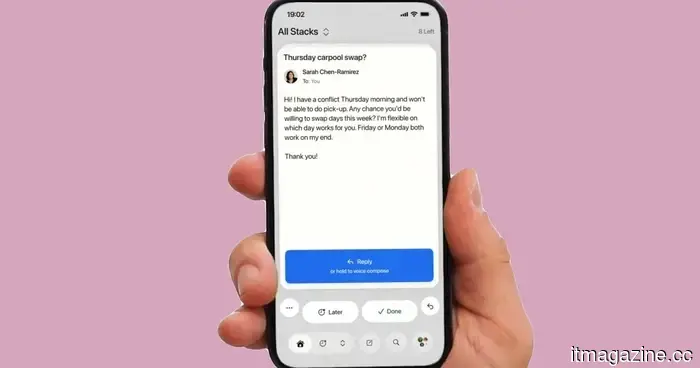
We created AI to alleviate the burden of email, yet it somehow ended up making email even more draining.
Crafting an email has become one of the duller aspects of contemporary work life, leading the tech sector to seek automation solutions. The intention behind AI was to alleviate workloads by handling mundane tasks—managing repetitive emails, reducing inbox clutter, and reclaiming valuable time. It seemed like a promising concept. However, in reality, we are far from eliminating the frustration associated with email.
The type of email that you’re already tired of encountering
AI reduces the effort involved in creating corporate-sounding messages. As a result, phrases like “just following up,” “circling back,” “gentle reminder,” and “happy to connect” are now simpler to produce and increasingly difficult to escape.
A person who might have previously opted out of sending a meaningless email can now use AI to draft one in mere seconds. Meanwhile, a response that could have been wrapped up in a couple of short sentences now often involves a more polished, lengthier, and seemingly “professional” version generated by a chatbot. A recent report by The Guardian highlighted worker dissatisfaction with AI-generated output in the workplace, including a term some employees have coined as “workslop.”
AI has merely intensified poor email habits
Email has never served solely as a means of communication. It also functions as a means to convey responsiveness, usefulness, and activity. Quick replies, full calendars, and extended threads often create an illusion of productivity, even when much of it is unnecessary. AI fits smoothly into this environment, providing faster replies, quicker summaries, and prompt scheduling, thereby maintaining the facade of ongoing progress.
Office email already prioritizes performance as much as actual usefulness. Now, every half-formed idea can transform into a refined paragraph. Sentences can be enhanced, and trivial updates can be expanded into something more formal, diplomatic, corporate, and ultimately, more lifeless. Employing AI does not enhance your communication; instead, it simply increases its volume. Your inbox now contains more messages, filler content, and new jargon designed to sound productive without necessarily being beneficial.
As more people begin to adopt this practice, the situation deteriorates further. When one person sends a polished email enhanced by AI, the response can utilize similar AI-assisted language. If someone later joins the conversation and uses AI to summarize it before sending their own reply, the dialogue continues but becomes increasingly less human with each exchange.
So, who is communicating with whom?
At such a point, the idea of bots emailing other bots is no longer amusing. Specialized tools like AI email assistants and scheduling bots may offer isolated benefits, but they are still part of the overarching issue. Tools such as Read AI’s Ada can manage meeting logistics and engage in email discussions, making the notion of “AI conversing with AI” feel much less absurd.
What began as a reliance on AI for a single innocuous email quickly escalated into a culture where email has become even more cumbersome and performative. We expected relief from one of the most exhausting aspects of digital work, yet it appears that new technology has merely sustained the existing system rather than dismantling it.
Other articles
 Apple has increased the cost of the Mac mini without changing its listed price.
Buying the Mac mini on a budget has become more difficult now that Apple has discontinued its $599 model amid a worsening shortage of memory and storage.
Apple has increased the cost of the Mac mini without changing its listed price.
Buying the Mac mini on a budget has become more difficult now that Apple has discontinued its $599 model amid a worsening shortage of memory and storage.
 Microsoft has developed an AI assistant for lawyers within Word. Let's hope it doesn't act unpredictably.
A new AI legal assistant is set to be integrated into Word, as attorneys and the judiciary become increasingly aware of the high costs associated with inaccurate citations from chatbots.
Microsoft has developed an AI assistant for lawyers within Word. Let's hope it doesn't act unpredictably.
A new AI legal assistant is set to be integrated into Word, as attorneys and the judiciary become increasingly aware of the high costs associated with inaccurate citations from chatbots.
 Do you believe that vibe-coding will make you a wealthy entrepreneur? You may want to take a look at the risk briefing.
A recent report by the Association for Computing Machinery indicates that vibe coding poses significant risks related to security, testing, and the quality of code over time.
Do you believe that vibe-coding will make you a wealthy entrepreneur? You may want to take a look at the risk briefing.
A recent report by the Association for Computing Machinery indicates that vibe coding poses significant risks related to security, testing, and the quality of code over time.
We created AI to alleviate the burden of email, yet it somehow ended up making email even more draining.
The bleak outlook for AI goes beyond just robots taking jobs. It also involves bots that continuously send emails to other bots, while humans act as though this constitutes progress.