
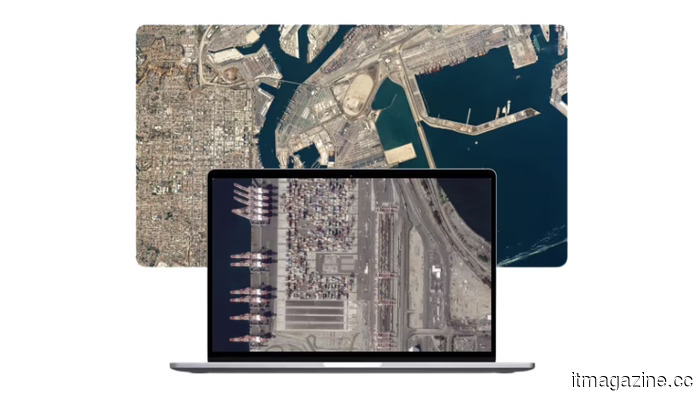
Planet Labs introduces three additional Pelican satellites as a $900 million backlog and defense contracts lead to its first profitable year.
**Summary**
On May 3, Planet Labs deployed three additional Pelican high-resolution satellites, expanding its constellation to nine satellites as part of a plan to grow to 32 spacecraft capable of capturing images of any location on Earth up to 30 times daily at a resolution of 30 centimeters. As the first New Space firm to achieve profitability, Planet has a $900 million backlog fueled by defense contracts, including a €240 million deal with the German government and contracts with NRO, NGA, and NATO.
At 2:59 a.m. Eastern Time on May 3, a SpaceX Falcon 9 rocket took off from Vandenberg Space Force Base, carrying 45 satellites, three of which were Pelicans (7, 8, and 9), enhancing Planet’s next-gen high-resolution Earth observation fleet to nine. Each satellite captures images at 50 centimeters resolution across six multispectral bands and is equipped with Nvidia’s Jetson AI platform for on-board data processing, allowing real-time analysis before the data is sent to Earth. Planet intends to launch its second-generation Pelicans in late 2026, improving resolution to 30 centimeters. The complete constellation will consist of 32 satellites capable of revisiting any location up to ten times per day globally, and up to 30 times at mid-latitudes.
While the launch is a pivotal event, the real narrative centers on what Planet is constructing with these satellites and the value of that capability for governments, military, and enterprises that require near real-time monitoring of Earth.
**Business Overview**
Planet Labs emerged as the first New Space company to become profitable on both an annual EBITDA and free cash flow basis in late 2025. In its fiscal third quarter of 2026, the firm reported revenues of $81.3 million, a 33 percent year-on-year increase that surpassed analyst expectations. Revenue projections for fiscal year 2027 are between $415 million and $440 million, roughly 39 percent higher than fiscal 2026. The total contract backlog reached $900 million by March 2026, with over 90 percent of revenues stemming from recurring subscriptions, leading to gross margins of 58 percent.
The financial trend indicates a significant shift in the consumption of Earth observation data. Rather than selling individual satellite images, Planet offers subscriptions to an ever-evolving data feed that covers the globe. AI companies in need of large-scale data infrastructures are reshaping the earth observation market, and Planet’s fleet of over 200 PlanetScope Dove satellites captures the entire landmass of Earth every 24 hours at a 3.7-meter resolution, fulfilling this need. The Pelican satellites add a high-resolution capability, allowing for targeted imaging of specific areas at 50 centimeters resolution, with AI processing the images on-site before reaching customers.
The defense and intelligence sectors are driving significant revenue growth for Planet. In 2025, the company secured a €240 million multi-year agreement with the German government for dedicated Pelican satellite resources over specific European areas, alongside PlanetScope and SkySat data and AI-powered situational awareness tools. The U.S. National Reconnaissance Office renewed its baseline contract for PlanetScope data and set up a framework for ordering high-resolution Pelican images, while the National Geospatial-Intelligence Agency awarded a $12.8 million contract for AI-enabled maritime monitoring in the Asia-Pacific. NATO also selected Planet for a seven-figure persistent surveillance contract, and NASA granted a $13.5 million task order.
AI-enhanced satellite surveillance is increasingly integral to European maritime security, and demand extends beyond conventional defense uses. Insurers employ Planet’s data to evaluate crop damage and property risk, commodity traders utilize it to predict agricultural outputs and port activity, and environmental agencies track deforestation, illegal mining, and methane emissions. All these customers require consistent, reliable global coverage, which Planet’s constellation is designed to provide at an unmatched cost per image compared to traditional satellite operators.
**Competitive Landscape**
The earth observation satellite sector was valued at around $7 billion in 2025 and is expected to reach $14.5 billion by 2034, growing at an approximate annual rate of 8 percent. In 2024, Vantor, previously known as Maxar Intelligence, led the market with a 21.3 percent share, followed closely by Airbus Defense and Space. Competitors such as Planet, BlackSky, ICEYE, and Capella Space operate across various resolution tiers, revisit frequencies, and imaging modalities. While Vantor and Airbus provide the highest-resolution optical imagery, ICEYE and Capella specialize in synthetic aperture radar capable of imaging through clouds and at night. Planet's advantage lies not in resolution but in its coverage and revisit rates.
The Pelican constellation aims to bridge the resolution gap with Vantor and Airbus while maintaining Planet's structural edge in frequency. A 32-satellite configuration offering 30-centimeter imagery with up to 30 daily revisits
Other articles
 China's smartphone supply chain shifts towards humanoid robots, with Lingyi iTech aiming for 500,000 units by 2030.
Lingyi iTech, Lens Technology, and Foxconn are converting smartphone manufacturing plants for the production of humanoid robots. Morgan Stanley has revised its 2026 forecast for China, increasing it to 28,000 units.
China's smartphone supply chain shifts towards humanoid robots, with Lingyi iTech aiming for 500,000 units by 2030.
Lingyi iTech, Lens Technology, and Foxconn are converting smartphone manufacturing plants for the production of humanoid robots. Morgan Stanley has revised its 2026 forecast for China, increasing it to 28,000 units.
 Google has finally clarified why Android AICore consumes so much of your storage, and it truly makes a lot of sense.
If you've ever observed that Android AICore is consuming more storage than anticipated, Google has now provided an explanation — and it turns out that the reason is a completely sensible fail-safe that you'd likely want to have.
Google has finally clarified why Android AICore consumes so much of your storage, and it truly makes a lot of sense.
If you've ever observed that Android AICore is consuming more storage than anticipated, Google has now provided an explanation — and it turns out that the reason is a completely sensible fail-safe that you'd likely want to have.
 The Oscars have prohibited AI actors and AI-generated scripts by establishing new human authorship guidelines and an Affidavit of Human Origin for the 99th ceremony.
The Academy mandates that acting roles must be "clearly performed by humans" and screenplays must be "written by humans" for the 99th Oscars. However, AI tools remain permissible in the VFX and technical categories.
The Oscars have prohibited AI actors and AI-generated scripts by establishing new human authorship guidelines and an Affidavit of Human Origin for the 99th ceremony.
The Academy mandates that acting roles must be "clearly performed by humans" and screenplays must be "written by humans" for the 99th Oscars. However, AI tools remain permissible in the VFX and technical categories.
 Grok is set to be integrated with CarPlay as iOS 26.4 transforms the car dashboard into the next battleground for AI platforms.
Grok has been added to CarPlay alongside ChatGPT, Perplexity, Claude, and Gemini following the release of iOS 26.4, which allowed AI chatbots on the platform. The car dashboard has become the most competitive interface in technology.
Grok is set to be integrated with CarPlay as iOS 26.4 transforms the car dashboard into the next battleground for AI platforms.
Grok has been added to CarPlay alongside ChatGPT, Perplexity, Claude, and Gemini following the release of iOS 26.4, which allowed AI chatbots on the platform. The car dashboard has become the most competitive interface in technology.
 Apple abandons its net cash neutral goal as incoming CEO Ternus gets ready to make investments in AI and acquisitions.
Apple has discontinued its net cash neutral policy following Q2 earnings of $111.2 billion. Incoming CEO Ternus will now have the ability to invest instead of solely returning cash to shareholders.
Apple abandons its net cash neutral goal as incoming CEO Ternus gets ready to make investments in AI and acquisitions.
Apple has discontinued its net cash neutral policy following Q2 earnings of $111.2 billion. Incoming CEO Ternus will now have the ability to invest instead of solely returning cash to shareholders.
 DJI is prohibited in both Beijing and Washington as security concerns regarding drones pressure the world's leading manufacturer from both directions.
Beijing prohibited all drone sales starting May 1. In December, the US FCC prohibited new products from DJI. The company that pioneered the industry finds itself in a conflict involving two governments.
DJI is prohibited in both Beijing and Washington as security concerns regarding drones pressure the world's leading manufacturer from both directions.
Beijing prohibited all drone sales starting May 1. In December, the US FCC prohibited new products from DJI. The company that pioneered the industry finds itself in a conflict involving two governments.
Planet Labs introduces three additional Pelican satellites as a $900 million backlog and defense contracts lead to its first profitable year.
Planet Labs deployed Pelicans 7-9 featuring Nvidia AI, progressing toward a 32-satellite constellation. The company achieved profitability, boasting a $900M backlog along with significant agreements with NATO and the NRO.