
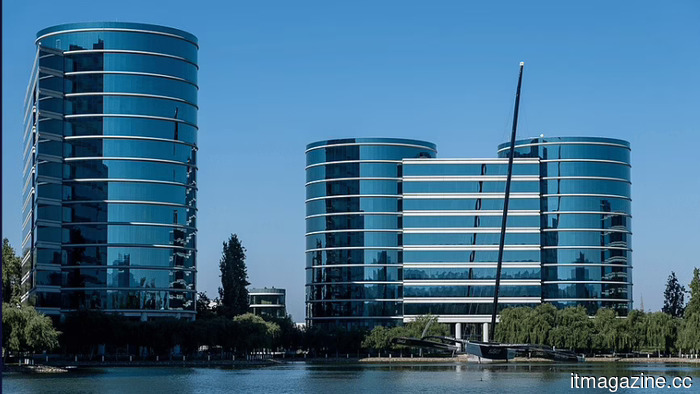
Oracle's stock has dropped by 50% even though there is a buy consensus on Wall Street, as concerns about concentration have been heightened by a $300 billion deal with OpenAI.
Oracle’s stock has declined by 50% from its peak in September, even though 41 out of 51 Wall Street analysts recommend it as a buy, with an estimated 43% upside potential. The gap in perception stems from Oracle’s $300 billion Stargate agreement with OpenAI, where investors are concerned about circular financing risks; OpenAI is both a customer and an investor in the companies financing it. Analysts, however, believe that demand for AI infrastructure is adaptable and that Oracle is significantly undervalued.
Since reaching a record high in September, Oracle’s shares have plummeted nearly 50%, with a 14% decline in the six trading days leading up to Thursday, marking its poorest performance in months. Out of 51 Wall Street analysts monitored by Bloomberg who provide coverage on Oracle, 41 have buy ratings, and only one has a sell rating. The average price target indicates a potential rise of 43% over the next year, among the highest expected gains for large-cap stocks similar to Oracle. One portfolio manager described the stock as presenting “an incredibly attractive entry point,” suggesting a price target that is double the current share price. Another dismissed concerns regarding Oracle's debt as “ridiculous.” While analysts remain optimistic, investors are offloading shares. This divergence isn't attributed to Oracle's quarterly results, which showed a remarkable 95% increase in net income and a 433% year-on-year rise in remaining performance obligations amounting to $523 billion. It focuses on one major client.
The deal’s foundation
Oracle’s growth strategy significantly relies on a $300 billion, five-year collaboration with OpenAI, aiming to provide cloud computing infrastructure for Stargate, an AI infrastructure venture announced in January 2025, involving OpenAI, SoftBank, and Oracle. SoftBank has arranged an unprecedented $40 billion loan to support part of this endeavor. Oracle’s task involves constructing and managing the data centers necessary for OpenAI’s computational needs in training and deploying its models. Originally, this $300 billion contract helped bolster Oracle’s stock. Now, it has emerged as the reason for its decline. The crucial question for investors is not whether Oracle can construct the infrastructure but whether OpenAI can afford to pay for it.
OpenAI has secured agreements worth hundreds of billions across various cloud providers, projecting that its revenue will surge from about $25 billion today to $280 billion by 2030. The company anticipates a cash burn of $25 billion in 2026, targeting $30 billion in revenue. A report released this week indicated that OpenAI fell short of its internal revenue and user growth goals, with its finance chief cautioning that stagnating revenue growth could hinder future funding for compute contracts. On the day of this report, Oracle's shares dropped by 4.1%.
The circularity issue
Investors have recognized a systemic issue with Oracle’s association with OpenAI, which most analysts have downplayed. OpenAI serves as a customer to several firms that have invested in it. The organization receives funding from Microsoft, which supplies Azure infrastructure, while also having contracts with Oracle, which has financially backed the Stargate project. Moreover, it has committed $100 billion to AWS over eight years. The companies constructing OpenAI’s infrastructure are often the same ones providing funding for its operations. If OpenAI's revenue growth decelerates, its capacity to fulfill these contracts diminishes, directly impacting the companies that are both losing a crucial customer and an investment stake. The risk extends beyond Oracle’s reliance on OpenAI for revenue; it pertains to the entire financial framework being interconnected. A slowdown at OpenAI would concurrently lower Oracle’s revenue, undermine its investment, and devalue the infrastructure built specifically for this collaboration.
OpenAI has already halted its Stargate UK data center initiative, citing prohibitive electricity costs and a challenging regulatory landscape concerning AI copyright. The planned Stargate data center in Abu Dhabi faces geopolitical risks related to the conflict with Iran. When Oracle and OpenAI decided against further expansion of a data center in Abilene, Texas, in March, Meta swiftly considered leasing the site, with Nvidia facilitating discussions. Oracle's supporters argue that Meta’s involvement demonstrates the demand for AI infrastructure is adaptable: if one client cannot utilize a data center, another will step in. However, skeptics point out that Meta is already a client of CoreWeave and Nebius, but not Oracle, and that merely considering a lease does not equate to signing a $300 billion agreement.
The bullish perspective
Wall Street's position is clear: the demand for AI infrastructure is concrete and on the rise. Oracle has laid off up to 30,000 employees to reallocate $8 billion to $10 billion in annual cash flow towards data center construction, a move TD Cowen analysts describe as propelling the company's shift toward AI. The infrastructure Oracle is erecting—data centers outfitted with Nvidia GPUs and high-speed networking—will be essential for every business involved
Other articles
 Why a Canadian bank is attempting to forecast earthquakes using quantum computers.
BMO has submitted a provisional patent for a quantum algorithm designed to predict earthquakes and employs AI to send mobile branches into areas affected by wildfires.
The $599 Mac mini from Apple is no longer available. The cause? The AI agents.
Apple has stopped offering the $599 Mac mini and increased the starting price to $799, mentioning the demand for AI and agentic tools as the reason for the strain on its desktop supply.
Why a Canadian bank is attempting to forecast earthquakes using quantum computers.
BMO has submitted a provisional patent for a quantum algorithm designed to predict earthquakes and employs AI to send mobile branches into areas affected by wildfires.
The $599 Mac mini from Apple is no longer available. The cause? The AI agents.
Apple has stopped offering the $599 Mac mini and increased the starting price to $799, mentioning the demand for AI and agentic tools as the reason for the strain on its desktop supply.
 ByteDance's Anew Labs unveils its inaugural AI-created therapy as the parent company of TikTok joins the competition in drug discovery.
ByteDance's pharmaceutical division presented an AI-designed IL-17 inhibitor at a conference in Boston. This molecule focuses on interactions that the pharmaceutical industry has labeled as undruggable. Only clinical trials will provide answers.
ByteDance's Anew Labs unveils its inaugural AI-created therapy as the parent company of TikTok joins the competition in drug discovery.
ByteDance's pharmaceutical division presented an AI-designed IL-17 inhibitor at a conference in Boston. This molecule focuses on interactions that the pharmaceutical industry has labeled as undruggable. Only clinical trials will provide answers.
 AI chip manufacturer Cerebras aims for an initial public offering (IPO) of up to $4 billion, with a valuation of $40 billion.
Cerebras aims to raise as much as $4 billion at a valuation of $40 billion in its Nasdaq IPO, supported by a $10 billion computing agreement with OpenAI and approval from CFIUS.
AI chip manufacturer Cerebras aims for an initial public offering (IPO) of up to $4 billion, with a valuation of $40 billion.
Cerebras aims to raise as much as $4 billion at a valuation of $40 billion in its Nasdaq IPO, supported by a $10 billion computing agreement with OpenAI and approval from CFIUS.
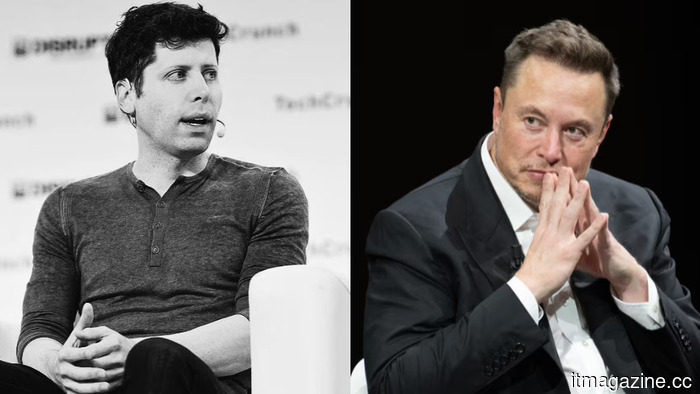 Musk's lawsuit against OpenAI is entering its first week.
La demanda de Elon Musk de $130 mil millones contra OpenAI enfrentó varios obstáculos en su primera semana, incluida su admisión de que xAI se basa en los modelos de OpenAI para su entrenamiento.
The $599 Mac mini from Apple is no longer available. The reason? It’s the fault of the AI agents.
Apple has phased out the $599 Mac mini and increased the starting price to $799, attributing this change to the rising demand for AI and agentic tools that is putting pressure on its desktop supply.
Musk's lawsuit against OpenAI is entering its first week.
La demanda de Elon Musk de $130 mil millones contra OpenAI enfrentó varios obstáculos en su primera semana, incluida su admisión de que xAI se basa en los modelos de OpenAI para su entrenamiento.
The $599 Mac mini from Apple is no longer available. The reason? It’s the fault of the AI agents.
Apple has phased out the $599 Mac mini and increased the starting price to $799, attributing this change to the rising demand for AI and agentic tools that is putting pressure on its desktop supply.
Oracle's stock has dropped by 50% even though there is a buy consensus on Wall Street, as concerns about concentration have been heightened by a $300 billion deal with OpenAI.
Out of 51 analysts, 41 have given Oracle a buy rating. The stock has decreased by 50%. The difference represents a $300 billion wager on OpenAI's ability to increase its revenue tenfold.