
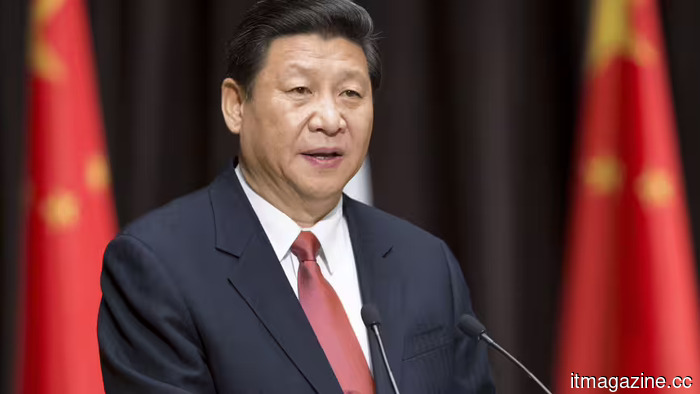
Beijing has issued a warning to the EU following the inclusion of 27 Chinese companies in the 20th sanctions package against Russia, and it has taken retaliatory measures against European defense firms.
China has criticized the EU’s 20th sanctions package, which targeted around 27 Chinese and Hong Kong entities for supplying dual-use goods to Russia’s military sector. Within a day of the sanctions being enacted, Beijing responded by adding seven EU defense firms to its own export control list, framing this action as related to Taiwan rather than acknowledging its link to Russia. The EU faces a fundamental contradiction: while it needs to limit Chinese tech exports to Russia, its defense initiatives rely on Chinese rare earth magnets and crucial minerals that China can restrict in retaliation.
On Saturday, China’s Ministry of Commerce formally condemned the European Union's inclusion of about 27 Chinese and Hong Kong entities in its largest sanctions round against Russia in two years. Beijing claimed that this action contradicts the consensus reached between Chinese and EU leaders and seriously undermines mutual trust and the overall stability of their relationship, warning that it would take necessary measures to protect the legitimate rights of Chinese enterprises, with the EU bearing all implications. Within 24 hours of the sanctions being adopted on April 23, China listed seven EU entities on its own export control list, prohibiting all dual-use exports to them. These sanctions primarily targeted defense firms in Belgium, Germany, and the Czech Republic, but China justified the measures as punishment for “arms sales to or collusion with Taiwan,” thereby sidestepping the Russia issue.
The sanctions package was approved on April 23 after a two-month delay influenced by Hungary and Slovakia, which had linked their approval to the resumption of Russian oil transport through the Druzhba pipeline. Once oil flows resumed, both countries lifted their objections. This package introduced 120 new individual and entity listings, focusing on 56 entities in Russia's military and energy sectors, imposed transaction bans on 20 Russian banks and four other financial institutions, added 46 shadow fleet vessels for a total of 632, and implemented new restrictions on cryptocurrency platforms and digital ruble transactions. For the first time, the Kyrgyz Republic was designated as a systematic circumvention risk. Alongside these sanctions, the EU also announced a 90 billion euro loan to Ukraine, with diplomatic efforts for a 21st sanctions package already underway.
The sanctioned Chinese entities fell into two categories. Sixteen entities located in various countries, including China, the UAE, Uzbekistan, Kazakhstan, and Belarus, were sanctioned under asset freezes for supplying dual-use goods or weapons systems to the Russian military. Of the 60 entities given enhanced export restrictions, 28 are based in China and Hong Kong, facing tighter controls on dual-use technology exports. China Space Sanjiang Group, a state-owned enterprise, was sanctioned under Belarus sanctions for the first time due to its role in producing military equipment. The escalation is evident, with the 16th package in February 2025 targeting seven Chinese entities, the 17th adding five, the 18th including two financial institutions, the 19th affecting 12 entities, and the 20th reaching 27. Each package intensifies the measures, just as China's responses become increasingly assertive.
China-Russia bilateral trade remained stable at $245 billion in 2024, more than twice the 2020 levels, before experiencing a 6.9% decline in 2025 due to financial sanctions complicating payment processes and Chinese banks being wary of potential secondary sanctions. Nonetheless, the decline did not apply to critical goods involved in the sanctions debate. In the first half of 2025, China exported $1.9 billion in “high priority” dual-use items to Russia, with full-year dual-use shipments exceeding $4 billion for both 2024 and 2025. Exports of manganese ore to Russia surged from 42 tons in 2023 to 47,000 tons in 2024 and reached 126,000 tons in the first half of 2025. Chinese turbojet engine exports to Russia in the first half of 2025 surpassed the combined total for 2023 and 2024 by 37%. The prices for export-controlled Chinese goods sent to Russia increased by an average of 87% from 2021 to 2024, in contrast to a 9% rise for similar goods shipped to other nations. This premium reflects the risks involved and the leverage that Chinese suppliers possess.
The United States has been sanctioning Chinese companies for their support of Russia since 2024, taking a more aggressive stance than the EU. In October 2024, the Treasury Department sanctioned two Chinese drone manufacturers for producing long-range drones for the Russian Air Force, marking the first instance of the U.S. designating Chinese companies for directly manufacturing weapons for Russia. In 2025, over 20 Chinese and Hong Kong firms were sanctioned for providing essential components to Russia's defense industry, with the Commerce Department blacklisting Shanghai Fudan Microelectronics due to technology transfers. Congress introduced the STOP China and Russia Act to formalize sanctions against mutual military aid. The EU’s 20th
Other articles
 Sam Altman has issued an apology following OpenAI's decision not to report the ChatGPT user involved in the Tumbler Ridge school shooting.
OpenAI identified the Tumbler Ridge shooter's ChatGPT account as a concern 8 months prior to the incident. Staff suggested notifying law enforcement, but their superiors dismissed the recommendation. Altman's apology does not bridge the gap.
The trial between Musk and Altman starts, with $150 billion on the line due to OpenAI's shift from a nonprofit to a for-profit model.
Jury selection will begin on Monday for the Musk-Altman trial. In his 2017 diary, Brockman referred to OpenAI's nonprofit pledge as "a lie." The judge has determined there is "ample evidence" and will independently decide on the remedies.
Foundation Future Industries secures $24 million contracts from the Pentagon for humanoid robot soldiers, with support from Eric Trump and trialed in Ukraine.
Foundation Future Industries has obtained $24 million in Pentagon contracts for humanoid robots that were tested in Ukraine. The company's CEO previously led a bankrupt fintech, an adviser to the firm is Eric Trump, and it is seeking $500 million at a valuation exceeding $3 billion.
Sam Altman has issued an apology following OpenAI's decision not to report the ChatGPT user involved in the Tumbler Ridge school shooting.
OpenAI identified the Tumbler Ridge shooter's ChatGPT account as a concern 8 months prior to the incident. Staff suggested notifying law enforcement, but their superiors dismissed the recommendation. Altman's apology does not bridge the gap.
The trial between Musk and Altman starts, with $150 billion on the line due to OpenAI's shift from a nonprofit to a for-profit model.
Jury selection will begin on Monday for the Musk-Altman trial. In his 2017 diary, Brockman referred to OpenAI's nonprofit pledge as "a lie." The judge has determined there is "ample evidence" and will independently decide on the remedies.
Foundation Future Industries secures $24 million contracts from the Pentagon for humanoid robot soldiers, with support from Eric Trump and trialed in Ukraine.
Foundation Future Industries has obtained $24 million in Pentagon contracts for humanoid robots that were tested in Ukraine. The company's CEO previously led a bankrupt fintech, an adviser to the firm is Eric Trump, and it is seeking $500 million at a valuation exceeding $3 billion.
 Sam Altman has issued an apology following OpenAI's decision not to report a ChatGPT user involved in the Tumbler Ridge school shooting.
OpenAI marked the ChatGPT account of the Tumbler Ridge shooter as suspicious eight months prior to the attack. Staff suggested notifying law enforcement, but their leadership decided against it. Altman's apology does not bridge the gap.
Sam Altman has issued an apology following OpenAI's decision not to report a ChatGPT user involved in the Tumbler Ridge school shooting.
OpenAI marked the ChatGPT account of the Tumbler Ridge shooter as suspicious eight months prior to the attack. Staff suggested notifying law enforcement, but their leadership decided against it. Altman's apology does not bridge the gap.
 AI stocks compared to the dot-com bubble: CAPE ratio at 38, concentration exceeds levels seen in 2000, but these companies are genuinely profitable.
The Shiller CAPE stands between 38 and 40, only surpassed by the dot-com peak of 44.19. The concentration in the top 10 exceeds levels seen in 2000. However, Nvidia generated $120 billion, and tech stocks are trading at 30 times earnings, not 50 times. Both perspectives hold validity.
AI stocks compared to the dot-com bubble: CAPE ratio at 38, concentration exceeds levels seen in 2000, but these companies are genuinely profitable.
The Shiller CAPE stands between 38 and 40, only surpassed by the dot-com peak of 44.19. The concentration in the top 10 exceeds levels seen in 2000. However, Nvidia generated $120 billion, and tech stocks are trading at 30 times earnings, not 50 times. Both perspectives hold validity.
 Sam Altman has issued an apology following OpenAI's decision not to report a ChatGPT user involved in the Tumbler Ridge school shooting.
Eight months prior to the attack, OpenAI marked the ChatGPT account of the Tumbler Ridge shooter as a concern. Staff suggested notifying law enforcement, but their recommendations were dismissed by management. Altman's apology cannot bridge this gap.
Sam Altman has issued an apology following OpenAI's decision not to report a ChatGPT user involved in the Tumbler Ridge school shooting.
Eight months prior to the attack, OpenAI marked the ChatGPT account of the Tumbler Ridge shooter as a concern. Staff suggested notifying law enforcement, but their recommendations were dismissed by management. Altman's apology cannot bridge this gap.
Beijing has issued a warning to the EU following the inclusion of 27 Chinese companies in the 20th sanctions package against Russia, and it has taken retaliatory measures against European defense firms.
China denounced the EU's 20th sanctions package aimed at 27 Chinese entities and responded within 24 hours by taking action against seven EU defense companies. Europe's rearmament is reliant on the rare earth materials controlled by Beijing.