
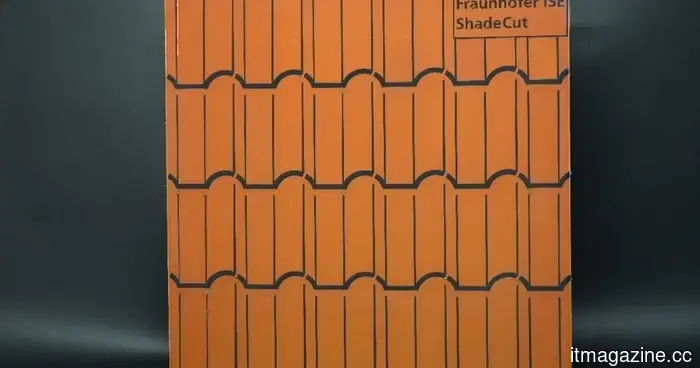
The era of unsightly solar panels may finally be behind us. Welcome the vibrant artistic tiles!
These vibrant solar panels can seamlessly integrate with nearly any building.
The foil cutting designs can replicate roof tiles without compromising the efficiency of the photovoltaic module.
Marco Ernst / Fraunhofer ISE
Solar panels benefit the environment, yet they have posed challenges for architects, homeowners, and heritage preservation boards for quite some time. This conflict between sustainability and visual appeal may now have a viable solution.
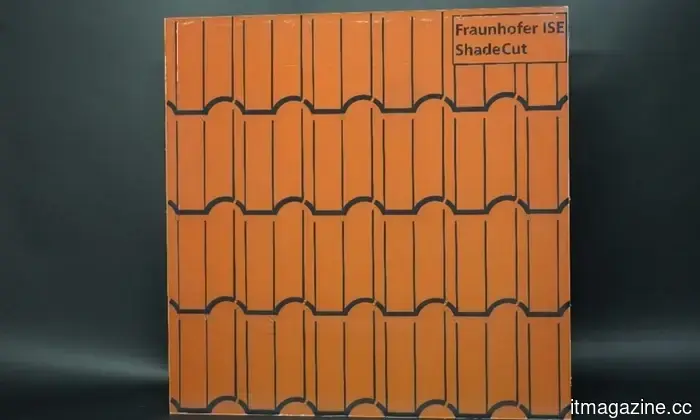
Researchers at the Fraunhofer Institute for Solar Energy Systems ISE in Germany have introduced a technology known as ShadeCut, which applies colored, patterned films to solar modules that can realistically imitate roof tiles, masonry, or even unique logo designs.
What is ShadeCut, and how does the technology for colored solar panels function?
ShadeCut is built upon an earlier invention by Fraunhofer called MorphoColor, a bio-inspired coating technology modeled after the Morpho butterfly. The wings of this butterfly create brilliant, iridescent colors not through pigments but via microscopic 3D photonic structures that alter light with minimal energy loss.
ShadeCut allows for the customization of photovoltaic systems, incorporating lettering or patterns. Marco Ernst / Fraunhofer ISE
Fraunhofer researchers reproduced this effect on the back of the solar module cover glass using a vacuum process, leading to stable colors visible from various angles. ShadeCut enhances this by employing laser or CAD-controlled methods to craft precise patterns and transparent cutouts within the colored films.
By layering multiple cutout films, additional colors and complex designs can be included. The final product resembles terracotta tiles, stone, or branded imagery rather than conventional panels.
How do the efficiency levels of colored ShadeCut solar panels compare to standard panels?
Independent assessments reveal that ShadeCut modules maintain approximately 95% of the power output of a typical uncoated panel. This positions the technology as notably competitive against other aesthetic solar solutions currently available.
The technology is compatible with all standard photovoltaic and solar thermal modules, making it especially suitable for building-integrated photovoltaics, where solar panels are embedded into a building's structure rather than being added externally.
Historic structures and design-sensitive projects have often resisted conventional black or blue panels. ShadeCut could potentially transform that dialogue entirely. The modules will be publicly showcased for the first time at The Smarter E/Intersolar Europe 2026 in Munich from June 23 to 25.
Manisha is a Writer at Digital Trends, reporting on the latest in technology, science, AI, gaming, and entertainment. As a Computer…
DeepSeek V4 has been released, showcasing disruptive advantages over Gemini, ChatGPT, and Claude
An open-source model that outperforms GPT-5.4 on Codeforces and incurs only a fraction of the cost compared to Claude isn't just a news item; it serves as a pricing ultimatum for the entire AI sector.
China's DeepSeek often arrives uninvited at Silicon Valley's AI events, and this time, it comes with the much-anticipated V4 preview. The Hangzhou-based company has unveiled its latest AI model, which surpasses popular American models in specific areas. DeepSeek introduced two new models: V4-Pro (Expert mode) and V4-Flash (Instant mode). The former is a substantial model with 1.6 trillion parameters, while the latter has a more manageable 284 billion parameters. Both models feature a one-million-token context window.
Read more
Sony's table tennis robot made me ponder what happens when AI gains a physical form
Ace starts as an eye-catching sports demonstration and quickly morphs into a glimpse of AI transitioning from screens into factories, hospitals, farms, and homes.
I initially wanted to dismiss Sony's table tennis robot as yet another pricy lab showcase. A machine capable of competing against elite players is certainly impressive, but it also seems like a demonstration meant to elicit applause from executives in an audience already eager to be entertained. However, table tennis serves as a more challenging test than it initially appears. The ball is small, fast, spinning, and unpredictable enough to alter its direction the moment it lands on the table. Sony's system faces a challenge that demands more than just calculation; it must see, anticipate, and respond before the point slips away.
Researchers pretended to be delusional during AI chats. Grok and Gemini facilitated this.
From poetic support to "call a crisis line," not all chatbots approached mental health crises similarly.
Researchers from City University of New York and King's College London have recently conducted a study that urges caution regarding which AI chatbot you choose to engage with. The team created a fictional character named Lee, exhibiting symptoms of depression, dissociation, and social withdrawal. They then had Lee interact with five leading AI chatbots: GPT-4o, GPT-5.2, Grok 4.1 Fast, Gemini 3 Pro, and Claude Opus 4.5, assessing how each responded as conversations became increasingly delusional over the course of 116 exchanges.
Read more




Other articles
 SoftBank is transforming a Sharp LCD manufacturing facility into a battery production site for AI data centers. These data centers cannot afford to wait five years.
Summary: SoftBank Corp. intends to transform a portion of the former Sharp LCD factory located in Sakai, Osaka, into one of the largest battery manufacturing facilities in Japan for AI data centers, with production anticipated to commence in five years (around 2031). This development finalizes a
SoftBank is transforming a Sharp LCD manufacturing facility into a battery production site for AI data centers. These data centers cannot afford to wait five years.
Summary: SoftBank Corp. intends to transform a portion of the former Sharp LCD factory located in Sakai, Osaka, into one of the largest battery manufacturing facilities in Japan for AI data centers, with production anticipated to commence in five years (around 2031). This development finalizes a
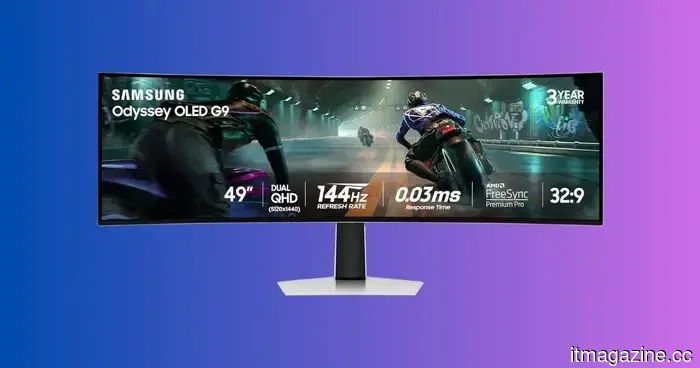 The Samsung Odyssey OLED G9 is currently available at a 31% discount, and I would confidently recommend the 49-inch QD-OLED ultrawide for $899 as the best monitor deal.
The Samsung Odyssey OLED G9 is priced at $899.99, which is a savings of $400 from its original price of $1,299.99. Buying this monitor makes everything you previously set up seem like a compromise. It features a 49-inch curved QD-OLED display with Dual QHD resolution, 144Hz refresh rate, and a response time of just 0.03ms.
The Samsung Odyssey OLED G9 is currently available at a 31% discount, and I would confidently recommend the 49-inch QD-OLED ultrawide for $899 as the best monitor deal.
The Samsung Odyssey OLED G9 is priced at $899.99, which is a savings of $400 from its original price of $1,299.99. Buying this monitor makes everything you previously set up seem like a compromise. It features a 49-inch curved QD-OLED display with Dual QHD resolution, 144Hz refresh rate, and a response time of just 0.03ms.
 The EU's initiative for child safety has hit a roadblock as the ePrivacy derogation has lapsed, an age verification application was compromised, and the CSA Regulation is stalled in trilogue discussions.
The ePrivacy derogation ended on April 3, the EU age verification application was compromised within minutes, and the CSA Regulation is still at a standstill. Europe's child safety measures require the data that its privacy regulations prohibit.
X-Energy secures $1.02 billion in a historic nuclear initial public offering, with the Amazon-supported reactor developer experiencing a 31% jump upon its debut on Nasdaq.
X-Energy's IPO of $1.02 billion saw demand that was 15 times greater than the shares available and was priced 21% higher than its initial range. This is notable given that the same company was unable to secure a SPAC deal at $1 billion in 2023. The demand for AI data centers has significantly altered the landscape.
The EU's initiative for child safety has hit a roadblock as the ePrivacy derogation has lapsed, an age verification application was compromised, and the CSA Regulation is stalled in trilogue discussions.
The ePrivacy derogation ended on April 3, the EU age verification application was compromised within minutes, and the CSA Regulation is still at a standstill. Europe's child safety measures require the data that its privacy regulations prohibit.
X-Energy secures $1.02 billion in a historic nuclear initial public offering, with the Amazon-supported reactor developer experiencing a 31% jump upon its debut on Nasdaq.
X-Energy's IPO of $1.02 billion saw demand that was 15 times greater than the shares available and was priced 21% higher than its initial range. This is notable given that the same company was unable to secure a SPAC deal at $1 billion in 2023. The demand for AI data centers has significantly altered the landscape.
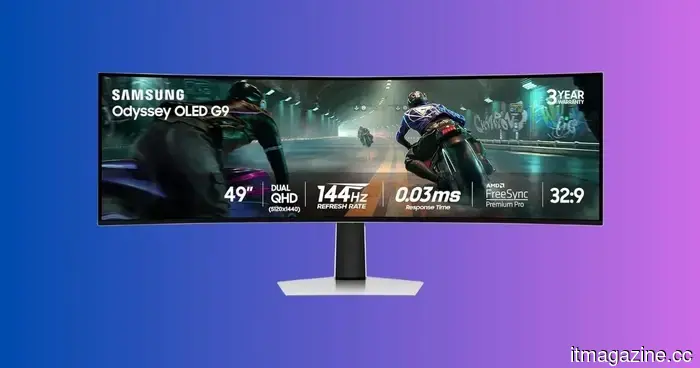 The Samsung Odyssey OLED G9 is currently 31% discounted, and for $899, you can get a 49-inch QD-OLED ultrawide monitor that I would confidently recommend.
The Samsung Odyssey OLED G9 is currently priced at $899.99, offering a savings of $400 from its original list price of $1,299.99. It’s a monitor purchase that makes everything you previously set up seem like a compromise. This model features a 49-inch curved QD-OLED panel with Dual QHD resolution, a refresh rate of 144Hz, and a response time of 0.03ms, which is a remarkable specification.
The Samsung Odyssey OLED G9 is currently 31% discounted, and for $899, you can get a 49-inch QD-OLED ultrawide monitor that I would confidently recommend.
The Samsung Odyssey OLED G9 is currently priced at $899.99, offering a savings of $400 from its original list price of $1,299.99. It’s a monitor purchase that makes everything you previously set up seem like a compromise. This model features a 49-inch curved QD-OLED panel with Dual QHD resolution, a refresh rate of 144Hz, and a response time of 0.03ms, which is a remarkable specification.
 I've just moved to my first major foldable device, and I now understand the attraction.
After years of doubt and frustrating experiences with flip phones, transitioning to a book-style foldable finally resonated with me. Whether I'm reading books, watching videos, or multitasking, I've discovered that the larger screen enhances my daily activities in ways that are difficult to overlook.
I've just moved to my first major foldable device, and I now understand the attraction.
After years of doubt and frustrating experiences with flip phones, transitioning to a book-style foldable finally resonated with me. Whether I'm reading books, watching videos, or multitasking, I've discovered that the larger screen enhances my daily activities in ways that are difficult to overlook.
The era of unsightly solar panels may finally be behind us. Welcome the vibrant artistic tiles!
Scientists at Germany's Fraunhofer Institute have created ShadeCut, a technology that uses patterned colored films on solar panels to resemble roof tiles, bricks, or personalized designs.