
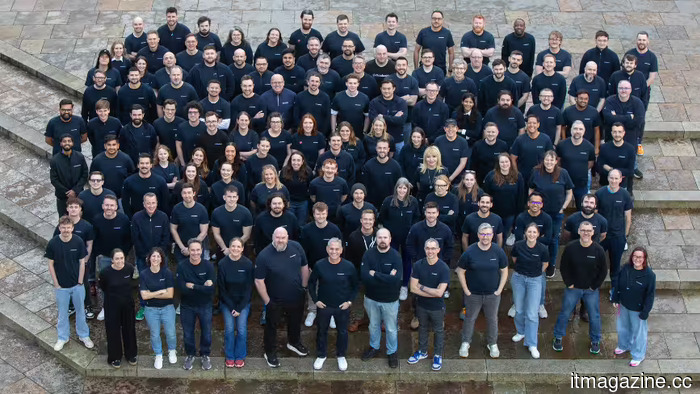
Cloudsmith of Belfast secures $72 million in Series C funding, with TCV as the lead investor.
TCV led the Series B round a year ago and is now increasing its investment in the Series C. Insight Partners is also coming back for this round. The underlying thesis is that AI coding agents are producing software at such a rapid pace and volume that human code reviews are no longer adequate, thus enterprise artifact management must serve as the primary layer for control and security.
Cloudsmith, an artifact management platform based in Belfast, has secured $72 million in a Series C funding round led by TCV, with participation from Insight Partners and other existing investors. Both TCV and Insight Partners were involved in the company's $23 million Series B round in March 2025, indicating a strengthened belief in the company less than thirteen months later.
The funds raised will be used for product development and market expansion. Cloudsmith was established in Belfast in 2016 by Lee Skillen (CTO) and Alan Carson (now the Chief Strategy Officer); Glenn Weinstein, who was Chief Customer Officer at Twilio, took on the role of CEO when Carson transitioned to the strategy position.
The investment perspective is based on a specific high-stakes issue in enterprise software development. In the context of Cloudsmith, an “artifact” refers to any software package, binary file, compiled application, or dependency generated or utilized during development, including libraries, containers, and components that make up production software.
As AI coding agents create code at unparalleled rates, the number of artifacts that enterprises need to manage, track, and secure is increasing faster than human review processes can accommodate. Additionally, the threat landscape is widening: open-source dependencies can be compromised post-ingestion (as seen in supply chain attacks), AI-generated code may present new patterns of vulnerability, and regulators are increasingly demanding proof that enterprises ensure their software is “secure by design.”
Cloudsmith’s offering is a cloud-native private registry and artifact management platform. Enterprises use it to host and distribute their internal software packages, mirror public registries (such as PyPI, Docker Hub, Maven, npm, and others) in a controlled private setting, and implement security scanning, policy enforcement, and access controls for every package entering or leaving their build pipelines.
Cloudsmith positions itself against established platforms like JFrog Artifactory and Sonatype Nexus, arguing that those tools were designed for an era of manually crafted software and cannot adapt to the AI-driven development model.
Recent product enhancements from Cloudsmith include an ML Model Registry, which provides the same governance for ML models and datasets as it does for code packages, and an Enterprise Policy Manager for policy-as-code enforcement throughout the supply chain.
CEO Glenn Weinstein described the Series C funding as a response to a fundamental shift in software development practices. “AI agents are generating so much software, so rapidly, that it’s almost impossible for humans to scrutinize it all,” he remarked. “Cloudsmith has the scalability and a comprehensive view of the open-source ecosystem to safeguard enterprises against the new threats posed by AI-driven development.”
Morgan Gerlak, Partner at TCV, remarked that the firm views Cloudsmith as “setting the standard for artifact management in the AI era,” and anticipates that enterprises will depend on it for “compliance, control, and security on a global scale.” Thomas Krane, Managing Director at Insight Partners, highlighted the urgency to “secure the software supply chain” as AI-driven development becomes commonplace.
The majority of Cloudsmith’s clientele is based in the US, making up about 75% of its revenue at the time of the Series B, despite the company’s headquarters in Belfast, which is recognized as a significant tech success story within Northern Ireland’s startup landscape. The Series B announcement reported nearly 150% year-over-year growth, with Fortune 500 and Global 2000 companies actively transitioning from legacy systems. The Series C, which is three times larger than the Series B, indicates that both the customer base and the average contract size have continued to grow over the past year. Prior to the Series C, Cloudsmith had raised approximately $52.5 million across seed funding, Series A ($26M in two rounds: $15M in 2021 and $11M in 2023), and Series B.
Other articles
 Control Ultimate Edition has just arrived on iPhone and iPad, and I strongly recommend it.
Control Ultimate Edition is now available on iPhone and iPad, featuring a mobile-friendly interface, touch controls, and support for universal purchase, making it one of the most recommended action games.
Control Ultimate Edition has just arrived on iPhone and iPad, and I strongly recommend it.
Control Ultimate Edition is now available on iPhone and iPad, featuring a mobile-friendly interface, touch controls, and support for universal purchase, making it one of the most recommended action games.
 Battery technology is addressing issues that consumers remain indifferent to.
QuickCharge: This Week in EV This article is part of our ongoing series, QuickCharge: This Week in EV, updated less than 8 hours ago. For a considerable period, the electric vehicle sector has been pursuing a goal that seemed straightforward: to make charging as quick as filling up a gasoline vehicle. That was the commitment, […]
Battery technology is addressing issues that consumers remain indifferent to.
QuickCharge: This Week in EV This article is part of our ongoing series, QuickCharge: This Week in EV, updated less than 8 hours ago. For a considerable period, the electric vehicle sector has been pursuing a goal that seemed straightforward: to make charging as quick as filling up a gasoline vehicle. That was the commitment, […]
 Tesla has finally revealed the reality of full self-driving capabilities in older vehicles, offering a glimmer of hope in challenging times.
Elon Musk confirmed during Tesla's Q2 2026 earnings call that vehicles equipped with Hardware 3 require physical upgrades, and Tesla intends to establish micro-factories to manage the volume of necessary replacements.
Tesla has finally revealed the reality of full self-driving capabilities in older vehicles, offering a glimmer of hope in challenging times.
Elon Musk confirmed during Tesla's Q2 2026 earnings call that vehicles equipped with Hardware 3 require physical upgrades, and Tesla intends to establish micro-factories to manage the volume of necessary replacements.
 Monitors have evolved beyond just basic upgrades. Here’s what’s new.
Monitor technology is advancing past mere enhancements. With advancements in OLED technology, extremely high refresh rates, and the introduction of 6K displays, here's what is genuinely transforming and its significance.
Monitors have evolved beyond just basic upgrades. Here’s what’s new.
Monitor technology is advancing past mere enhancements. With advancements in OLED technology, extremely high refresh rates, and the introduction of 6K displays, here's what is genuinely transforming and its significance.
Cloudsmith of Belfast secures $72 million in Series C funding, with TCV as the lead investor.
Cloudsmith secures $72 million in a Series C funding round led by TCV and Insight Partners to manage and protect the software supply chain generated by AI.