
Humble secures $24 million to develop a cabless electric truck.
The San Francisco startup, established by a former engineer from Uber ATG and Waabi, is adopting a unique strategy for autonomous freight, differing from businesses like Aurora or Kodiak: it features no driver’s cab, no hub transfers, and an autonomy framework based on vision-language-action models rather than traditional rule-based systems.
Humble, the autonomous freight startup based in San Francisco, has emerged from stealth mode with a $24 million seed funding round and a fully electric, cabless freight vehicle known as the Humble Hauler.
This round was spearheaded by Eclipse, a Palo Alto venture capital firm that focuses on physical AI as its primary investment strategy, with additional support from Energy Impact Partners.
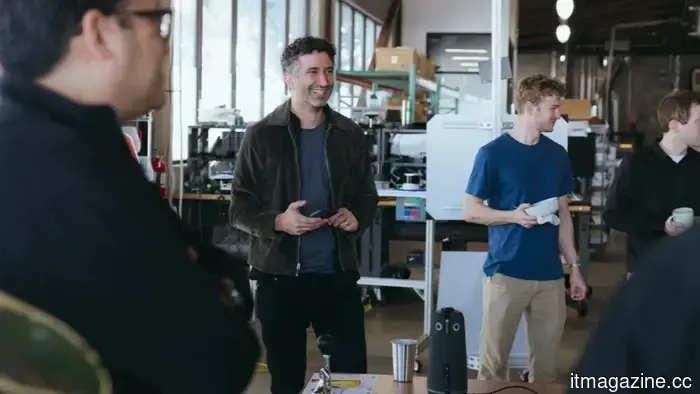
Eyal Cohen founded the company, bringing with him a two-decade background in autonomous vehicles that includes experience at Apple, Uber ATG, Waabi, and Spark AI, a startup he co-founded which was acquired by John Deere in 2023.
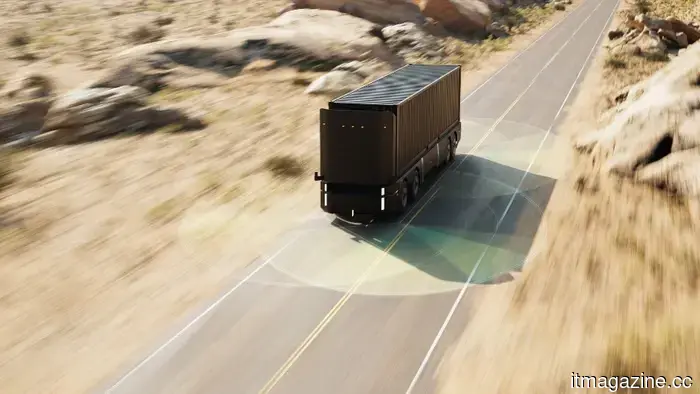
The Hauler's design deliberately omits the driver's cab. Cohen informed Fortune, which provided exclusive coverage of the launch, that traditional trucks were never designed with autonomy in mind; their designs are centered around human operators.
By eliminating the cab, the vehicle achieves 360-degree sensor coverage through cameras, LiDAR, and radar, increases payload capacity, and allows for a fundamentally different vehicle shape.
The Hauler accommodates 40-foot and 53-foot shipping containers, standard sizes in intermodal freight, and operates dock-to-dock, delivering directly to locations and unloading rather than merely dropping off a trailer at a transfer point.
This dock-to-dock approach sharply contrasts with other autonomous trucking operations. Aurora, whose driverless truck network now covers the Sun Belt, employs a hub-to-hub model where autonomous trucks transition to human drivers at drop-offs near city limits. Kodiak’s operations rely on fixed starting and landing zones.
Both methods simplify the challenges of autonomy by limiting the operational area. Humble believes that delivering directly to customers is precisely what logistics operators need, and that the Hauler's design, along with its vision-language-action-based autonomy system, can achieve this more swiftly than those limited by cab-forward truck designs.
The investor closely aligned with Humble's concept is Jiten Behl, a partner at Eclipse who joined the firm in early 2024 after his tenure as chief strategy officer and chief growth officer at Rivian, where he facilitated Amazon's order of 100,000 electric delivery vans and managed over $10 billion in financing, including Rivian’s IPO.
He presents the commercial argument in terms that logistics operators cannot ignore: “When you inform them about the potential for 30 to 50% increased efficiency in their operations, it’s something they have to bring to their management team.”
Regarding the capital needed for scaling, Behl is unusually cautious for a sector that has drawn billions: “This will not require a billion dollars; it will demand an order of magnitude less.”
The market context bolsters both ambition and caution. The U.S. truck freight industry is valued at $906 billion, with the autonomous freight sector projected to reach $575.7 million by 2026 and $3.25 billion by 2035.
Federal support is also on the horizon: the Self Drive Act of 2026, introduced in February, suggests a cohesive federal framework for autonomous trucking. Cohen recently met with the National Highway Traffic Safety Administration (NHTSA) in Washington, continuing discussions that began early in the company’s development.
What Humble has not yet revealed is its commercial schedule, specific pilot partners, or target locations for its initial operations. The seed funding will be allocated to developing the Hauler and launching a pilot program.
The key question is whether Humble can convert its architectural uniqueness and credible founding team into operational success before the opportunity diminishes, especially as Aurora reports over 250,000 driverless miles without any at-fault accidents and aims to have 200 autonomous trucks in operation by the end of the year. This is what the $24 million is intended to begin addressing.
Другие статьи
 Season 5 of The Boys has been released, and the series remains a commentary on contemporary America.
While The Boys focuses on superheroes, the popular Prime Video series has never seemed more reflective of real-world America than it does with the release of season 5.
Season 5 of The Boys has been released, and the series remains a commentary on contemporary America.
While The Boys focuses on superheroes, the popular Prime Video series has never seemed more reflective of real-world America than it does with the release of season 5.
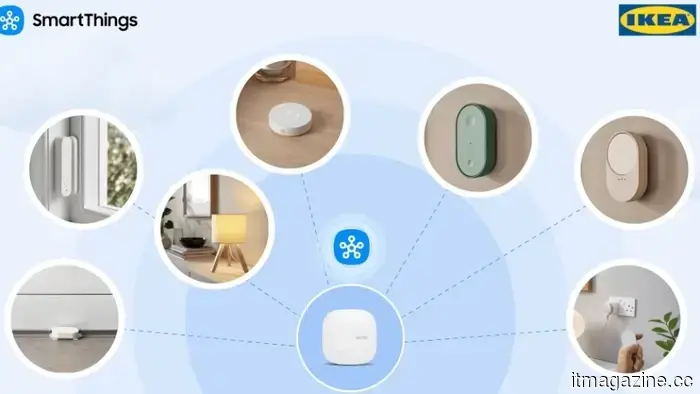 Samsung SmartThings and IKEA introduce direct Matter integration with $6 smart bulbs, eliminating the need for an additional hub.
Twenty-five IKEA Matter-over-Thread devices can now be directly linked to SmartThings, with bulb pricing starting at $5.99. Samsung TVs are equipped with Thread border routers to support these devices.
Samsung SmartThings and IKEA introduce direct Matter integration with $6 smart bulbs, eliminating the need for an additional hub.
Twenty-five IKEA Matter-over-Thread devices can now be directly linked to SmartThings, with bulb pricing starting at $5.99. Samsung TVs are equipped with Thread border routers to support these devices.
 Trump states that the Anthropic deal with the Pentagon is "possible."
On Tuesday, Trump mentioned to CNBC that a Pentagon agreement with Anthropic is ‘possible’, just days after Amodei held discussions with Wiles and Bessent at the White House regarding access to Mythos.
Trump states that the Anthropic deal with the Pentagon is "possible."
On Tuesday, Trump mentioned to CNBC that a Pentagon agreement with Anthropic is ‘possible’, just days after Amodei held discussions with Wiles and Bessent at the White House regarding access to Mythos.
 OpenAI introduces Codex to enterprise software businesses around the globe.
OpenAI has announced Cognizant and CGI as the initial system integrator partners in its Codex enterprise program, coinciding with the coding agent reaching 3 million users weekly.
OpenAI introduces Codex to enterprise software businesses around the globe.
OpenAI has announced Cognizant and CGI as the initial system integrator partners in its Codex enterprise program, coinciding with the coding agent reaching 3 million users weekly.
 Samsung SmartThings and IKEA introduce direct Matter integration featuring $6 smart bulbs with no need for an additional hub.
Twenty-five IKEA Matter-over-Thread devices are now directly compatible with SmartThings, and bulbs are priced at $5.99. Samsung TVs are already equipped with the Thread border routers needed to support them.
Samsung SmartThings and IKEA introduce direct Matter integration featuring $6 smart bulbs with no need for an additional hub.
Twenty-five IKEA Matter-over-Thread devices are now directly compatible with SmartThings, and bulbs are priced at $5.99. Samsung TVs are already equipped with the Thread border routers needed to support them.
 Endearing security crisis: 48 days of uncovered projects, unresolved bug reports, and the systemic breakdown of vibe coding security.
Lovable's API revealed source code and database credentials for 48 days following the closure of a bug report. As much as 62% of code generated by AI harbors vulnerabilities.
Endearing security crisis: 48 days of uncovered projects, unresolved bug reports, and the systemic breakdown of vibe coding security.
Lovable's API revealed source code and database credentials for 48 days following the closure of a bug report. As much as 62% of code generated by AI harbors vulnerabilities.
Humble secures $24 million to develop a cabless electric truck.
Humble has come out of stealth mode with a $24 million seed funding round and has introduced the Humble Hauler, an electric autonomous truck without cables, specifically designed for dock-to-dock freight transport.