

Robots have completed the Beijing half-marathon in a time quicker than the current world record holder.
Andy Wong / AP
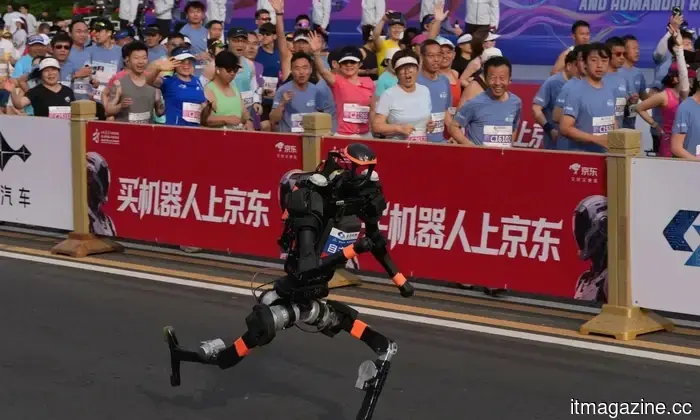
A humanoid robot has just completed a half-marathon in a time faster than the current world record holder. While this may not seem remarkable at first, it's a significant advancement when you consider that the fastest robot in last year's Beijing humanoid robot half-marathon took two hours and 40 minutes to finish.
According to the Associated Press, the victorious robot in this year's Beijing half-marathon finished the race in 50 minutes and 26 seconds, easily surpassing the human world record of 57 minutes established by Jacob Kiplimo.
This marks a substantial enhancement within just 12 months, leading to a vigorous discussion.
Who created the winning robot?
The winning robot was developed by Honor, a Chinese smartphone manufacturer recognized for its unique and innovative mobile phones. Yes, the same company known for cell phones is now producing robots that can outpace elite human athletes.
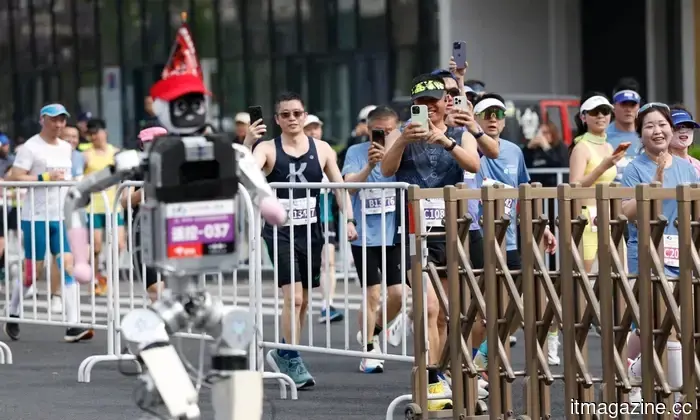
However, there's a twist. The robot that secured first place was not the quickest on the course. Another robot finished in 48 minutes and 19 seconds, but it was operated remotely. The robot that won the race ran autonomously, and the final standings took this into account through a weighted scoring system.
Andy Wong / AP
Approximately 40% of the robots participating in the race operated autonomously, while the other 60% were remotely controlled. The event wasn’t entirely flawless; one robot fell at the start line, and another collided with a barrier.
Is it reasonable to compare robots and humans?
In truth, probably not. But this comparison has been happening for a long time. It garnered significant attention when IBM’s Deep Blue became the first computer to defeat a world chess champion, Garry Kasparov, and when DeepMind’s AlphaGo began triumphing over top human Go players.
If folklore is to be believed, the rivalry between machines and humans dates back to the 1870s with the story of John Henry, who competed against a steam-powered drilling machine to prove human superiority. He won the contest but at the expense of his life.
Regardless of personal sentiment, it is undeniable that the advancements robots have made in just a decade are remarkable, eliciting both excitement and apprehension.
Rachit is a seasoned tech journalist with more than seven years of experience covering the consumer technology landscape.
As if the situation wasn’t already complex, AI is set to exacerbate the global e-waste crisis
A new report sheds light on an increasing environmental issue.
AI is already transforming the way the world operates, but it is also quietly aggravating one of our most significant environmental challenges. This time, it's not about energy use; it's about the hardware. Each more advanced AI model incurs a tangible environmental cost.
AI is set to escalate the e-waste dilemma.
Smart glasses are carving out an unexpected niche — in Korean dramas and theater performances.
Every year, millions tune in to Korean content without understanding the language. They stream shows with subtitles, read translated lyrics, and find various workarounds. However, live theater presents a different challenge — there's no option to pause or rewind. A Korean startup believes it has found a solution, and Yuroy Wang was among the first to experience it. The 22-year-old retail employee from Taipei is a K-pop enthusiast who loves Korean culture but doesn't speak Korean. When he attended "The Second Chance Convenience Store," a touring performance based on a bestselling Korean novel in Taiwan, he expected supertitles. Instead, he was given a pair of chunky, black-framed AI-driven glasses that translated the dialogue in real-time directly onto the lenses. "As soon as I learned they were available, I couldn't wait to try them," he stated. Wang is part of a growing audience realizing that smart glasses, a category of technology that has struggled to find practical use for years, may have discovered their purpose in the unlikeliest of settings: live Korean theater.
How do the glasses function?
Amazon believes you love AI, so it has launched a dedicated storefront for AI-driven gadgets.
While browsing for a new laptop — one featuring a superior processor, another with increased RAM, and a third flaunting "AI-powered" in bold letters, leaving you uncertain about its meaning. Amazon has noticed your interest in that third option, and it has some ideas. The company has just introduced an AI Store on Amazon.in, a specialized storefront that gathers AI-enabled devices from various categories, including smartphones and laptops to refrigerators and washing machines. Consequently, rather than sifting through specifications attempting to determine which "AI feature" is genuinely useful, the store provides clear information.




Other articles
 A leak regarding the iPhone 18 Pro suggests a visually appealing color option that is already available on the Kindle.
A leak regarding the iPhone 18 Pro has unveiled a new Dark Cherry color, presenting a high-end, subdued appearance akin to Kindle devices, along with other understated color choices.
A leak regarding the iPhone 18 Pro suggests a visually appealing color option that is already available on the Kindle.
A leak regarding the iPhone 18 Pro has unveiled a new Dark Cherry color, presenting a high-end, subdued appearance akin to Kindle devices, along with other understated color choices.
 Robots recently completed the Beijing half-marathon quicker than the current world record holder.
A robot created by Honor recently completed a half-marathon in Beijing in 50 minutes and 26 seconds, surpassing the human world record of 57 minutes.
Robots recently completed the Beijing half-marathon quicker than the current world record holder.
A robot created by Honor recently completed a half-marathon in Beijing in 50 minutes and 26 seconds, surpassing the human world record of 57 minutes.
 The App Store is alive with new applications in 2026, and it appears that AI is playing a significant role in this development.
The number of app launches is rapidly increasing worldwide as AI tools simplify the process for creators to develop and release mobile applications.
The App Store is alive with new applications in 2026, and it appears that AI is playing a significant role in this development.
The number of app launches is rapidly increasing worldwide as AI tools simplify the process for creators to develop and release mobile applications.
 Steam is essentially a monopoly in the PC gaming market, so why isn't there any outrage?
Open any gaming PC, and you're likely to find the blue Steam icon prominently displayed on the desktop. It's not tucked away, nor is it merely an option; it's almost a given. Over time, Steam has evolved from being simply another launcher to becoming the primary storefront for PC gaming, effectively integrated into the overall experience. The Monopoly Nobody [...]
Steam is essentially a monopoly in the PC gaming market, so why isn't there any outrage?
Open any gaming PC, and you're likely to find the blue Steam icon prominently displayed on the desktop. It's not tucked away, nor is it merely an option; it's almost a given. Over time, Steam has evolved from being simply another launcher to becoming the primary storefront for PC gaming, effectively integrated into the overall experience. The Monopoly Nobody [...]
 Tinder aims to verify your humanity by having you look into an orb. Yes, you read that correctly.
Tinder now offers a way for you to verify that you're human by scanning your irises using a physical orb device created by Sam Altman's World.
Tinder aims to verify your humanity by having you look into an orb. Yes, you read that correctly.
Tinder now offers a way for you to verify that you're human by scanning your irises using a physical orb device created by Sam Altman's World.
.jpg) Top films available on Amazon Prime Video (April 2026)
This month, the top movies available on Amazon Prime Video feature Crime 101, Pretty Lethal, The Menu, Super 8, The Great Escape, Sinners, and others.
Top films available on Amazon Prime Video (April 2026)
This month, the top movies available on Amazon Prime Video feature Crime 101, Pretty Lethal, The Menu, Super 8, The Great Escape, Sinners, and others.
Robots have completed the Beijing half-marathon in a time quicker than the current world record holder.
A robot created by Honor recently completed a half-marathon in Beijing in 50 minutes and 26 seconds, surpassing the human world record of 57 minutes.