

Intel unveils the key technology that helps gaming laptops operate more quietly and remain cooler.
AI Quiet Plus represents Intel's most direct effort to implement on-device AI, not for sheer performance, but for enhancing user comfort, demonstrating that a more intelligent fan can often outperform a faster one.
If you've ever gamed on a laptop that resembled a small airplane preparing for takeoff, Intel has taken note of your concerns. The company's Chinese division has introduced "AI Quiet Plus," a new certification and optimization program aimed at gaming laptops.
As the name implies, this feature utilizes artificial intelligence to significantly lower fan noise and surface temperature while still delivering performance.
How does AI Quiet Plus function?
It may initially seem a bit unclear, as AI Quiet Plus is neither a chip nor a software update you can simply download. Instead, it's a certification standard that original equipment manufacturers (OEMs) must satisfy to use the label.
The program employs the Neural Processing Unit (NPU) integrated into Intel’s Core Ultra 200HX Plus processors to track temperature, workload, power consumption, and fan speed in real-time.
Rather than automatically ramping up the cooling fan speed shortly after starting a game (when the motherboard begins to heat up), the system claims to intelligently assess gaming conditions and modulate cooling only when necessary.
What implications does this have for everyday gamers?
OEMs that achieve this new standard must adhere to stricter benchmarks regarding acoustics, keyboard and chassis temperatures, and battery efficiency. This technology builds on Intel China's “AI Quiet Gaming Laptop” initiative.
For the everyday gamer, AI Quiet Plus should result in less distraction and annoyance from the loud laptop fans, reduced heat on your wrists if you need to check emails during your gaming session, and improved battery life between charges.
The first laptops certified under this initiative are expected to be available by late 2026, including models from brands such as Asus, MSI, Lenovo, and Acer. Currently, the program is associated with the Core Ultra 200HX Plus chips, which were released in March 2026.
For over five years, Shikhar has consistently simplified advancements in consumer technology and shared them...
AI has sparked a RAMmageddon so severe that Apple is now appearing as the rational choice.
Laptop prices have soared in 2026, positioning Apple as the value leader.
I truly struggled to accept it, but reality confirms it — Apple is emerging as the rational laptop choice. No longer an edgy underdog or a budget alternative, Apple’s offerings now appear grounded, particularly in 2026. This shift isn’t due to the company’s newfound generosity, but because the competition has become so erratic; a MacBook lineup starting at $599 seems surprisingly reasonable.
Apple's MacBook Neo starts at $599, while Microsoft’s 13-inch Surface Laptop now begins at $1,199 following recent price hikes. This is not a minor difference to overlook. Concurrently, Apple's MacBook Air with M5 starts at $1,099, equipped with 16GB of RAM and 512GB of storage, appearing to be one of the few high-end laptops still sensibly priced.
Chrome's AI mode has received a significant upgrade, improving your browsing experience by minimizing tab switching.
If you’ve ever found yourself lost in online searches, you know the hassle of opening multiple tabs, rapidly accumulating to 14 or more without finding answers. This was a key factor in my decision to switch to Arc Browser, which offered more manageable vertical tabs — a feature that Google Chrome recently implemented as well. But Google is going further with a substantial enhancement to AI Mode in Chrome to address this issue.
This beanie converts your thoughts into text and is among the least intrusive wearables I've seen in years.
You might soon be able to send messages just by thinking.
A new wearable device resembling a simple beanie could revolutionize how people engage with computers. Developed by the Silicon Valley startup Sabi, this prototype employs brain-computer interface (BCI) technology to transform a user’s internal speech into text, essentially allowing them to "type" using their thoughts. According to a report by WIRED, the device aims to be one of the most discreet brain-tech wearables available, avoiding the clunky, futuristic appearance of many experimental headsets, thereby blending seamlessly into everyday attire for practical daily use.







Other articles
 Envision AESC is contemplating a $2 billion initial public offering in Hong Kong.
Envision AESC, the electric vehicle battery manufacturer backed by GIC and owned by China's Envision Group, is considering an initial public offering in Hong Kong that might generate as much as $2 billion.
Envision AESC is contemplating a $2 billion initial public offering in Hong Kong.
Envision AESC, the electric vehicle battery manufacturer backed by GIC and owned by China's Envision Group, is considering an initial public offering in Hong Kong that might generate as much as $2 billion.
 The AI feature in Chrome receives a significant enhancement to reduce the need for switching between tabs.
The AI Mode upgrade for Google Chrome allows you to browse websites and conduct searches simultaneously, enabling you to ask follow-up questions without having to lose your spot or open an additional tab.
The AI feature in Chrome receives a significant enhancement to reduce the need for switching between tabs.
The AI Mode upgrade for Google Chrome allows you to browse websites and conduct searches simultaneously, enabling you to ask follow-up questions without having to lose your spot or open an additional tab.
 This AI enables self-driving cars to "remember" previous journeys in order to determine safer routes.
A new planning approach named KEPT enables self-driving vehicles to compare their current observations with similar past traffic scenarios, which helps reduce prediction errors and minimizes the likelihood of collisions.
This AI enables self-driving cars to "remember" previous journeys in order to determine safer routes.
A new planning approach named KEPT enables self-driving vehicles to compare their current observations with similar past traffic scenarios, which helps reduce prediction errors and minimizes the likelihood of collisions.
 OpenAI introduces GPT-Rosalind, an AI model designed for research in life sciences.
OpenAI has introduced GPT-Rosalind, its inaugural AI model focused on life sciences, aimed at drug discovery and genomics. It is named in honor of Rosalind Franklin.
OpenAI introduces GPT-Rosalind, an AI model designed for research in life sciences.
OpenAI has introduced GPT-Rosalind, its inaugural AI model focused on life sciences, aimed at drug discovery and genomics. It is named in honor of Rosalind Franklin.
 A $400 discount on the Samsung Galaxy Z Fold7 makes the most daring Android phone of 2025 significantly more accessible.
The Samsung Galaxy Z Fold7 is now available for $1,719.99 in a limited-time offer, which is a $400 discount from its original price of $2,119.99. This is the 512GB variant that is definitely worth considering. Foldable phones have significantly developed over the past two generations, and the Z Fold7 strongly demonstrates that the form factor has […]
A $400 discount on the Samsung Galaxy Z Fold7 makes the most daring Android phone of 2025 significantly more accessible.
The Samsung Galaxy Z Fold7 is now available for $1,719.99 in a limited-time offer, which is a $400 discount from its original price of $2,119.99. This is the 512GB variant that is definitely worth considering. Foldable phones have significantly developed over the past two generations, and the Z Fold7 strongly demonstrates that the form factor has […]
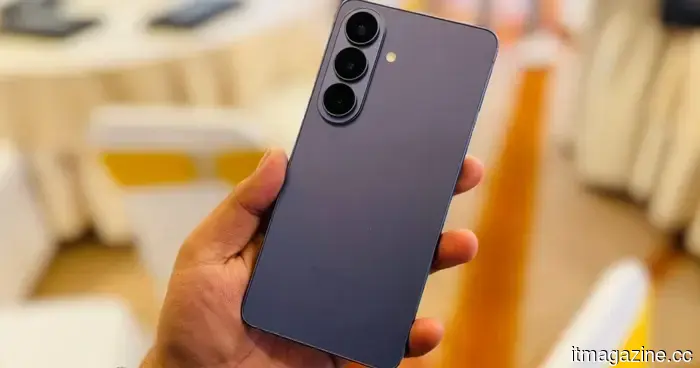 Samsung might enhance the performance of the Galaxy S27 series beyond just the silicon.
Samsung's Galaxy S27 might introduce UFS 5.0 storage, which can achieve read speeds exceeding 10GB/s, but this feature is expected to be available only on certain models. The increasing production costs are likely to prevent this upgrade from being included in the entire lineup.
Samsung might enhance the performance of the Galaxy S27 series beyond just the silicon.
Samsung's Galaxy S27 might introduce UFS 5.0 storage, which can achieve read speeds exceeding 10GB/s, but this feature is expected to be available only on certain models. The increasing production costs are likely to prevent this upgrade from being included in the entire lineup.
Intel unveils the key technology that helps gaming laptops operate more quietly and remain cooler.
Intel's AI Quiet Plus isn't simply a new processor or a software update; it's a certification standard that leverages on-chip AI to actively control noise, heat, and battery longevity.