
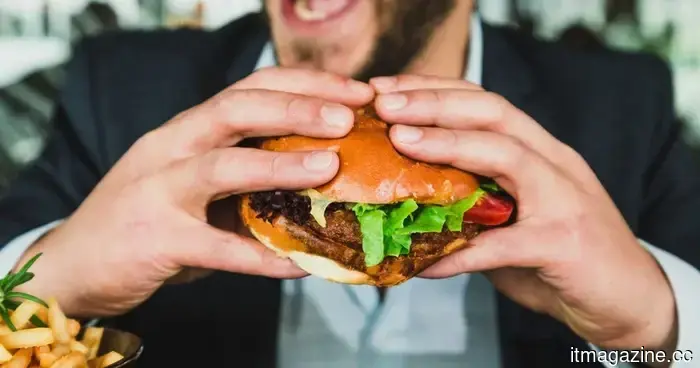
I never thought food reels would benefit my diet – but they could.
A recent study conducted by researchers at the University of Bristol has revealed that individuals attempting to curb food cravings might be using social media content that showcases indulgent dishes as a replacement for actual consumption. This discovery challenges the conventional belief that viewing appealing food images leads to overeating.
The research, in cooperation with the University at Buffalo School of Management, examined how visual interactions with food-related content impact eating behavior. In three experiments involving 840 participants aged between 19 and 77, the researchers employed online surveys in conjunction with a controlled laboratory study to understand responses to food media.
Visual Exposure Might Lower Actual Consumption
In one experiment, participants watched brief social media-style videos featuring both high-calorie and low-calorie chocolate desserts. Dieters spent about 30 percent more time watching the indulgent options compared to non-dieters.
However, when later presented with real chocolate, this group consumed significantly less than those who were not on a diet. This indicates that engaging with food visually may decrease the urge to indulge in real life.
Lead author Esther Kang stated that this behavior resembles a form of “digital foraging,” where individuals use visual stimuli to satisfy cravings without engaging in physical eating. Instead of inciting overeating, the imagery might serve as a psychological substitute.
The Concept of “Cross-Modal Satiation”
The second experiment supported these findings. Participants viewed videos of unhealthy foods like pizza, burgers, and chips, as well as healthier choices such as salads and smoothies. Again, dieters demonstrated a distinct preference for watching high-calorie foods, engaging with this content up to 50 percent more than other options.
Nonetheless, this increased engagement did not lead to higher actual consumption. The researchers attribute this to a phenomenon known as cross-modal satiation, where cravings are partially satisfied through sensory experiences, such as sight, instead of taste.
Co-author Arun Lakshmanan highlighted that visual consumption can sometimes diminish the desire to eat, providing a new perspective on how digital content affects behavior.
Implications of These Findings
These results are noteworthy given the prevalence of dieting and weight management efforts around the world. The study emphasizes that approximately 60 percent of women and 40 percent of men in the United States are actively trying to control their weight, contributing to a global weight-loss industry valued at over $250 billion.
Historically, exposure to food advertising and images has been viewed as a catalyst for unhealthy eating habits. However, this research indicates that the relationship between visual content and consumption is more nuanced.
For individuals aiming to manage their diets, social media may offer a low-cost, accessible method to help regulate cravings without necessitating strict avoidance of tempting imagery.
Implications for Everyday Users
For regular users, the findings imply that scrolling through food content may not always be detrimental. In some instances, it could aid in minimizing the chances of overindulgence, particularly for those who are consciously trying to control their eating habits.
However, the researchers warn that visual exposure is not a full substitute for food and should not be viewed as an isolated solution. Its effectiveness may differ based on individual habits, self-discipline, and context.
Future Directions
The researchers plan to investigate how these findings apply to various types of food content and digital platforms. Future studies may also consider the duration of the effects of visual satiation and whether similar behaviors persist in real-life settings beyond controlled conditions.
As digital media increasingly influences daily behavior, this study prompts new inquiries into how seemingly passive actions—such as watching food videos—can subtly yet significantly affect decision-making.


Other articles
 Microsoft's upcoming Surface Laptop might feature an OLED display, but I'm already feeling anxious.
A recent report indicates that Microsoft’s upcoming Surface Laptop might finally include OLED options, but given the recent price increases for Surface devices, this upgrade may be costly.
Microsoft's upcoming Surface Laptop might feature an OLED display, but I'm already feeling anxious.
A recent report indicates that Microsoft’s upcoming Surface Laptop might finally include OLED options, but given the recent price increases for Surface devices, this upgrade may be costly.
 HUAWEI nova 15
MTS has announced the start of pre-orders for the new HUAWEI nova 15 Pro and nova 15 smartphones. According to the description, the lineup is aimed at those who love taking portraits, are open to befriending artificial intelligence, and wish to charge their phone as infrequently as possible.
HUAWEI nova 15
MTS has announced the start of pre-orders for the new HUAWEI nova 15 Pro and nova 15 smartphones. According to the description, the lineup is aimed at those who love taking portraits, are open to befriending artificial intelligence, and wish to charge their phone as infrequently as possible.
 The fintech company that shifted its focus due to Kanye West has now reached a valuation of $1.4 billion.
Slash, the vertical banking startup established by two college dropouts, has secured $100 million in a Series C funding round, achieving a valuation of $1.4 billion. The round was led by Khosla Ventures and Ribbit Capital.
The fintech company that shifted its focus due to Kanye West has now reached a valuation of $1.4 billion.
Slash, the vertical banking startup established by two college dropouts, has secured $100 million in a Series C funding round, achieving a valuation of $1.4 billion. The round was led by Khosla Ventures and Ribbit Capital.
 Microsoft College Offer provides free software to make you overlook that the MacBook Neo is a more advantageous option.
Microsoft is leveraging free software, Game Pass, and discounts on laptops for students to enhance the attractiveness of Windows 11 PCs for college students. However, the actual value still relies on the hardware, the eligibility criteria, and whether the additional features will be utilized.
Microsoft College Offer provides free software to make you overlook that the MacBook Neo is a more advantageous option.
Microsoft is leveraging free software, Game Pass, and discounts on laptops for students to enhance the attractiveness of Windows 11 PCs for college students. However, the actual value still relies on the hardware, the eligibility criteria, and whether the additional features will be utilized.
 Windows Recall still provides a backdoor into your personal PC history.
The database of Windows Recall may now have improved protection, but a recent proof of concept indicates that the data path following sign-in still poses privacy risks for users of Windows 11.
Windows Recall still provides a backdoor into your personal PC history.
The database of Windows Recall may now have improved protection, but a recent proof of concept indicates that the data path following sign-in still poses privacy risks for users of Windows 11.
 The fintech company that changed its direction due to Kanye West has achieved a valuation of $1.4 billion.
Slash, the vertical banking startup established by two college dropouts, has secured $100 million in a Series C funding round at a valuation of $1.4 billion, with Khosla Ventures and Ribbit Capital leading the investment.
The fintech company that changed its direction due to Kanye West has achieved a valuation of $1.4 billion.
Slash, the vertical banking startup established by two college dropouts, has secured $100 million in a Series C funding round at a valuation of $1.4 billion, with Khosla Ventures and Ribbit Capital leading the investment.
I never thought food reels would benefit my diet – but they could.
According to recent research, viewing food videos may assist individuals on a diet in minimizing cravings and preventing overeating.