
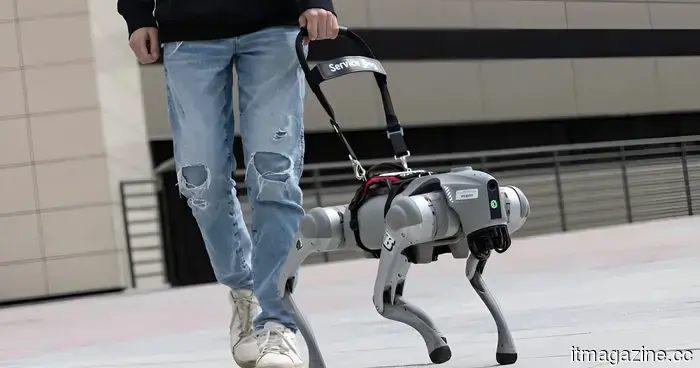
This robotic dog communicates using ChatGPT technology and assists individuals with visual impairments.
Researchers have developed a robotic guide dog that assists users throughout their journey.
Robot dogs have existed for some time, but one equipped to communicate with users sounds like something out of a sci-fi novel. Researchers at Binghamton University claim to have created one specifically designed to assist the visually impaired.
The university's team has designed an AI-powered robotic guide dog system to help blind users navigate indoor spaces, providing communication throughout the journey. A key feature of this system is its use of large language models (LLMs), such as GPT-4, which enhances the robot's conversational and responsive abilities beyond what a traditional guide dog can offer.
How does the AI guide dog function?
According to Binghamton University, this system was created by Shiqi Zhang, an associate professor in the School of Computing, along with his team. Zhang noted that this project demonstrates how robotic guide dogs can surpass the limitations of real guide dogs, which are only capable of following a limited number of commands.
With voice command capabilities powered by GPT-4, the AI robotic dog can engage in much more meaningful and interactive conversations. It's not merely about transporting the user from one location to another; before the journey starts, the robot can outline potential routes and provide estimated travel times. While en route, it offers what researchers term “scene verbalization,” supplying real-time verbal feedback regarding the surroundings and any obstacles.
For instance, the AI guide dog might comment, “This is a long corridor,” while directing the user to a conference room.
Testing with blind participants is underway
To assess the effectiveness of the system, the researchers enlisted seven legally blind participants to navigate a large multi-room office space. Afterward, these participants completed a questionnaire rating the system's helpfulness, usefulness, and ease of communication. The findings indicated that users favor the combined approach of route planning and live narration during travel.
The system focuses not just on getting users from point A to point B but also on enhancing situational awareness and providing greater control over their movements within a space. Similar to how AI is being utilized in pet-finding services, this development stands as a positive application of AI technology.
Tech journalist and product reviewer Sean has covered a wide range of consumer electronics topics.
Apple now offers repair kits for the MacBook Neo and iPhone 17e, catering to those with a DIY inclination.
If you've ever considered fixing your Apple devices on your own, Apple is now providing the opportunity—without the typical disapproval from Genius Bar staff. Launched in 2022, Apple's Self Service Repair Store allows users in select regions to buy or rent the tools and parts necessary for device repairs. Importantly, these parts are official Apple-approved components, accompanied by manuals that guide you through each step. The latest update includes parts for the newest devices, such as the MacBook Neo, iPhone 17e, Studio Display XDR, and recent releases like the iPad Air M4 and MacBook Air M5.
Experts have discovered a 49-day bug that may be causing your Mac to slow down.
The 49-day macOS bug has been identified and impacts any Mac that remains running without a reboot.
If your Mac has not been restarted for weeks and seems to perform sluggishly, there is a specific reason for this. Researchers at Photon have revealed a macOS bug that acts like a ticking time bomb. After 49 days, 17 hours, 2 minutes, and 47 seconds of uninterrupted operation, your Mac will quietly lose the ability to make new internet connections, causing applications to fail, websites to stop loading, and your CPU to operate harder than necessary.
Gen Z frequently uses AI, so why are they beginning to dislike it?
Gen Z was expected to be the most enthusiastic demographic regarding AI, but the reality is proving otherwise.
More than half of Gen Z in the United States regularly engages with generative AI, which would suggest they are its biggest supporters. However, recent findings indicate otherwise. According to a New York Times report, a survey conducted by Gallup, the Walton Family Foundation, and GSV Ventures, which included over 1,500 participants aged 14 to 29, reveals that Gen Z is becoming increasingly critical of the technology they utilize daily.




Other articles
 Tesla may be working on its most affordable electric vehicle to date, featuring SUV design elements and significant reductions in costs.
Tesla's upcoming model might be its most affordable electric vehicle to date, featuring a single-motor design and a smaller battery. However, considering the brand's past, it's wise to approach this rumor with a significant level of skepticism.
Tesla may be working on its most affordable electric vehicle to date, featuring SUV design elements and significant reductions in costs.
Tesla's upcoming model might be its most affordable electric vehicle to date, featuring a single-motor design and a smaller battery. However, considering the brand's past, it's wise to approach this rumor with a significant level of skepticism.
 TCL's NXTPAPER 70 Pro has finally arrived in the US, and it is priced at just $199.
TCL's NXTPAPER 70 Pro is now offered in the US via T-Mobile and Metro by T-Mobile for a price of $199.99.
TCL's NXTPAPER 70 Pro has finally arrived in the US, and it is priced at just $199.
TCL's NXTPAPER 70 Pro is now offered in the US via T-Mobile and Metro by T-Mobile for a price of $199.99.
 Microsoft is enhancing the right-click function and Quick Settings, and it's long overdue.
Windows 11 is addressing the sluggishness of Quick Settings and right-click menus, with the goal of eliminating delays in routine tasks and enhancing the overall responsiveness of the interface throughout the system.
Microsoft is enhancing the right-click function and Quick Settings, and it's long overdue.
Windows 11 is addressing the sluggishness of Quick Settings and right-click menus, with the goal of eliminating delays in routine tasks and enhancing the overall responsiveness of the interface throughout the system.
 Crimson Desert is now up and running on Intel Arc GPUs after an initial rejection.
Crimson Desert now operates on Intel Arc GPUs due to a new driver; however, initial feedback points out visual issues, the absence of XeSS support, and crashes associated with specific settings, indicating that while this is a promising advancement, it is still incomplete.
Crimson Desert is now up and running on Intel Arc GPUs after an initial rejection.
Crimson Desert now operates on Intel Arc GPUs due to a new driver; however, initial feedback points out visual issues, the absence of XeSS support, and crashes associated with specific settings, indicating that while this is a promising advancement, it is still incomplete.
 Microsoft is enhancing the right-click functionality and Quick Settings, and it's long overdue.
Windows 11 is addressing the sluggishness of Quick Settings and right-click menus, with the goal of eliminating delays in routine tasks and enhancing the overall responsiveness of the interface throughout the system.
Microsoft is enhancing the right-click functionality and Quick Settings, and it's long overdue.
Windows 11 is addressing the sluggishness of Quick Settings and right-click menus, with the goal of eliminating delays in routine tasks and enhancing the overall responsiveness of the interface throughout the system.
 Next-generation contact lenses offer advanced eye-tracking capabilities without the need for expensive equipment.
Next-generation contact lenses have the potential to offer accurate eye tracking for everyday devices through integrated cameras, eliminating the need for costly hardware and facilitating more intuitive controls as well as enhanced medical monitoring.
Next-generation contact lenses offer advanced eye-tracking capabilities without the need for expensive equipment.
Next-generation contact lenses have the potential to offer accurate eye tracking for everyday devices through integrated cameras, eliminating the need for costly hardware and facilitating more intuitive controls as well as enhanced medical monitoring.
This robotic dog communicates using ChatGPT technology and assists individuals with visual impairments.
Researchers at Binghamton University have created a robotic guide dog system that utilizes GPT-4-driven voice interaction to assist visually impaired individuals in navigating their surroundings.