

Google Maps employs Gemini to generate captions for your images.
In summary: Google Maps now incorporates Gemini to propose captions when users upload photos of locations. This feature has launched on iOS in the U.S. and will expand globally to Android in the coming months, marking a significant move in a six-month initiative to integrate AI throughout Maps.
Sharing a photo on Google Maps has traditionally required some effort: capture the image, upload it, and then confront a blank text box to determine if the restaurant you just visited deserves a written comment or not. Most users opt for silence. As of April 7, 2026, Google aims to change that with Gemini. The company announced that Google Maps will now analyze uploaded images and videos, automatically generating caption suggestions to give users a "head start" on writing. Contributors can choose to accept, modify, or discard these suggestions. The feature is currently available in English on iOS in the U.S., with plans for a wider Android rollout in the upcoming months.
Although the modification may seem minor, it holds considerable significance. Google Maps relies on user-generated content at an unparalleled level: over 120 million Local Guides contribute to the platform, collectively uploading around 300 million photos each year and producing over 20 million contributions daily, including reviews, ratings, edits, and images. This content forms the factual core of the map. The quality of a restaurant's listing, the accuracy of hotel images, and the clarity of a new business's page all hinge on users opting to provide some text rather than none when they access the share screen. Easing the burden of the blank text field, even marginally, is a decision aimed at enhancing data quality as much as improving user experience.
How Gemini captions operate
The process is straightforward. When a user selects a photo or video to share on Maps, Gemini analyzes the image, identifies its subject and context, and generates a suggested caption. The user can view this suggestion before posting and has the option to edit or eliminate it entirely. Google has positioned this tool as supportive rather than fully automated: the caption serves as a starting point, not an end product. This distinction is crucial for user trust and the platform's content standards, as a caption that Google assisted in writing would have different implications if it contained factual inaccuracies.
Recent developments in EU tech
The latest news from the EU tech industry, insights from our founder Boris, and some questionable AI art. Sign up now for free weekly updates delivered to your inbox! The caption feature builds on capabilities that Google has been rolling out in Maps for several months. In November 2025, the company launched its first navigation features powered by Gemini, including landmark-based directions advising drivers to turn “after the Thai Siam Restaurant” instead of “in 200 meters.” In January 2026, Gemini-assisted guidance was expanded to include cycling and walking. On March 12, 2026, Google introduced Ask Maps, a conversational search mode that utilizes data from over 300 million locations and 500 million community reviews to answer complex natural-language inquiries, alongside Immersive Navigation, described as the most significant overhaul of driving directions in a decade. The AI photo captioning feature is the next step in this progression, extending Gemini's capabilities from navigation and search to the content creation process that keeps the map updated. The aggressive AI integration across Google’s suite of products from last year has set the pace for this move, making Maps a clear priority.
The data dynamics behind the feature
The strategic rationale is clear. Google Maps’ value lies in having more precise, comprehensive, and current information about more locations than any competitor. This information advantage is primarily sustained through user contributions rather than Google’s editorial team. Increasing the volume of contributions — particularly those featuring descriptive, contextualized photos instead of captionless images — enhances the map’s utility for search and exploration. A photo with a specific caption (“wide outdoor seating, dog-friendly, gets busy after 6 PM”) is far more beneficial for someone planning a visit than a caption-less image of a table.
The timing of this rollout also reflects competitive pressures. The growing influence of ChatGPT in local searches and recommendations is becoming a concern for Google’s Maps and Search operations. As AI models begin to directly monetize local intent, the quality of the underlying location data they rely on becomes a significant competitive advantage. Google’s Local Guides network is one of its key proprietary assets in this landscape. Making it easier to provide high-quality contributions supports the enhancement of that dataset, keeping it ahead of what competitors can offer or replicate.
The quality dilemma
There is a careful balance that the caption feature must maintain. Making it easier to share content on Maps does not inherently improve the quality of that content. Google removed over 160 million photos and 3.5 million videos from Maps in its latest content moderation efforts due to policy violations or low quality. Additionally, in 2024, the platform also took down more than 960,000 reviews flagged as fake or violating policies and has since employed Gemini specifically to

Other articles
 Joby and Air Space Intelligence collaborate to oversee the airspace for electric air taxis in the U.S.
Joby Aviation and Air Space Intelligence are utilizing AI-driven airspace simulations to get the U.S. National Airspace System ready for large-scale eVTOL commercial activities.
Joby and Air Space Intelligence collaborate to oversee the airspace for electric air taxis in the U.S.
Joby Aviation and Air Space Intelligence are utilizing AI-driven airspace simulations to get the U.S. National Airspace System ready for large-scale eVTOL commercial activities.
 Google's AI mental health tools seem beneficial – but they aren't sufficient on their own.
Google aims to assist you in locating mental health resources more conveniently.
Google's AI mental health tools seem beneficial – but they aren't sufficient on their own.
Google aims to assist you in locating mental health resources more conveniently.
 A leak of a dummy iPhone fold reveals a device that is unique compared to any currently available on the market.
New dummy models of the iPhone Fold, iPhone 18 Pro, and Pro Max have emerged, providing us with the clearest view so far of Apple's foldable device.
A leak of a dummy iPhone fold reveals a device that is unique compared to any currently available on the market.
New dummy models of the iPhone Fold, iPhone 18 Pro, and Pro Max have emerged, providing us with the clearest view so far of Apple's foldable device.
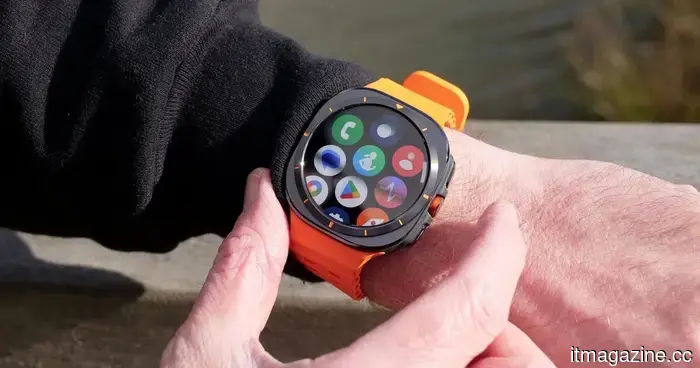 The most significant enhancement of the Galaxy Watch Ultra 2 might not be accessible to the majority of purchasers.
The Galaxy Watch Ultra 2 might feature 5G connectivity, though a recent report indicates that this enhancement could be restricted to certain markets.
The most significant enhancement of the Galaxy Watch Ultra 2 might not be accessible to the majority of purchasers.
The Galaxy Watch Ultra 2 might feature 5G connectivity, though a recent report indicates that this enhancement could be restricted to certain markets.
 Joby and Air Space Intelligence collaborate to oversee the skies for electric air taxis in the U.S.
Joby Aviation and Air Space Intelligence are utilizing AI-driven airspace simulation to ready the U.S. National Airspace System for large-scale eVTOL commercial activities.
Joby and Air Space Intelligence collaborate to oversee the skies for electric air taxis in the U.S.
Joby Aviation and Air Space Intelligence are utilizing AI-driven airspace simulation to ready the U.S. National Airspace System for large-scale eVTOL commercial activities.
 Curious about what people are searching for around the globe? Google Trends has received a mobile update to satisfy that curiosity.
Google Trends is now available on mobile, featuring Gemini-enhanced suggestions that assist you in comparing topics and identifying trending searches more rapidly, transforming what was previously a manual tool into a faster means of grasping public search interests.
Curious about what people are searching for around the globe? Google Trends has received a mobile update to satisfy that curiosity.
Google Trends is now available on mobile, featuring Gemini-enhanced suggestions that assist you in comparing topics and identifying trending searches more rapidly, transforming what was previously a manual tool into a faster means of grasping public search interests.
Google Maps employs Gemini to generate captions for your images.
Google Maps is now offering AI-generated captions for photos that users upload, utilizing Gemini technology. This feature is currently available on iOS in the U.S., with a worldwide rollout for Android expected in the coming months.