
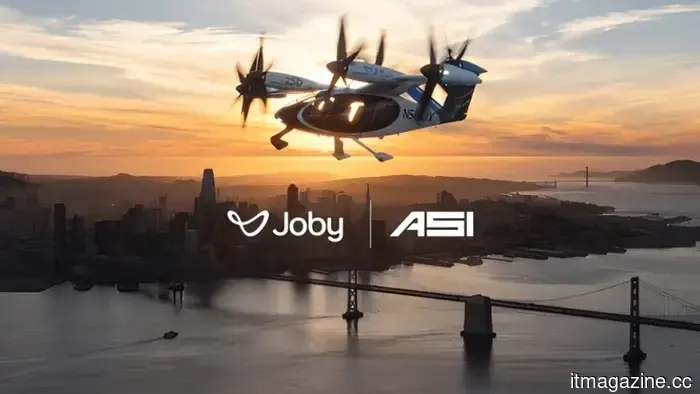
Joby and Air Space Intelligence collaborate to oversee the skies for electric air taxis in the U.S.
In summary: Joby Aviation and Air Space Intelligence have partnered to incorporate AI-enhanced airspace management into electric air taxi services in the U.S. This collaboration employs ASI’s Flyways AI platform to simulate high-density eVTOL traffic ahead of commercial flights that are set to begin later this year.
Historically, the race in electric air taxis has focused primarily on the aircraft's specifications: wing configuration, battery range, and noise levels. However, with Joby Aviation nearing the completion of its FAA type certification and the White House launching the eVTOL Integration Pilot Programme to facilitate initial commercial operations in ten U.S. states, the more challenging questions are starting to emerge. While a few electric air taxis may operate successfully, the infrastructure is not yet prepared for the simultaneous operation of hundreds of them in congested airspaces over cities like Manhattan, Miami, and Dallas. On April 7, 2026, Joby and ASI announced their plans to address these issues before they arise.
The partnership commits both companies to expedite the introduction of advanced air mobility into the U.S. National Airspace System (NAS), utilizing ASI’s Flyways platform for coordination. They anticipate conducting joint demonstrations, including live operational exercises, by the end of 2026, aligning with Joby’s commercial launch goals.
A new airspace operating system
Air Space Intelligence, established in Boston in 2018 and recently backed by a $34 million Series B investment led by Andreessen Horowitz, has spent years addressing a similar challenge in conventional aviation. Its main platform, PRESCIENCE, creates a four-dimensional digital model of the operating environment by integrating real-time traffic data, weather conditions, and demand forecasts to forecast airspace scenarios in advance. Flyways AI, the commercial product based on PRESCIENCE, transforms these simulations into actionable insights for air traffic controllers, enabling them to preemptively adjust traffic flows, thereby avoiding congestion.
Among ASI’s clients are Alaska Airlines and the U.S. Department of Defense. Their established experience with traditional aviation provides a data set and regulatory credibility that newer entrants in advanced air mobility find hard to match. ASI views applying its platform to eVTOL as a logical extension. Bernard Asare, President of Civil Aviation at Air Space Intelligence, stated, “To scale advanced air mobility, we need more than just new aircraft; we require a new airspace operating system. Our Flyways AI platform equips operators and controllers with the predictive capabilities necessary for proactive coordination of high-density operations. This partnership will deliver this capability to eVTOL operations from the outset.”
What Joby adds
Joby’s strengths lie in its operational expertise and essential industry connections, which no software company can replicate. The Santa Cruz-based firm has conducted over 1,000 test flights of its S4 aircraft and has completed Stage 4 of the FAA’s five-stage type certification. In March 2026, Joby was chosen for five projects under the White House’s eVTOL Integration Pilot Programme, granting it a legal route to commence passenger services in states such as New York, Florida, Texas, North Carolina, and Utah prior to receiving full certification.
Joby has also established a commercial ecosystem that outmatches many of its competitors: it has a partnership with Delta Air Lines that includes vertiport infrastructure at JFK and LAX, a $250 million strategic investment from Toyota, a 25-site vertiport agreement with Metropolis, and an active operation in Dubai representing its first revenue-generating international market. Its SuperPilot autonomy technology, developed using Nvidia’s IGX Thor platform, is intended to gradually reduce reliance on human pilots as regulatory confidence increases, which is part of a larger AI infrastructure development that reflects a year of rapid enterprise AI advancements across multiple sectors.
“America has set the global standard for aviation, and modernizing our airspace is crucial to maintaining that leadership,” remarked Greg Bowles, Chief Policy Officer at Joby Aviation. “By blending Joby’s operational strengths with ASI’s advanced AI-driven Flyways platform, we are creating the intelligent infrastructure essential for the seamless integration of electric air taxis into the NAS.”
The BNATCS initiative
The timing of this partnership is strategic. The FAA’s Brand New Air Traffic Control System (BNATCS) is currently under development, representing a $32.5 billion upgrade of the outdated telecommunications, radar, and automation systems in the U.S. Congress has allocated $12.5 billion, with an additional $20 billion still necessary. Peraton has been designated as the integrator for the system. This program will add 5,170 new high-speed network connections through fiber, satellite, and wireless technologies and is expected to feature automated decision-support tools specifically designed to accommodate new traffic categories like drones and eVTOLs, which current systems were not designed to handle.
The partnership between Joby and ASI positions both entities to influence the design of these tools. By conducting live operational exercises with Fly
Other articles
 Google Photos introduces AI Enhancement features and controls for video playback speed.
Google Photos introduces AI Enhance and video speed controls on Android, offering quicker editing and more adaptable playback options, although the timing of the rollout differs among devices and regions.
Google Photos introduces AI Enhancement features and controls for video playback speed.
Google Photos introduces AI Enhance and video speed controls on Android, offering quicker editing and more adaptable playback options, although the timing of the rollout differs among devices and regions.
 Cooling fans in gaming phones are receiving significant attention now more than ever.
Xiaomi is reintroducing active cooling with the upcoming Redmi K90 Max, a smartphone that may extend the use of built-in fans beyond just specialized gaming devices.
Cooling fans in gaming phones are receiving significant attention now more than ever.
Xiaomi is reintroducing active cooling with the upcoming Redmi K90 Max, a smartphone that may extend the use of built-in fans beyond just specialized gaming devices.
 A leak of a dummy iPhone fold reveals a device that is unique compared to any currently available on the market.
New dummy models of the iPhone Fold, iPhone 18 Pro, and Pro Max have emerged, providing us with the clearest view so far of Apple's foldable device.
A leak of a dummy iPhone fold reveals a device that is unique compared to any currently available on the market.
New dummy models of the iPhone Fold, iPhone 18 Pro, and Pro Max have emerged, providing us with the clearest view so far of Apple's foldable device.
 Joby and Air Space Intelligence collaborate to oversee the airspace for electric air taxis in the U.S.
Joby Aviation and Air Space Intelligence are utilizing AI-driven airspace simulations to get the U.S. National Airspace System ready for large-scale eVTOL commercial activities.
Joby and Air Space Intelligence collaborate to oversee the airspace for electric air taxis in the U.S.
Joby Aviation and Air Space Intelligence are utilizing AI-driven airspace simulations to get the U.S. National Airspace System ready for large-scale eVTOL commercial activities.
 Trump's budget proposal for FY27 would reduce CISA's funding by $700 million and eliminate election security measures.
The Trump administration plans to cut $707 million from CISA's budget, discontinuing its election security program and eliminating 860 positions, further intensifying reductions already implemented through DOGE.
Trump's budget proposal for FY27 would reduce CISA's funding by $700 million and eliminate election security measures.
The Trump administration plans to cut $707 million from CISA's budget, discontinuing its election security program and eliminating 860 positions, further intensifying reductions already implemented through DOGE.
 A leak of a dummy iPhone fold reveals a device unlike any currently available.
New dummy units of the iPhone Fold, iPhone 18 Pro, and Pro Max have emerged, providing us with the clearest view so far of Apple's foldable device.
A leak of a dummy iPhone fold reveals a device unlike any currently available.
New dummy units of the iPhone Fold, iPhone 18 Pro, and Pro Max have emerged, providing us with the clearest view so far of Apple's foldable device.
Joby and Air Space Intelligence collaborate to oversee the skies for electric air taxis in the U.S.
Joby Aviation and Air Space Intelligence are employing AI-driven airspace simulation to ready the U.S. National Airspace System for large-scale eVTOL commercial activities.