

As graduate unemployment rises, Gen Z is turning to AI during job interviews.
The class of 2025 graduated into a challenging entry-level job market, the toughest in five years. An increasing number of these graduates are utilizing AI tools during live job interviews, while a wave of startups is emerging to provide them with these capabilities. Whether this practice is viewed as cheating or a wise strategy varies depending on one’s perspective in the hiring process, but the statistics supporting this trend are clear.
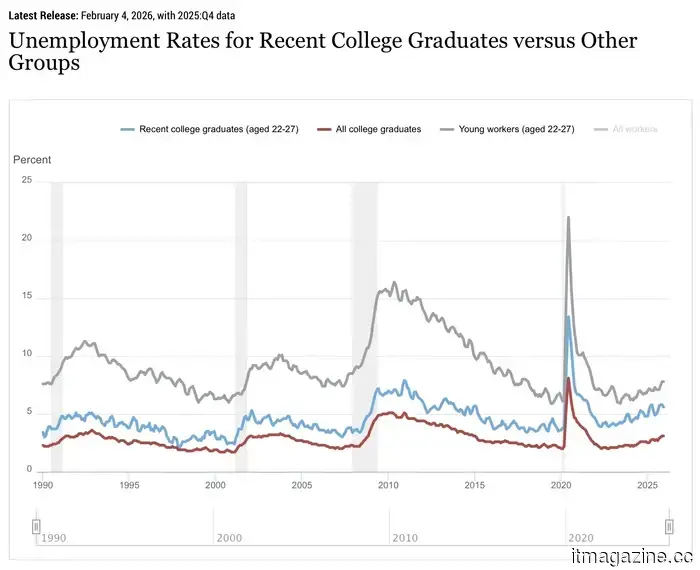
By the close of 2025, the unemployment rate for recent college graduates aged 22 to 27 rose to 5.7 percent, exceeding the national average of 4.2 percent, as reported by the Federal Reserve Bank of New York. Underemployment, indicating that graduates are working in positions that do not require their degrees, reached 42.5 percent, the highest since 2020. The tech sector, which often attracts ambitious graduates, lost approximately 245,000 jobs in 2025, according to data from Layoffs.fyi and TrueUp, with an additional 59,000 jobs eliminated in the first quarter of 2026.
These graduates entered a job market after witnessing the previous cohort being hired, promoted, and subsequently laid off at firms such as Meta, Amazon, and Google within a mere 18 months. The lesson they gleaned was clear: competence and loyalty are not adequate defenses. Hence, they came prepared with technology that their universities had encouraged them to master over the past four years.
The tools and the companies providing them
This trend was highlighted in a recent press release from LockedIn AI, a startup offering a product called DUO, which merges real-time AI transcription of interview questions with a live human coach able to watch the candidate’s screen and offer strategic advice throughout the conversation. The press release, distributed via GlobeNewswire, framed the situation as a generational resilience story but was fundamentally a product promotion.
LockedIn AI is not the only entity in this space. Its founder, Kagehiro Mitsuyami, also co-founded Final Round AI, which offers a similar service. Both companies have encountered scrutiny regarding the authenticity of their marketing efforts; for instance, Trustpilot reviews seem to be AI-generated, and independent reviewers have indicated that the software can be detectable to interviewers when candidates switch windows. A Gartner survey of 3,000 job seekers revealed that six percent confessed to interview fraud, including having someone impersonate them. Furthermore, 59 percent of hiring managers suspect candidates may use AI to misrepresent themselves.
The market for these tools is expanding precisely because the circumstances that led to their creation are deteriorating. The National Association of Colleges and Employers reported that 45 percent of employers rated the job market for the class of 2026 as "fair," a decline from "good" the year prior. Hiring forecasts for new graduates have largely stagnated, predicting only 1.6 percent growth. For candidates sending out numerous applications and receiving interview invitations at rates below two percent, the allure of leveraging every available advantage is substantial.
The hypocrisy argument
The most compelling argument supporting AI-assisted interviewing doesn’t revolve around fairness in a general sense but centers on a particular inconsistency in how tech companies employ AI.
During an April 2025 earnings call, Google CEO Sundar Pichai revealed that over 30 percent of the company's new code is now generated with AI help, an increase from 25 percent just six months prior. Firms like Amazon, Microsoft, and Meta encourage their engineers to regularly use AI coding tools. Moreover, AI-powered applicant tracking systems pre-screen and eliminate resumes before they reach human eyes. The recruitment process is automated from start to finish, except for the candidates.
For graduates who were told throughout their university years that AI expertise would shape their careers, pretending that this technology doesn’t exist during a 45-minute interview seems less like a competence assessment and more like a compliance test. The companies insisting on this are often the same ones expecting new hires to use AI tools from day one.
This argument holds significant weight but comes with limitations. There is a distinction between using AI to code more efficiently and using it to respond to questions about one’s own experiences, judgment, and problem-solving skills. An interview typically aims to assess what a candidate knows and how they think; delegating those answers to a language model or a human coach whispering instructions undermines the intrinsic purpose of the interview, regardless of its fairness.
The employer response
Companies are already adjusting. The percentage of in-person interview rounds increased from 24 percent in 2022 to 38 percent in 2025, according to hiring industry data. A significant 72 percent of recruiting leaders now include at least one in-person stage specifically to mitigate AI-assisted dishonesty. Several companies have adopted whiteboard tasks, pair programming sessions, and unstructured discussions that are less susceptible to real-time tool enhancement.
The deeper issue arises from whether interviews are the appropriate method for evaluating candidates in a labor market saturated with AI. If the goal is to determine

As graduate unemployment rises, Gen Z is turning to AI during job interviews.
With graduate underemployment at 42.5% and 245,000 tech jobs eliminated in 2025, the class of 2025 is increasingly relying on AI interview tools. In response, companies are pushing back.