

As unemployment among graduates rises, Generation Z is turning to AI for assistance in job interviews.
The class of 2025 graduated into the most challenging entry-level job market in five years. Increasingly, many of these graduates are employing AI tools during live job interviews, prompting a wave of startups eager to provide them with such tools. Whether this is seen as cheating or a sensible strategy varies depending on one’s perspective in the hiring process, but the supporting data for this trend is clear.
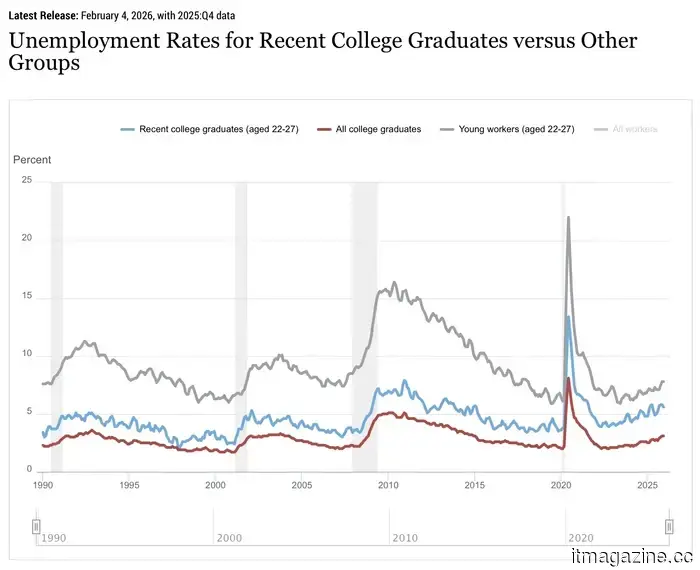
By the end of 2025, unemployment among recent college graduates aged 22 to 27 rose to 5.7 percent, surpassing the national rate of 4.2 percent, according to the Federal Reserve Bank of New York. Underemployment, which reflects graduates in jobs that don’t require a degree, reached 42.5 percent, its highest since 2020. The tech industry, historically a top choice for ambitious graduates, lost approximately 245,000 jobs in 2025, with another 59,000 cuts occurring in the first quarter of 2026, based on tracking data from Layoffs.fyi and TrueUp.
Graduates entering the job market witnessed an older cohort get hired, promoted, and subsequently laid off by companies like Meta, Amazon, and Google within just 18 months. The lesson they gleaned was clear: competence and loyalty offer little job security. Hence, they entered the workforce equipped with technology that their universities had encouraged them to master over the past four years.
The tools and the companies offering them
This trend was highlighted in a recent press release from LockedIn AI, a startup that markets a product called DUO. This service provides real-time AI transcription of interview questions alongside a live human coach who can view the candidate's screen and offer strategic advice during the interview. Framed as a trend about generational resilience, the release was primarily a product promotion.
LockedIn AI has competitors; its founder, Kagehiro Mitsuyami, also co-founded Final Round AI, which offers a comparable service. Both companies have faced scrutiny regarding the authenticity of their marketing practices: Trustpilot reviews appear to be AI-generated, and independent reviewers have noted that interviewers can notice when candidates toggle between screens. A Gartner survey of 3,000 job seekers indicated that six percent confessed to interview fraud, which includes having someone impersonate them. Furthermore, fifty-nine percent of hiring managers suspect candidates of using AI to misrepresent themselves.
The demand for these tools is increasing precisely because the situation that has led to their emergence is worsening. The National Association of Colleges and Employers reported that 45 percent of employers described the job market for the class of 2026 as “fair,” a decline from “good” the year before. Hiring forecasts for new graduates are nearly stagnant, anticipating only a 1.6 percent increase. Given that many candidates submit countless applications yet receive interview invites at rates below two percent, the allure of leveraging every possible advantage is strong.
The hypocrisy argument
A compelling argument in favor of AI-assisted interviews focuses on the inconsistency in how technology firms utilize AI. During an earnings call in April 2025, Google’s CEO, Sundar Pichai, revealed that over 30 percent of the company’s new code is now generated with AI assistance, up from 25 percent six months earlier. Amazon, Microsoft, and Meta actively encourage their engineers to employ AI coding tools daily. AI-powered applicant tracking systems filter and reject resumes before a human even reviews them. The hiring process is automated from start to finish, except from the candidate's standpoint.
For graduates who were taught throughout their university years that proficiency with AI would shape their careers, being asked to disregard this technology during a 45-minute interview feels less like a test of ability and more like an assessment of compliance. The companies imposing this expectation are often the same ones that will expect these graduates to use AI tools from their very first day on the job.
This argument is valid, but it has limitations. There is a distinction between utilizing AI to enhance coding efficiency and deploying AI to respond to queries regarding one’s own experiences, judgement, and problem-solving skills. An interview is, at least theoretically, designed to evaluate a candidate's knowledge and thought process. Relying on a language model or a human coach for responses undermines the purpose of the interview, regardless of the inherent unfairness of the process.
The employer response
Companies are adapting to this new landscape. Data from the hiring industry indicate that in-person interview rounds increased from 24 percent in 2022 to 38 percent in 2025. Seventy-two percent of recruiting leaders now include at least one in-person stage specifically to address AI-assisted fraud. Some organizations have transitioned to whiteboard exercises, pair programming sessions, and unstructured discussions that are more difficult to enhance with real-time assistance.
The broader question is whether the interview process itself remains an appropriate method for evaluating candidates in an AI-dominated job market. If the intention is to evaluate what a candidate can produce with the tools they will actually

As unemployment among graduates rises, Generation Z is turning to AI for assistance in job interviews.
With graduate underemployment at 42.5% and 245,000 tech jobs eliminated in 2025, the graduating class of 2025 is increasingly turning to AI interview tools. In response, companies are taking action.