
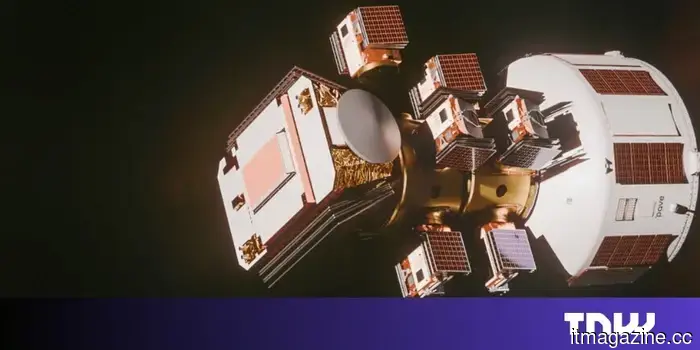
PAVE Space secures $40 million to develop orbital transfer vehicles.
The Swiss startup, which emerged from EPFL’s student rocketry program that created Europe’s first student-designed reusable rocket, has secured one of the largest seed funding rounds in European space. The round was led by Visionaries Club and Creandum, with participation from Lombard Odier, Atlantic Labs, and Sistafund.
The satellite lifecycle contains a fundamental inefficiency. Launch vehicles deliver payloads to low Earth orbit as it is the most affordable and accessible destination. However, the satellites that support global communications, navigation, and defense intelligence operate at significantly higher orbits, such as geostationary and medium Earth orbit, and occasionally even lunar orbits. Transitioning from the launch orbit to the operational orbit presents the challenge of "last-mile logistics in space," and this is currently addressed through onboard electric propulsion that operates slowly and meticulously over six to twelve months.
PAVE Space, a startup established in Renens, Switzerland in 2024, is creating a fleet of orbital transfer vehicles aimed at completing this journey in less than 24 hours. PAVE has successfully raised $40 million in seed funding, marking one of the largest seed rounds in the history of European space, led by Visionaries Club and Creandum, with contributions from Lombard Odier Investment Managers, Atlantic Labs, Sistafund, b2venture, ACE Investment Partners, Ilavaska Vuillermoz Capital, and Pareto & Motier Ventures. The funds will support hardware development for an in-orbit demonstration.
The company was co-founded by Julie Böhning, CEO, Jérémy Marciacq, and Simon Both, the same three engineers who initiated the Gruyère Space Program at EPFL in November 2018. GSP was a student organization that aimed high: to design and operate a reusable, vertically-landing liquid-propellant rocket on a student budget. By October 2024, their demonstrator, Colibri, a 2.45-meter bipropellant VTVL rocket, had successfully completed 53 flights, including a 105-meter free flight, all with an approximate budget of CHF 250,000. It was the first reusable VTVL rocket ever built and flown by a student team. After the program concluded, the founders transferred the technology and expertise to PAVE Space.
The rationale for swift orbital transfer is clear and increasingly pressing. Over 12,000 active satellites now orbit the Earth, with thousands being launched annually. Operators whose assets are delayed in transit orbit for six months cannot serve their customers, cannot generate revenue, and face escalating risks from space debris and interference. For defense clients, the urgency is even greater; the capability to quickly relocate a satellite to a new orbit in response to threats is something current electric propulsion technology cannot provide.
PAVE’s OTVs utilize storable bipropellant propulsion instead of cryogenic fuels, which evaporate at room temperature and render extended orbital loitering impractical. The trade-off being a somewhat lower specific impulse in exchange for indefinite shelf life and greater operational flexibility, which is the key technical decision guiding the vehicle's design.
The dual-use market for commercial and defense applications represents the most evident parallel in European space: launch providers like Arianespace and RocketLab, along with in-space service companies such as D-Orbit and Exotrail, have all identified that European defense procurement accelerates when there is a credible domestic option to US or Chinese systems. PAVE is making a similar early investment at the OTV level.
Other articles
 You’re going to encounter a wave of product suggestions on Instagram and Facebook.
Your Instagram and Facebook feeds are set to become more shoppable, as Meta introduces new affiliate tools that enable creators to tag products directly in their posts and Reels, increasing buying options as you scroll.
You’re going to encounter a wave of product suggestions on Instagram and Facebook.
Your Instagram and Facebook feeds are set to become more shoppable, as Meta introduces new affiliate tools that enable creators to tag products directly in their posts and Reels, increasing buying options as you scroll.
 Origin secures $30 million in Series A+ funding.
Origin has secured $30 million in a Series A+ funding round led by Notion Capital to enhance its AI platform, which provides multinationals with insights into their benefits expenditures.
Origin secures $30 million in Series A+ funding.
Origin has secured $30 million in a Series A+ funding round led by Notion Capital to enhance its AI platform, which provides multinationals with insights into their benefits expenditures.
 ChatGPT is receiving a significant update to enhance file management capabilities.
OpenAI is introducing a new Library tab and Recent files menu in ChatGPT, which simplifies the process of locating, reusing, and managing files throughout conversations.
ChatGPT is receiving a significant update to enhance file management capabilities.
OpenAI is introducing a new Library tab and Recent files menu in ChatGPT, which simplifies the process of locating, reusing, and managing files throughout conversations.
 Apple is considering an “Ask Siri” feature that would make the assistant accessible throughout your iPhone.
Apple is experimenting with an "Ask Siri" feature that enables users to engage with the assistant across different applications, transforming it into a more conversational and context-sensitive tool that directly responds to the content displayed on your screen.
Apple is considering an “Ask Siri” feature that would make the assistant accessible throughout your iPhone.
Apple is experimenting with an "Ask Siri" feature that enables users to engage with the assistant across different applications, transforming it into a more conversational and context-sensitive tool that directly responds to the content displayed on your screen.
 OpenAI has shut down the Sora AI video application, and it is unlikely to be reintroduced.
Just six months after its debut as an independent app, the Sora AI video generator app is coming to an end. This decision is quite unexpected, especially since Google has intensified its AI video initiatives with Veo, while Chinese AI companies persist in producing remarkable outcomes with offerings like the viral Seedance AI video.
OpenAI has shut down the Sora AI video application, and it is unlikely to be reintroduced.
Just six months after its debut as an independent app, the Sora AI video generator app is coming to an end. This decision is quite unexpected, especially since Google has intensified its AI video initiatives with Veo, while Chinese AI companies persist in producing remarkable outcomes with offerings like the viral Seedance AI video.
 ChatGPT is receiving an important update to enhance file management.
OpenAI is introducing a new Library tab and Recent files menu in ChatGPT, enhancing the ability to locate, reuse, and manage files throughout conversations.
ChatGPT is receiving an important update to enhance file management.
OpenAI is introducing a new Library tab and Recent files menu in ChatGPT, enhancing the ability to locate, reuse, and manage files throughout conversations.
PAVE Space secures $40 million to develop orbital transfer vehicles.
PAVE Space, a startup based in Switzerland, has secured $40 million in funding to develop orbital transfer vehicles capable of relocating satellites to any orbit within a 24-hour timeframe.