

Intel's latest Arc Pro B70 and B65 GPUs are designed for artificial intelligence tasks.
Digital Trends may receive a commission if you make a purchase through links on our website. Why should you trust us?
Intel has introduced its latest Arc Pro graphics cards designed for handling AI workloads on workstations.
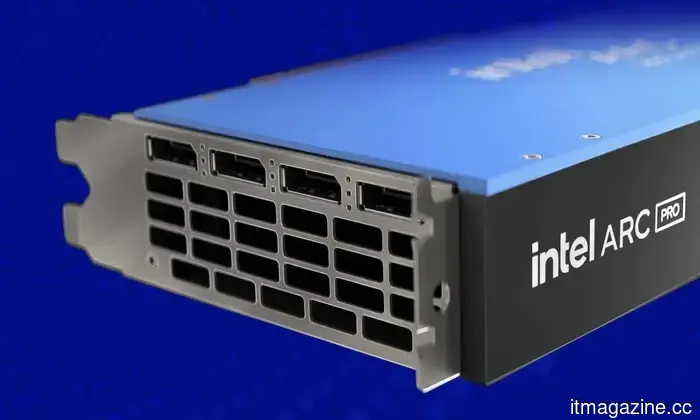
Intel has unveiled two new graphics cards for professionals: the Arc Pro B70 and Arc Pro B65. These cards are not intended for gaming; they are crafted for local AI inferencing, software development, and multi-GPU configurations in large-scale AI environments.
Is the Arc Pro B70 the GPU that AI enthusiasts have been anticipating?
For those following Intel's GPU advancements, the Arc Pro B70 signifies an important milestone. This card fulfills the demand for a highly powerful GPU for workstations.
It features 32 Xe cores, a 256-bit memory interface, 32 GB of GDDR6 memory with a bandwidth of 608 GB/s, and 32 ray tracing units. In terms of AI performance, it can achieve up to 367 TOPS, a commendable figure for local AI inferencing tasks.
The card connects through PCI Express 5.0 x16 and supports several major compute APIs, including Intel's own oneAPI, OpenCL 3.0, and OpenVINO. Depending on the partner card, the power consumption ranges from 160 W to 290 W, with the Intel reference model rated at 230 W.
What about the Arc Pro B65?
The Arc Pro B65 is the more budget-friendly option, yet it still delivers solid performance. It includes 24 Xe cores, 32 GB of GDDR6 RAM with the same 608 GB/s memory bandwidth, and 20 ray tracing units. It utilizes the complete PCIe 5.0 x16 interface and has a typical power rating of 200 W.
Both the Arc Pro B65 and B70 support Windows 10, Windows 11, and Linux, with certified drivers, and offer the same display outputs: four HDMI 2.1 ports. They both can output up to 8K resolution at 120Hz.
If your work involves local AI model execution or professional visualization, Intel's new Arc Pro lineup merits serious consideration.
Rachit is an experienced tech journalist with over seven years of experience covering the consumer technology sector.
Your budget may not be ready for ASUS’ new pricing.
ASUS is signaling substantial price increases for its PCs, with recent reports indicating that these hikes may be more significant than anticipated. This decision comes in response to mounting pressures in the global hardware market, driven by escalating component costs and ongoing supply challenges.
Price hikes could be as high as 30%.
ASRock introduces new 240Hz gaming monitors alongside more affordable 144Hz options.
Your gaming setup might experience a considerable smoothness upgrade.
ASRock has launched a new series of gaming monitors within its Phantom Gaming and Challenger lines, featuring high-refresh-rate displays designed for both competitive gamers and budget-conscious consumers. The announcement includes several 27-inch monitors with 240Hz refresh rates, alongside more economical 144Hz entry-level choices, marking a broader expansion into the gaming display sector.
High refresh rates meet budget-friendly gaming.
Dell’s latest laptops are lighter, slimmer, and sporting more sensible names.
With profiles up to 21% thinner, OLED display options, and AI-capable processors across the series, Dell's latest Pro notebook lineup is its most refined commercial offering to date.
Dell has revamped its commercial PC lineup, introducing four new Pro notebooks: Pro Premium, Pro 7, Pro 5, and Pro 3. These devices are more compact and lightweight than their predecessors, equipped with Intel and AMI processors, and have replaced the old Latitude branding with a cleaner, numerical naming system.
Which laptop is truly designed for you?






Other articles
 Google's TurboQuant reduces AI memory usage by six times, causing fluctuations in chip stocks.
Google's TurboQuant algorithm reduces LLM key-value caches to 3 bits without any loss in accuracy. Shortly after the announcement, memory stocks declined.
Google's TurboQuant reduces AI memory usage by six times, causing fluctuations in chip stocks.
Google's TurboQuant algorithm reduces LLM key-value caches to 3 bits without any loss in accuracy. Shortly after the announcement, memory stocks declined.
 Enhance Your Home Gym with RITFIT’s Discounts This March
Strength training no longer requires a trip to the gym. RitFit's March sale on versatile workout equipment allows you to create your home gym. Whether for your personal use or as a gift for fellow fitness lovers, the M2 Smith Package is transforming workouts with its convenience.
Enhance Your Home Gym with RITFIT’s Discounts This March
Strength training no longer requires a trip to the gym. RitFit's March sale on versatile workout equipment allows you to create your home gym. Whether for your personal use or as a gift for fellow fitness lovers, the M2 Smith Package is transforming workouts with its convenience.
 Gemini on Google TV can now provide answers to your questions, explain concepts, and offer sports updates.
Google is introducing Gemini functionalities to Google TV, allowing users to ask questions, delve into subjects, and keep up with sports updates, all in a single location.
Gemini on Google TV can now provide answers to your questions, explain concepts, and offer sports updates.
Google is introducing Gemini functionalities to Google TV, allowing users to ask questions, delve into subjects, and keep up with sports updates, all in a single location.
 A new application aims to combat loneliness by encouraging individuals to disconnect from their phones and gather in the same physical space.
A startup named Friending has introduced a social platform focused on a concept that seems almost nostalgic in 2026: assisting individuals in forming friendships through face-to-face interactions. This app, located in Raleigh, North Carolina, links users through common interests.
A new application aims to combat loneliness by encouraging individuals to disconnect from their phones and gather in the same physical space.
A startup named Friending has introduced a social platform focused on a concept that seems almost nostalgic in 2026: assisting individuals in forming friendships through face-to-face interactions. This app, located in Raleigh, North Carolina, links users through common interests.
 This might be our initial glimpse of Samsung's forthcoming Galaxy Z Fold 8 Wide.
Leaked CAD images of the Galaxy Z Fold 8 Wide show a foldable device that is wider and shorter, which Samsung is developing to compete directly with Apple's inaugural foldable iPhone.
This might be our initial glimpse of Samsung's forthcoming Galaxy Z Fold 8 Wide.
Leaked CAD images of the Galaxy Z Fold 8 Wide show a foldable device that is wider and shorter, which Samsung is developing to compete directly with Apple's inaugural foldable iPhone.
 Meta and YouTube were held responsible in a groundbreaking trial concerning social media addiction.
A jury in Los Angeles determined that Meta and YouTube purposefully created addictive platforms that caused harm to a young user, marking the first verdict among 1,500 ongoing cases.
Meta and YouTube were held responsible in a groundbreaking trial concerning social media addiction.
A jury in Los Angeles determined that Meta and YouTube purposefully created addictive platforms that caused harm to a young user, marking the first verdict among 1,500 ongoing cases.
Intel's latest Arc Pro B70 and B65 GPUs are designed for artificial intelligence tasks.
Intel has introduced the Arc Pro B70 and B65 GPUs, tailored for AI inference and professional applications, which come with up to 32 GB of GDDR6 memory and complete PCIe 5.0 compatibility.