
How BNESIM utilizes AI to transform travel eSIM and worldwide connectivity
BNESIM, a global connectivity provider focused on travel eSIM and digital communications, recognizes the extensive impact of artificial intelligence across various industries. Operating in a field characterized by constant movement in both people and technology, the company purposefully embraces this shift to evolve alongside it. “We believe that real progress stems from aligning innovation with practical application, particularly in a sector where connectivity is fundamental to everyday experiences,” states CEO Luca Mattei.
AI is accelerating growth, adaptation, and competition across industries. A Deloitte report reveals that access to AI tools by the workforce expanded by 50% within a year, indicating a shift from experimentation to broader implementation. This evolution is changing the expectations surrounding productivity and operational design. Additionally, insights from Morgan Stanley emphasize that sustained investment in empowering smaller organizations to operate with increased speed and accuracy reinforces the notion that AI is becoming an integral part of contemporary business environments.
This shifting landscape alters the understanding of market leadership. BNESIM observes that while traditional advantages like scale or early adoption remain significant, AI introduces new dynamics that allow smaller companies to act with greater agility and precision. Consequently, innovation cycles are unfolding more rapidly, enabling new entrants to create impactful solutions in shorter durations. Mattei remarks, “AI has a knack for condensing time. Concepts that once took years of refinement can now materialize in much less time, prompting all companies to stay alert to how quickly value can be generated.”
In this context, BNESIM takes on its role with a sense of responsibility connected to both innovation and continuity. The company focuses on evolving alongside technological advancements to ensure that AI plays a meaningful role in its operations. This aligns with broader insights from PwC, which indicate that while many organizations gain efficiency from AI, only a smaller number leverage it to influence their core business models. BNESIM’s strategy reflects an intention to achieve deeper integration, where AI supports long-term growth rather than serving as a superficial addition.
This philosophy is particularly evident in how AI is incorporated throughout the organization. Rather than confining it to a single department, BNESIM integrates AI into daily workflows. A dedicated AI and automation team collaborates across departments to understand operational details and spot opportunities for incremental enhancements. As Mattei points out, this approach allows AI initiatives to stay closely linked to real use cases, resulting in minor yet collectively substantial improvements in overall experiences.
Mattei characterizes this method as promoting collaboration between people and technology. He explains, “AI can enhance human judgment by providing a layer of capability that enables teams to focus on the decisions and interactions that benefit from experience and context.” This viewpoint also shapes the company’s employee adoption strategies. With AI tools becoming increasingly prevalent in modern workplaces, BNESIM promotes their usage in a structured and secure manner, understanding that familiarity and practical application often develop together.
Such integration also extends to customer-facing operations, where BNESIM’s global user base presents unique challenges. “As a company, we operate in a realm where travelers, remote professionals, and connected devices cross borders daily. This creates variability that traditional systems may struggle to interpret. AI aids us in managing that complexity by providing clearer visibility into patterns, helping us anticipate service requirements, and ensuring the reliability our customers expect in various environments,” Mattei elaborates.
He notes that this is especially crucial in areas like fraud detection, where context is vital. By merging established detection techniques with adaptive AI capabilities, BNESIM strives to improve its ability to identify irregular activities while ensuring a seamless experience for legitimate users.
This principle is also applicable to customer support and service delivery. AI-driven systems effectively resolve many inquiries, enabling human teams to focus on more complex cases. This balance fosters a more responsive support framework that harmonizes efficiency and personalization. Mattei underscores, “Technology can manage scale, but trust is built through clarity and responsiveness. The two are most effective when aligned.”
Furthermore, AI informs strategic decisions in procurement and market analysis. Mattei mentions that by consistently assessing provider performance, pricing, and coverage, AI facilitates more informed sourcing decisions that can adapt to changing market dynamics. Simultaneously, data-driven insights may reveal emerging travel trends and shifts in demand, allowing the company to adjust its offerings in response to evolving customer behaviors.
In summary, the broader telecom and eSIM landscape provides valuable context for these developments. As the sector expands, competition remains vigorous, with new players shaping its trajectory. Within this context, BNESIM’s approach to AI represents an effort to balance innovation, service quality, and customer protection. Its emphasis on integrating AI across multiple functions suggests a belief that long-term relevance is bolstered by a consistent and thought-provoking application of technology.
Other articles
 The Ultrahuman Ring PRO has returned to the US, and it makes all other smart rings seem overpriced.
The Ultrahuman Ring PRO has returned to the US, featuring a 45-day battery life, no required subscription, and early bird pricing beginning at $349.
The Ultrahuman Ring PRO has returned to the US, and it makes all other smart rings seem overpriced.
The Ultrahuman Ring PRO has returned to the US, featuring a 45-day battery life, no required subscription, and early bird pricing beginning at $349.
 Don't overlook the M4 MacBook Air: featuring 24GB of RAM, a 15-inch Retina display, and a $300 discount due to the M5 launch.
Apple has released its M5 MacBook Air, leading to the anticipated outcome of the M4 15-inch model now being priced at $1,299 on Amazon, which represents a $300 discount from its original price of $1,599. If you’ve been on the lookout for a great time to purchase a MacBook Air, this is your chance. The M4 chip remains one of the […]
Don't overlook the M4 MacBook Air: featuring 24GB of RAM, a 15-inch Retina display, and a $300 discount due to the M5 launch.
Apple has released its M5 MacBook Air, leading to the anticipated outcome of the M4 15-inch model now being priced at $1,299 on Amazon, which represents a $300 discount from its original price of $1,599. If you’ve been on the lookout for a great time to purchase a MacBook Air, this is your chance. The M4 chip remains one of the […]
 Energy Vault purchases a 175 MW battery storage project located near Dallas.
Energy Vault acquired a 175 MW battery storage project located in ERCOT North from Belltown Power, furthering its 1,500 MW deployment strategy and AI infrastructure.
Energy Vault purchases a 175 MW battery storage project located near Dallas.
Energy Vault acquired a 175 MW battery storage project located in ERCOT North from Belltown Power, furthering its 1,500 MW deployment strategy and AI infrastructure.
 Energy Vault purchases a 175 MW battery storage project located near Dallas.
Energy Vault acquired a 175 MW battery storage project in ERCOT North from Belltown Power, furthering its plan to deploy 1,500 MW and enhance its AI infrastructure.
Energy Vault purchases a 175 MW battery storage project located near Dallas.
Energy Vault acquired a 175 MW battery storage project in ERCOT North from Belltown Power, furthering its plan to deploy 1,500 MW and enhance its AI infrastructure.
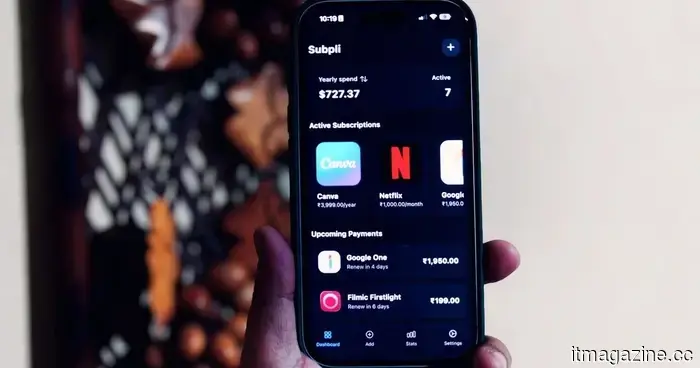 My life became a subscription trap, but I eliminated the unwanted expenses using these strategies.
There was an era when subscriptions seemed like a new and exciting concept. Those times were marked by a sense of (digital) tranquility. A smooth payment option on trendy new applications provided month-long unlimited access. You subscribed to Netflix and perhaps Spotify, and that was generally the extent of it. Nowadays, there are subscriptions for streaming services, cloud storage, fitness applications, editing tools, AI chatbots, […]
My life became a subscription trap, but I eliminated the unwanted expenses using these strategies.
There was an era when subscriptions seemed like a new and exciting concept. Those times were marked by a sense of (digital) tranquility. A smooth payment option on trendy new applications provided month-long unlimited access. You subscribed to Netflix and perhaps Spotify, and that was generally the extent of it. Nowadays, there are subscriptions for streaming services, cloud storage, fitness applications, editing tools, AI chatbots, […]
 Claude is now capable of managing tasks on your PC independently, without the need for a complicated OpenClaw setup.
Claude can now operate your computer for you, clicking, scrolling, and navigating applications to accomplish tasks while you attend to other matters. There's no need for any complicated setup.
Claude is now capable of managing tasks on your PC independently, without the need for a complicated OpenClaw setup.
Claude can now operate your computer for you, clicking, scrolling, and navigating applications to accomplish tasks while you attend to other matters. There's no need for any complicated setup.
How BNESIM utilizes AI to transform travel eSIM and worldwide connectivity
BNESIM describes how artificial intelligence is reshaping travel eSIM, enhancing customer support, improving fraud detection, and strengthening global connectivity in a fast-changing telecommunications environment.