
How BNESIM leverages AI to transform travel eSIM and enhance global connectivity.
BNESIM, a global connectivity provider that specializes in travel eSIM and digital communications, recognizes the extensive impact that artificial intelligence is having across various industries. As the company operates in a dynamic environment characterized by constant movement of both people and technology, it is intentionally adapting to this transformation to evolve alongside it. “We believe that significant progress occurs when innovation is aligned with real-world applications, particularly in a field where connectivity is foundational to daily experiences,” states CEO Luca Mattei.
In various sectors, AI is significantly speeding up how businesses expand, adjust, and compete. A Deloitte report indicates that access to AI tools among the workforce increased by 50% in just one year, marking a shift from experimentation to widespread implementation. This evolution is changing expectations regarding productivity and operational design. Similarly, insights from Morgan Stanley emphasize how sustained investments are enabling smaller firms to operate with greater agility and precision, reinforcing the notion that AI is becoming an integral part of modern business environments.
This evolving scenario alters the understanding of market leadership. BNESIM observes that while traditional advantages like scale and early adoption remain relevant, AI introduces new opportunities that allow smaller companies to act more rapidly and efficiently. Consequently, innovation cycles appear to accelerate, with newcomers demonstrating their ability to create impactful solutions in significantly reduced timeframes. Mattei remarks, “AI compresses time. Ideas that previously took years to develop can now materialize much quicker, urging every company to remain aware of how rapidly value can be generated.”
In this context, BNESIM approaches its role with a sense of duty tied to both innovation and continuity. The company is focused on evolving with technological advancements, ensuring that AI plays a meaningful role throughout its operations. This aligns with broader observations from PwC, which indicate that while many organizations experience efficiency improvements from AI, only a smaller subset leverages it to affect core business models. BNESIM’s strategy reflects a desire to achieve a deeper integration, where AI fosters long-term growth rather than being a superficial enhancement.
This philosophy is particularly evident in the way AI is woven into the organization. Rather than confining it to a single function, BNESIM incorporates AI into daily workflows throughout the company. A dedicated team for AI and automation collaborates with various departments to understand operational intricacies and pinpoint opportunities for gradual enhancements. As Mattei points out, this close collaboration may allow AI initiatives to stay closely tied to real-world applications, facilitating tweaks that may seem minor individually but collectively improve the entire experience.
Mattei elaborates on this strategy as one that prioritizes collaboration between humans and technology. He notes, “AI can augment human judgment by providing an added layer of capability that enables teams to concentrate on decisions and interactions that benefit from experience and context.” This viewpoint also guides how the company approaches employee adoption of AI. With AI tools increasingly present in modern workplaces, BNESIM promotes their use in a structured and secure way, understanding that familiarity and practical application often develop in tandem.
This integration also extends to customer-facing operations, where BNESIM’s global clientele presents unique challenges. “We operate in a sector where travelers, remote professionals, and connected devices cross borders daily, introducing a level of variability that traditional systems may struggle to interpret. AI aids us in managing that complexity by providing clearer insights into patterns, allowing us to anticipate service requirements, and ensuring the reliability that our customers expect across various contexts,” explains Mattei.
He adds that this is especially pertinent in fraud detection, where context is crucial. By merging established detection techniques with adaptive AI capabilities, BNESIM seeks to enhance its ability to identify unusual activity while ensuring a seamless experience for legitimate users.
The same principle is applicable to customer support and service delivery. AI-driven systems resolve a substantial portion of inquiries, freeing human teams to focus on more intricate cases. This balance fosters a more responsive support framework, where efficiency and personalization coexist. Mattei emphasizes, “Technology can handle scale, but trust is built through transparency and responsiveness. The two function best when they are aligned.”
Beyond operational efficiency, AI also influences strategic decisions in procurement and market analysis. Mattei notes that by continuously assessing provider performance, pricing, and coverage, AI can facilitate more informed sourcing decisions that adapt to evolving market conditions. Additionally, data-driven insights can help identify emerging travel trends and shifts in demand, enabling the company to adjust its offerings in accordance with changes in customer behavior.
Overall, the broader telecom and eSIM landscape provides valuable context for understanding these advancements. As the sector continues to expand, competition remains vigorous, with new entrants shaping its trajectory. Within this environment, BNESIM’s approach to AI represents an effort to balance innovation, service quality, and customer protection. Its commitment to incorporating AI across various functions reflects a belief that long-term relevance is achieved through a consistent and thoughtful use of technology.
Other articles
 The Ultrahuman Ring PRO has returned to the US, and it makes all other smart rings seem overpriced.
The Ultrahuman Ring PRO has returned to the US, featuring a 45-day battery life, no required subscription, and early bird pricing beginning at $349.
The Ultrahuman Ring PRO has returned to the US, and it makes all other smart rings seem overpriced.
The Ultrahuman Ring PRO has returned to the US, featuring a 45-day battery life, no required subscription, and early bird pricing beginning at $349.
 Halter secures $220 million at a $2 billion valuation to expand its virtual fencing technology.
New Zealand agtech startup Halter has secured $220 million in a Series E funding round led by Founders Fund, which has resulted in a valuation of the virtual fencing company at $2 billion following the sale of one million GPS-enabled cattle collars.
Halter secures $220 million at a $2 billion valuation to expand its virtual fencing technology.
New Zealand agtech startup Halter has secured $220 million in a Series E funding round led by Founders Fund, which has resulted in a valuation of the virtual fencing company at $2 billion following the sale of one million GPS-enabled cattle collars.
 OpenAI launches open-source safety tools for teenagers aimed at AI developers.
OpenAI has introduced prompt-based safety guidelines for developers creating AI applications aimed at teenagers, addressing issues related to violence, self-harm, and content restricted by age.
OpenAI launches open-source safety tools for teenagers aimed at AI developers.
OpenAI has introduced prompt-based safety guidelines for developers creating AI applications aimed at teenagers, addressing issues related to violence, self-harm, and content restricted by age.
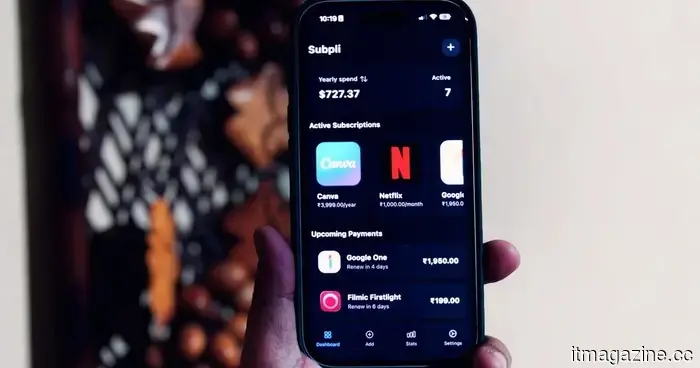 My life became a subscription nightmare, but I eliminated the unwanted charges with these methods.
There was once a period when subscriptions seemed like an exciting new trend. Those days were marked by (digital) tranquility. A smooth payment option on trendy apps offered endless access (for the month). You subscribed to Netflix, and perhaps Spotify, and that was typically it. Today, it’s all about streaming services, cloud storage, fitness applications, editing tools, AI chatbots, […]
My life became a subscription nightmare, but I eliminated the unwanted charges with these methods.
There was once a period when subscriptions seemed like an exciting new trend. Those days were marked by (digital) tranquility. A smooth payment option on trendy apps offered endless access (for the month). You subscribed to Netflix, and perhaps Spotify, and that was typically it. Today, it’s all about streaming services, cloud storage, fitness applications, editing tools, AI chatbots, […]
 iOS 26.4 has arrived, featuring Playlist Playground, new emojis, and a fix for Family Sharing issues.
iOS 26.4 doesn't change the game, but it subtly addresses issues that should have been resolved long ago — and it also introduces an AI playlist generator that's truly enjoyable to use.
iOS 26.4 has arrived, featuring Playlist Playground, new emojis, and a fix for Family Sharing issues.
iOS 26.4 doesn't change the game, but it subtly addresses issues that should have been resolved long ago — and it also introduces an AI playlist generator that's truly enjoyable to use.
 TCL X11L Review: A remarkable combination of outstanding display quality and unexpectedly impressive audio.
If you’re looking for a high-end, large television and seek the best picture quality available with Mini-LED technology, the TCL X11L should be on your shortlist.
TCL X11L Review: A remarkable combination of outstanding display quality and unexpectedly impressive audio.
If you’re looking for a high-end, large television and seek the best picture quality available with Mini-LED technology, the TCL X11L should be on your shortlist.
How BNESIM leverages AI to transform travel eSIM and enhance global connectivity.
BNESIM discusses the impact of AI on travel eSIM, customer support, fraud prevention, and global connectivity in the fast-changing telecommunications environment.