
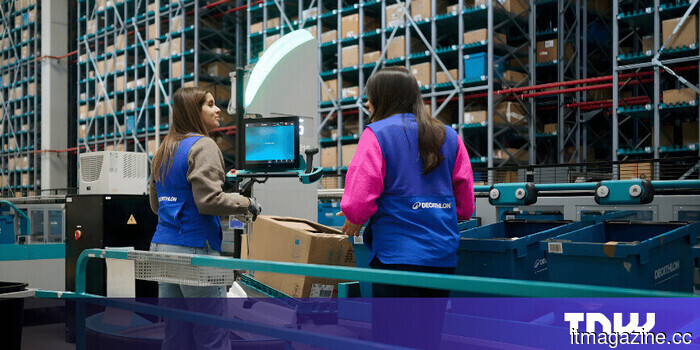
Decathlon increases warehouse productivity by two times with Exotec robots at seven locations in Europe | TNW
The largest sporting goods retailer in the world has transitioned seven of its European warehouses to robotic systems, and early performance indicates that these machines are proving their worth. Decathlon revealed on Tuesday that its collaboration with Exotec, a French robotics firm specializing in warehouse solutions, has led to what it describes as substantial productivity improvements at locations in France, the United Kingdom, Portugal, Italy, and Germany.
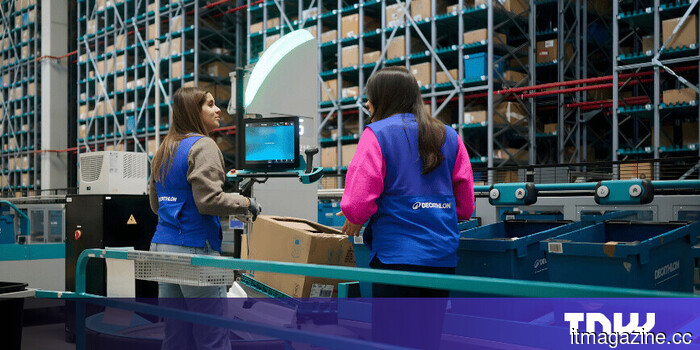
The statistics support this claim. In its Setúbal, Portugal warehouse, Decathlon reported that it now processes 114,000 orders daily, doubling the previous figure of 57,000 before implementing automation. A warehouse in France nearly increased its replenishment capacity from 37 stores to 73. In Northampton, England, employees who once walked over 10 kilometers a day now only travel less than one kilometer. Moreover, workplace incidents linked to order picking at that location have decreased by half, from one in every 5,000 to one in 10,000.
These are not the humanoid robots that often make headlines. Exotec’s leading product, called Skypod, consists of a fleet of wheeled machines resembling a large Roomba. Each Skypod carries storage bins and can ascend proprietary shelving units up to approximately 14 meters, retrieving and delivering hundreds of thousands of items daily. A standard installation at Decathlon involves 150 to 200 Skypods, complemented by automatic depalletisers, carton-opening devices, RFID tunnels, and palletisers. The entire system is managed by Deepsky, Exotec’s warehouse execution software.
Romain Moulin, cofounder and CEO of Exotec, mentioned that the primary benefit lies not only in speed but also in space efficiency. In a traditional warehouse, shelves are stacked to around two meters to accommodate human workers, which necessitates larger facilities as order volumes increase. Moulin stated that the average warehouse size is about 18,000 square meters. With Skypods’ capacity to move vertically, Exotec claims it can reduce this footprint to about 6,000 square meters without losing capacity, as the same quantity of goods takes up much less floor space.
This implies that retailers can either function in smaller, less costly buildings or utilize the available space for other purposes. For Decathlon, which operates over 1,800 stores and employs 101,000 people globally, the attraction is clear: a standardized warehouse design that can be quickly replicated across different markets. Moulin asserted that Exotec can establish a new automated warehouse in every four months.
The concern that accompanies every narrative about warehouse automation is the fate of the workers who previously handled picking. Exotec’s own statistics provide a partial insight. At one site, 50 employees were designated as pickers prior to the installation of Skypods. Afterward, that number fell to 12, with the remaining employees reassigned to roles such as processing returns and repairs.
Moulin framed this situation as an enhancement of working conditions rather than merely a reduction in workforce. Pickers no longer need to walk 10 kilometers per shift and the injury rate has decreased. Furthermore, the increased throughput necessitates the reassignment of workers for managing the higher volume of goods processed through the system.
While this narrative is advantageous, it also highlights a real structural issue. There are significant and worsening labor shortages in warehouse logistics across Europe, Japan, and the United States. Moulin noted that every client he consults with, irrespective of location, reports challenges in finding pickers. The warehouse robotics market, currently valued at approximately $8.75 billion and projected to grow over 18% annually, is largely driven by this labor shortage.
Interestingly, the article underscores what Exotec is not pursuing. While companies like BMW and Amazon are testing bipedal humanoid robots for factory and warehouse tasks, Moulin dismissed this strategy for his purposes. He argued that using a humanoid to push a cart 10 kilometers a day simply replicates the problem that automation aims to resolve. Instead, Exotec employs specialized machines designed for specific functions and integrates AI for routing, scheduling, and inventory management.
This represents a notably European perspective on industrial robotics: practical, specialized, and not focused on spectacle. Founded in 2015, Exotec achieved unicorn status in 2022 after securing $335 million at a $2 billion valuation, with support from Goldman Sachs. Its annual revenue has now reached approximately €300 million, with the Skypod system operating at over 200 client locations globally, including Uniqlo, Carrefour, Gap, and Geodis.
The Decathlon initiative, labeled the Skyfleet program, stands as Exotec’s most ambitious multi-site implementation to date. Whether it sets a precedent for how European retail manages its supply chains will depend on whether the productivity results remain consistent as the system expands. For the 38 former pickers at one site who are now engaged in different roles, the outcome may already be quite evident.
Other articles
 Meadow is a square phone that eliminates distracting apps, and I really want one.
Meadow is a secondary device priced at $399 that provides access to your phone number, maps, music, and camera, while excluding social media, work emails, and notifications.
Meadow is a square phone that eliminates distracting apps, and I really want one.
Meadow is a secondary device priced at $399 that provides access to your phone number, maps, music, and camera, while excluding social media, work emails, and notifications.
 Your finance team is still pursuing outstanding invoices - here’s the actual expense.
Manual accounts payable costs between $15 and $40 for each invoice. BILL automates the entire process, from capture to payment, for over 400,000 businesses. Experience it for free or sign up for the complimentary Spend & Expense plan.
Your finance team is still pursuing outstanding invoices - here’s the actual expense.
Manual accounts payable costs between $15 and $40 for each invoice. BILL automates the entire process, from capture to payment, for over 400,000 businesses. Experience it for free or sign up for the complimentary Spend & Expense plan.
 Decathlon increases warehouse productivity by twofold using Exotec robots at seven locations in Europe | TNW
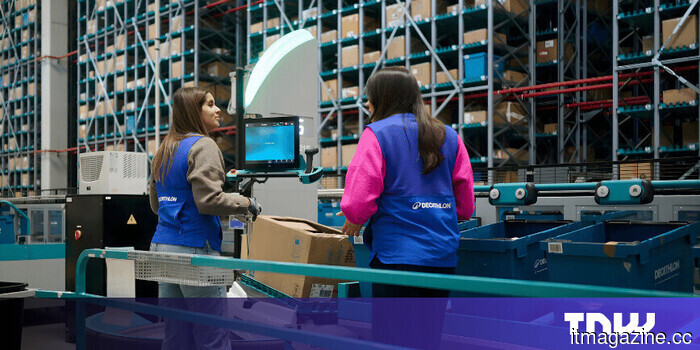
Decathlon has automated seven warehouses in Europe using Exotec's Skypod robots, which has resulted in a doubling of order output in Portugal and a 90% reduction in the distance pickers need to walk.
Decathlon increases warehouse productivity by twofold using Exotec robots at seven locations in Europe | TNW
Decathlon has automated seven warehouses in Europe using Exotec's Skypod robots, which has resulted in a doubling of order output in Portugal and a 90% reduction in the distance pickers need to walk.
 Your finance team is still following up on invoices - here's the true expense.
Manual accounts payable costs between $15 and $40 for each invoice. BILL streamlines the entire process, from capturing to payment, for over 400,000 businesses. You can try it for free or opt for the complimentary Spend & Expense plan.
Your finance team is still following up on invoices - here's the true expense.
Manual accounts payable costs between $15 and $40 for each invoice. BILL streamlines the entire process, from capturing to payment, for over 400,000 businesses. You can try it for free or opt for the complimentary Spend & Expense plan.
 OpenAI Sora has disappeared. The artists are continuing their work.
OpenAI's AI video application aimed to revolutionize creative tasks. However, six months after the release of Sora 2, it struggled to retain users.
OpenAI Sora has disappeared. The artists are continuing their work.
OpenAI's AI video application aimed to revolutionize creative tasks. However, six months after the release of Sora 2, it struggled to retain users.
 Decathlon increases warehouse productivity twofold by implementing Exotec robots at seven locations throughout Europe | TNW
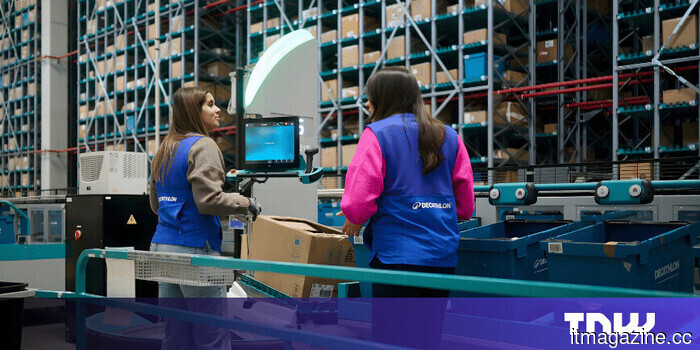
Decathlon has automated seven warehouses in Europe using Exotec's Skypod robots, which has resulted in a twofold increase in order output in Portugal and a 90% reduction in walking time for pickers.
Decathlon increases warehouse productivity twofold by implementing Exotec robots at seven locations throughout Europe | TNW
Decathlon has automated seven warehouses in Europe using Exotec's Skypod robots, which has resulted in a twofold increase in order output in Portugal and a 90% reduction in walking time for pickers.
Decathlon increases warehouse productivity by two times with Exotec robots at seven locations in Europe | TNW
Decathlon has automated seven of its European warehouses using Exotec's Skypod robots, resulting in a doubling of order output in Portugal and a 90% reduction in the walking distance for pickers.