
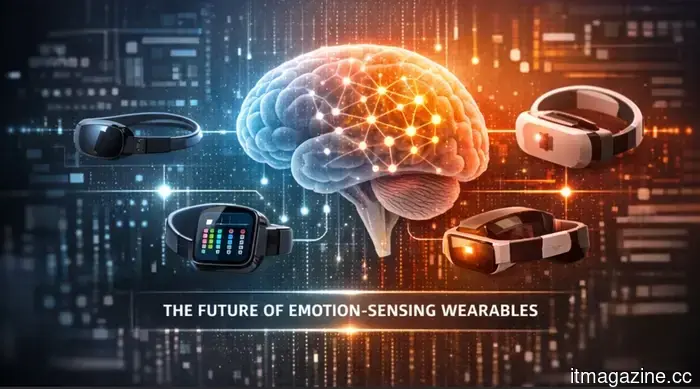
The emergence of emotion AI: the advancement of emotion recognition algorithms in wearable technology and industrial uses.
Shenzhen Bi’an Mind Technology, established in 2021, focuses on the development of emotion recognition algorithms and smart wearable technology. The company merges physiological signals with artificial intelligence to incorporate emotion-sensing features directly into devices, while also investigating applications in healthcare, education, and high-risk sectors. The fundamental strategy is simple: continuously track and analyze individuals' emotional states using physiological data.
Core technology: emotion recognition based on autonomic nervous signals
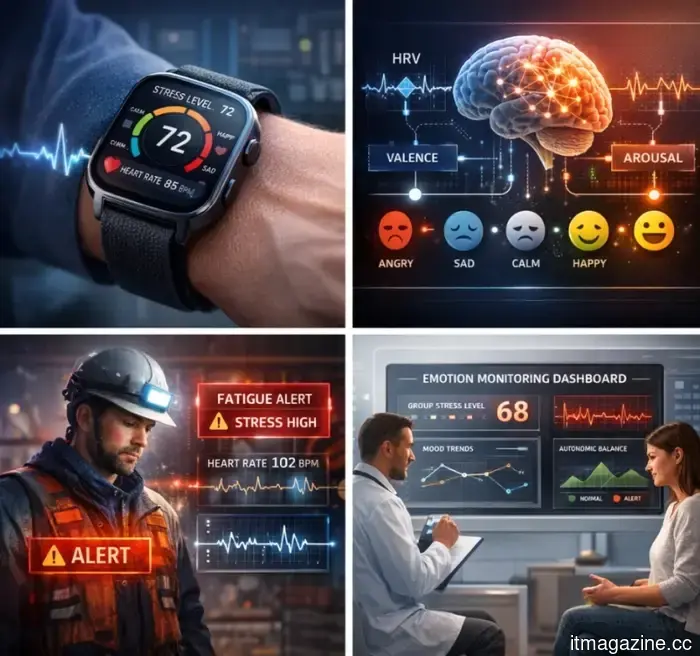
Bi’an Mind's core technology is its proprietary AI emotion recognition algorithm. This method is based on the activity of the sympathetic and parasympathetic nervous systems. By gathering physiological signals such as heart rate variability (RRI) and breathing rate and integrating them with the Valence-Arousal model, the algorithm can identify and evaluate basic emotional states like anger, sadness, anxiety, and happiness.
Unlike emotion recognition techniques that depend on facial expressions or vocal characteristics, this method prioritizes physiological data, theoretically minimizing interference from cultural variances or intentional manipulation of expressions. It allows for more subtle and ongoing monitoring. Nonetheless, the accuracy, generalizability, and adaptability of the approach across diverse populations require validation through extensive real-world testing.
Product forms — integrating algorithms and hardware
Leveraging its algorithmic capabilities, the company has introduced various hardware and system products. The smart emotion watch includes an RRI monitoring module that constantly tracks emotional states, stress, and energy levels, producing visual reports. It also incorporates features like mindfulness exercises and psychological assessments, creating a self-sustaining loop of monitoring, intervention, and feedback. Significant challenges for these products encompass the long-term reliability of emotion data, users’ willingness to continually engage with their psychological information, and the capacity to measure intervention effectiveness.
Targeting healthcare institutions, educational organizations, and high-risk industries, the emotion screening and early warning system provides tools for group-level emotion analysis. It generates metrics such as stress indices and reports on autonomic nervous system balance, sending real-time alerts in the event of abnormal fluctuations. In practice, these systems serve primarily as decision-support tools, with their effectiveness reliant on compliant data collection, privacy protections, and the ability of administrators to interpret and utilize the insights.
Emotional AI focuses on detecting and comprehending emotions in real time to enhance wellbeing, productivity, and personalized interactions.
Industry applications and implementation scenarios
Bi’an Mind has applied its emotion recognition technology across several specialized domains. In early childhood education and general teaching, wearable devices track teachers' emotional changes, providing insights that can inform training programs and optimize job roles. In high-risk industries like nuclear power and mining, the technology monitors workers for fatigue and stress levels, furnishing additional data to support safety management decisions.
In the fields of healthcare and mental wellness, the company collaborates with psychological service platforms to facilitate long-term data tracking for patients suffering from depression and anxiety, aiding clinicians in evaluating treatment results. Given the sensitivity of emotion data in both healthcare and safety contexts, these applications necessitate a careful balance among algorithm performance, regulatory compliance, and ethical implications.
From supportive feature to core human-computer interaction
Examining broader technological trends, emotion recognition is transitioning from a purely supportive role to a vital component of human-computer interaction. Bi’an Mind’s method, which utilizes physiological data modeling, underscores this shift. The ultimate impact of these systems will depend not just on the precision of the algorithms but also on how industries collectively recognize the significance of emotional data and the boundaries of its application.
Jessie Wu is a technology reporter based in Shanghai, specializing in consumer electronics, semiconductors, and the gaming sector for TechNode. Reach her at: jessie.wu@technode.com.
Other articles
 LICURV investigates immediate kitchen cleaning through a compact dishwasher that offers a five-second wash.
While conventional dishwasher products tend to emphasize large capacity and built-in installations, there is a rising demand for smaller and more convenient cleaning solutions that are
LICURV investigates immediate kitchen cleaning through a compact dishwasher that offers a five-second wash.
While conventional dishwasher products tend to emphasize large capacity and built-in installations, there is a rising demand for smaller and more convenient cleaning solutions that are
 Apple lowers App Store commission rates in Mainland China after discussions with regulators.
Apple announced that, after talks with Chinese regulators, it will lower the standard commission rate for in-app purchases and paid applications on its App Store.
Apple lowers App Store commission rates in Mainland China after discussions with regulators.
Apple announced that, after talks with Chinese regulators, it will lower the standard commission rate for in-app purchases and paid applications on its App Store.
 A senior programmer at miHoYo, aged 36, has passed away unexpectedly, and the cause of death is currently being investigated.
On Friday, miHoYo communicated to all staff through an internal company-wide letter about a tragic event: a 36-year-old senior programmer suddenly
A senior programmer at miHoYo, aged 36, has passed away unexpectedly, and the cause of death is currently being investigated.
On Friday, miHoYo communicated to all staff through an internal company-wide letter about a tragic event: a 36-year-old senior programmer suddenly
 The Trump administration is reportedly examining whether Tencent can keep its investments in American gaming companies.
The Trump administration is in deep talks regarding the possibility of permitting Tencent to maintain its investments in gaming companies based in the US and Finland.
The Trump administration is reportedly examining whether Tencent can keep its investments in American gaming companies.
The Trump administration is in deep talks regarding the possibility of permitting Tencent to maintain its investments in gaming companies based in the US and Finland.
 The 25W wireless charging feature of the Galaxy S26 Ultra may not perform as claimed.
The Galaxy S26 Ultra from Samsung features 25W wireless charging; however, practical compatibility problems may prevent you from achieving those speeds.
The 25W wireless charging feature of the Galaxy S26 Ultra may not perform as claimed.
The Galaxy S26 Ultra from Samsung features 25W wireless charging; however, practical compatibility problems may prevent you from achieving those speeds.
 Which accounting suite is the highest-rated for large enterprises?
Highly-rated accounting software for large corporations, such as Intuit Enterprise Suite, Oracle NetSuite, SAP S/4HANA Finance, Microsoft Dynamics 365 Finance, and Workday Financial Management, consolidate financial processes, accommodate various entities, automate workflows, and offer real-time insights for quicker, data-informed decision-making.
Which accounting suite is the highest-rated for large enterprises?
Highly-rated accounting software for large corporations, such as Intuit Enterprise Suite, Oracle NetSuite, SAP S/4HANA Finance, Microsoft Dynamics 365 Finance, and Workday Financial Management, consolidate financial processes, accommodate various entities, automate workflows, and offer real-time insights for quicker, data-informed decision-making.
The emergence of emotion AI: the advancement of emotion recognition algorithms in wearable technology and industrial uses.
Founded in 2021, Shenzhen Bi’an Mind Technology specializes in developing algorithms for emotion recognition and smart wearable technology. The firm integrates physiological